Edo Berger

4 articles · 30 co-authors · latest: 2026-06-03
67 citations · h-index 5 · 30 papersData: Semantic Scholar

We have retold 4 papers by this author. most often about: supernova remnant, supernova, cosmic dust. 30 co-authors across our retellings.

Links in the knowledge graph
Stellar2026-01-081 minarXiv:2601.05317express
Fireworks Called Off: Star Shrouded in Smoke
Some stars fizzle out like a dud firework: instead of a bright blast, just a cloud of smoke. Usually, a massive star ends with a supernova explosion, leaving a black hole. But sometimes there's no bang: the star collapses straight into a black hole, almost unnoticed.
High Energy2026-04-302 minarXiv:2604.27480express
Gamma-Ray Burst Polarimetry: How Magnetic Fields Reveal the Secrets of Cosmic Catastrophes
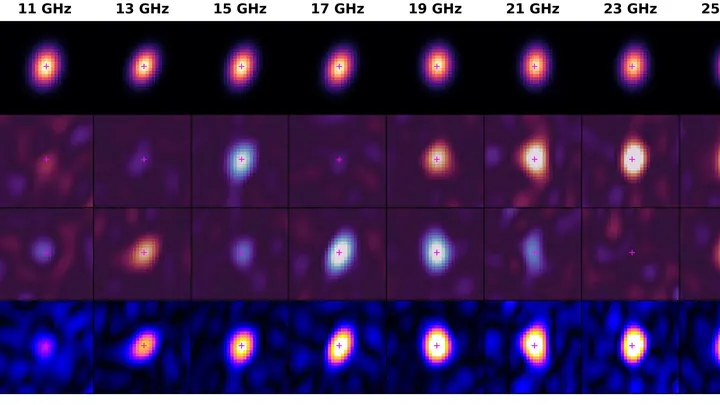
Radio waves from a gamma-ray burst — the cataclysmic death of a massive star whose flash briefly outshines an entire galaxy — reach Earth polarized. This means their electric field oscillates predominantly in a single plane, like a compass needle frozen in a magnetic field.
High Energy2026-05-152 minarXiv:2605.16487express
The Star That Exploded Twice
A light bulb that doesn't burn out but flares brighter and brighter until it blows the whole fixture apart. That's roughly how the most massive stars in the universe die. When a star's core heats up to billions of degrees, pairs of particles (electrons and their antimatter counterparts, positrons) begin to form.
High Energy2026-06-031 minarXiv:2606.05322express
Cosmic Cuisine: Black Holes and Their Secret Recipes
Detectors pick up the “ripples” of gravitational waves from mergers of black holes or neutron stars — like an echo from the kitchen where a cosmic dish was being prepared. Astronomers are trying to reconstruct the recipe: how two massive stars turned into an exotic pair and collided.