GW250114: Testing Hawking's Area Law and the Kerr Nature of Black Holes ✛
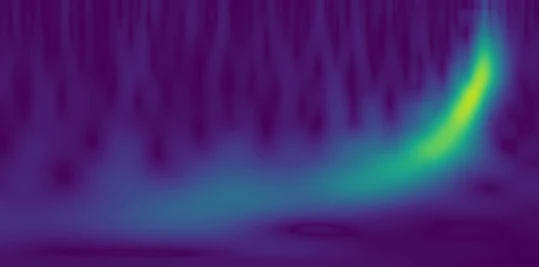
Context
Ten years ago, the first detected signal, GW150914, opened the era of gravitational-wave astronomy. Since then, catalogs have been enriched with hundreds of mergers, but none have achieved the clarity of GW250114. This signal stands alongside works testing fundamental predictions of general relativity in the strong-field regime: Hawking's area law and the no-hair hypothesis for black holes. Unlike previous analyses that relied on model assumptions about the entire signal shape, here, for the first time, the most dynamic part of the merger was excluded, and the law was tested independently on the 'tails' of the signal, before and after the peak.
Methods
The signal was divided into two independent parts: the inspiral (before the merger) and the ringdown (after). For the inspiral, the NRSur7dq4 model was used, truncating the data at 40 mass times before the peak to exclude nonlinear dynamics. For the ringdown, the ringdown and pyRing packages were used, fitting damped sinusoids (quasi-normal modes) to the data after the peak. The areas of the initial black holes were computed using the Kerr formula from the masses and spins obtained from the inspiral; the area of the remnant was computed from the frequency and damping rate of the fundamental mode. The statistical significance of a violation of the law was assessed via the difference in means and variances of the area distributions.
Results
Two modes are confidently identified in the post-merger signal: the fundamental (n=0) and the first overtone (n=1). The overtone frequency is 249 Hz, and the damping rate is 708 Hz; the deviation of the frequency from the Kerr spectrum is constrained to δf221 = 0.1 ± 0.3, that is, within 30%. For the area law, with the inspiral truncated at 40 mass times before the peak, the final area exceeds the initial one at the 4.4σ level. For other truncation times, the significance does not drop below 3.4σ, and when approaching the peak it reaches 5σ. The two-mode ringdown analysis gives agreement at the 3.6σ level.
Implications
This work differs from neighboring studies in that it tests the area law for the first time while completely excluding the loudest and most nonlinear part of the signal from the analysis. Previously, similar tests for GW150914 yielded only ~2σ and required assumptions about the circular polarization of the modes. Here, high statistical significance is achieved without modeling the nonlinear dynamics with numerical relativity, making the conclusion about the non-decrease of the horizon area more independent of theoretical assumptions.
Future development
The next generation of detectors (Einstein Telescope, Cosmic Explorer) will increase sensitivity by an order of magnitude, allowing the area law to be tested on dozens of events with even higher SNR. A transition to tests of the generalized second law, accounting for the entropy of radiation, may become possible. Also promising is the joint measurement of inspiral and ringdown parameters with a common sky position, as proposed in some works, to eliminate systematics from the remnant's recoil.
Impact
The results strengthen confidence in the Kerr description of astrophysical black holes and in the thermodynamic analogy underlying attempts to quantize gravity.
Next steps
Apply the same method to other loud events from the GWTC-4 catalog and to future LIGO–Virgo–KAGRA observations, and develop a joint analysis of the inspiral and ringdown with common external parameters.
Key open problems
The question of the microscopic nature of black hole entropy remains open, as does whether the area law is violated when quantum effects (Hawking radiation) are taken into account. This work does not test the generalized second law, but only the classical limit, yet it sets a benchmark of precision for future tests.
The knowledge machine's view
This section is addressed to the author of the paper and their colleagues. Neighbouring works were found by meaning-based search across our archive, not by word overlap. We do not review: we show the field around the work.
What the work does
The study analyzes the GW250114 signal, examining the inspiral and post-merger ringdown separately to independently test Hawking's area theorem and the Kerr nature of the remnant. From the inspiral, the masses and spins of the initial black holes are extracted; from the ringdown, the frequency and damping of the fundamental mode and its overtone are obtained. The horizon area after the merger is found to exceed the sum of the initial areas by 4.4σ.
Where its strength is
A key strength is the exclusion of the most nonlinear part of the signal: the area theorem is tested only on the 'tails', which reduces reliance on numerical simulations of the merger.
Where it could go next
- One could compare the obtained constraint on the quasinormal mode frequency deviation with predictions from non-standard compact objects, such as domain walls, which are considered as alternatives to black holes in our archive.based on: Gravitational Phantoms: Domain Walls Instead of Black Holes arXiv:2606.06478v1
- It would be interesting to see how the extracted ringdown modes relate to the nonlinear overtones detected in other events: possibly GW250114 contains traces of secondary modes worth searching for.based on: A black hole rings nonlinearly: new gravitational overtones heard arXiv:2601.05734v1
- The high significance of the area theorem in this event motivates testing it on a larger sample of mergers, similar to how hundreds of events were processed for statistical analysis in the archive.based on: Record Haul: 161 Black Hole Mergers in Gravitational Waves arXiv:2605.27225
Worth trying
- Investigate whether the significance of the area theorem changes when multiple overtones are included in the ringdown fit.
- Use the remnant spin constraint to test the no-hair hypothesis by comparing with predictions for exotic compact objects.
- Search for nonlinear modes in the signal, similar to those found in other events, and assess their contribution to the area.
Why this may matter
Confirming the area theorem at the 4.4σ level without relying on merger models strengthens confidence in fundamental predictions of general relativity in the strong-field regime and paves the way for more stringent tests with future data.
Nearby works in our archive
- The First Cry of a Merging Black Hole Confirms Hawking's Unbreakable Lawsimilarity 0.58
- How Gravitational Waves Test Black Holes for 'Purity'similarity 0.56
- The Collapsar's Gravitational Boomerang: Cracking the GW190814 Anomalysimilarity 0.56
- Gravitational Phantoms: Domain Walls Instead of Black Holessimilarity 0.55
- Cosmic Hot Tap: How Primordial Black Holes Rewrite the Speed of the Universesimilarity 0.54
- A black hole rings nonlinearly: new gravitational overtones heardsimilarity 0.54
- Record Haul: 161 Black Hole Mergers in Gravitational Wavessimilarity 0.54
The archive is sparse around this work: the closest review is only 0.58, against a usual 0.64. It looks like few have drilled nearby.
The GW250114 signal was so loud that even after discarding the two loudest cycles before the merger, its SNR (55) remained higher than that of any previously detected event.
Key numbers
- SNR: 80 (network)
- primary black hole mass: 33.6 solar masses
- secondary black hole mass: 32.2 solar masses
- remnant mass: 62.7 solar masses
- remnant spin: 0.68
- significance of the area law: 4.4σ