Are you one of the authors of this paper? Email us from your institutional or work email address mentioning this article's arXiv ID and we'll verify you and give you edit access to this page.
Are you an author who sees something we missed or got wrong? Write to us — the subject line already carries the paper id. We read every note and correct the write-up.
Astronomers have found two warm Saturn-sized planets that weigh differently and likely formed under different conditions.
📄 Showing the "Simple" version — "Popular" is not ready yet. Add it to favorites to help prioritize it.
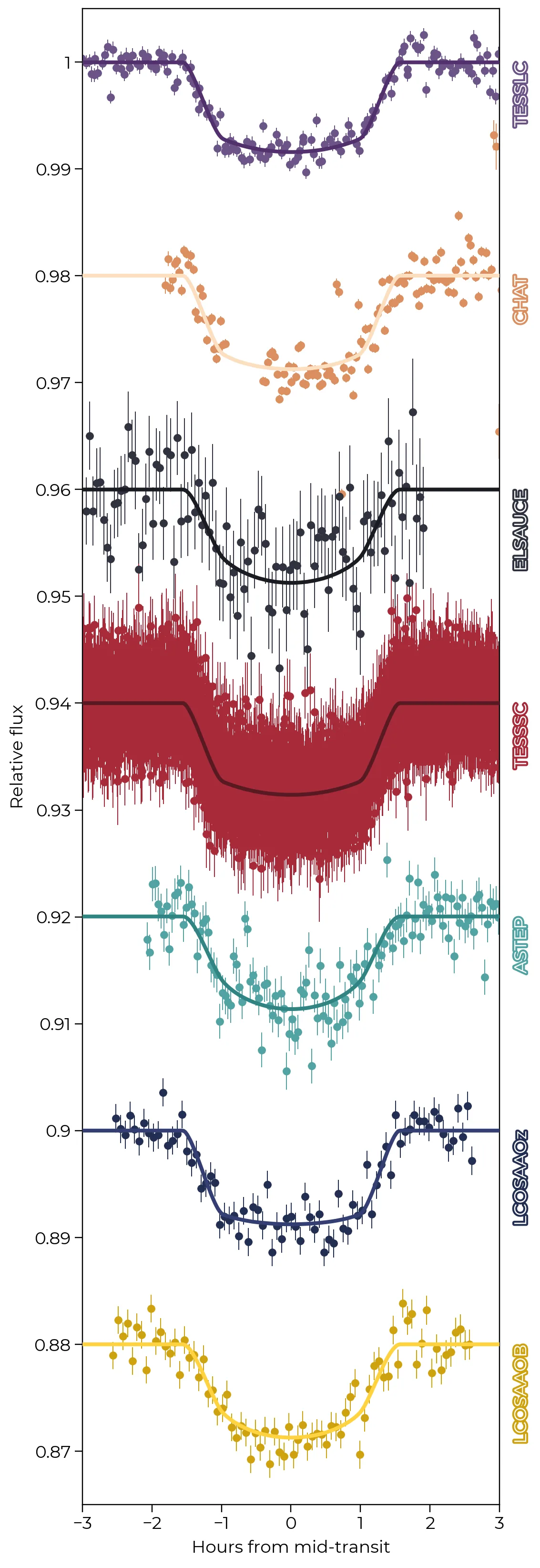
NASA's TESSspace telescope monitors thousands of stars, catching the moment when a planet crosses its star's disk — the star's light dims slightly. That's how astronomers spotted two planets orbiting stars similar to our Sun. One, TOI-883 b, completes an orbit in ten days; the other, TOI-899 b, takes nearly thirteen. Both are hot: their temperatures reach about 800 degrees Celsius, like a ceramic kiln.
Ground-based telescopes then took over, measuring how each planet's gravity makes its star wobble — a method akin to a heavy child on a swing making the whole frame vibrate. It turns out both planets are lighter than Saturn: one weighs as much as 39 Earths, the other 68. But here's the twist: despite nearly identical masses and similar host stars, the planets differ in size. The first is just over half of Jupiter's radius, while the second is nearly Jupiter-sized. That means their interiors have different compositions.
Why the difference? Perhaps one planet accumulated more heavy elements, rock and metal, while the other stayed fluffy and gas-rich. It's like two pies of equal weight: one dense, packed with nuts and dried fruit, the other a light sponge cake.
Such a difference under similar birth conditions is puzzling. Maybe the planets formed in different parts of the protoplanetary disk, or one suffered a collision that reshaped its interior. Now both planets serve as excellent laboratories: their atmospheres can be studied as they transit their stars, and the gas composition may reveal where and how they formed.