Black holes are not just cosmic vacuum cleaners; they are also powerful particle accelerators. When matter falls toward a black hole, it forms an accretion disk that is heated to millions of degrees, and the intense magnetic fields in the region can accelerate charged particles to energies far beyond what any particle collider on Earth can achieve. These particles, mostly protons and electrons, are then ejected in relativistic jets that stretch for thousands of light-years, acting as cosmic ray factories.
History
The idea that black holes could accelerate particles was proposed in the 1970s by Roger Blandford and Roman Znajek, who developed a model for extracting rotational energy from a black hole via magnetic fields. This remains a cornerstone of high-energy astrophysics.
How it works
The acceleration happens through a process called Fermi acceleration, where particles repeatedly cross shock fronts in the jet or the accretion disk, gaining energy with each crossing. Additionally, magnetic reconnection events near the black hole's event horizon can directly convert magnetic energy into particle kinetic energy. The resulting high-energy particles emit synchrotron radiation and inverse Compton scattering, producing X-rays and gamma rays that we observe from Earth.
In practice
Understanding black hole particle acceleration helps astrophysicists interpret observations of active galactic nuclei and gamma-ray bursts, and it also informs models of cosmic ray origins, which have implications for space radiation shielding for astronauts.
Fun fact
The most energetic cosmic rays ever detected, with energies over 10^20 electronvolts, are believed to originate from black hole jets, packing the punch of a baseball thrown at 100 km/h into a single subatomic particle.
A stroboscope in a dark room picks out fleeting shadows from the crowd, shadows the eye cannot catch. A primordial black hole the size of a virus, passing in front of a distant star, briefly magnifies its light for a few seconds, like a magnifying glass held over a bulb.
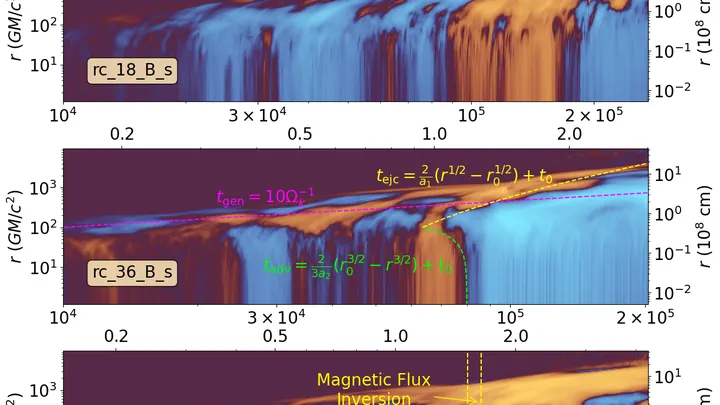
At the center of a distant galaxy, where a supermassive black hole weighing a hundred million suns spins, space is threaded with magnetic fields. They coil into tight vortices, like a drain in a sink, but instead of water, there's plasma whipped up to near-light speeds.
A massive star collapses, and a black hole is born, surrounded by a disk of incandescent plasma. For narrow jets to burst out of this disk, an ordered magnetic field is needed. But inside the star, it's tangled.
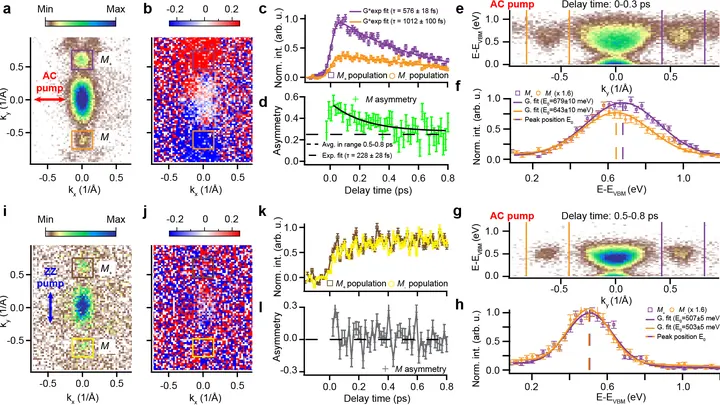
An ordinary sheet of black phosphorus looks like a layered cake of atoms. If you shine a regular lamp on it, nothing special happens: the electrons sit still, like spectators in a dark theater. But a short laser flash lasting millionths of a billionth of a second shakes up that theater.
The universe is expanding faster and faster, and scientists blame it on dark energy. Its origin is explained in a new way: dark energy isn't eternal, but appears only after dark matter clumps together into lumps — future galaxies.
The mechanism works like a pump that turns on when pressure drops.
In its youth, Earth resembled a beehive: it grew by sticking together from countless rocky chunks. When the main construction was over, a late swarm of meteorites rained down on the young planet — the so-called late veneer. These impacts, scientists thought, brought platinum, gold, and other rare metals to Earth's upper layers.
At night, invisible bullets streak across the sky — cosmic rays. These are atomic nuclei accelerated to near-light speeds. The Galaxy's magnetic fields tangle their paths, making it hard to pinpoint where they were born.
Cosmic rays are elementary particles carrying colossal energy that pierce the intergalactic void. When two such particles smash head-on, the energy density at the point of impact could be enough to collapse into a black hole the size of an atomic nucleus.