Cosmic Mirage of Radio Waves express
A galaxy is like a glowing pancake studded with stars. If you look at it face-on, you see everything at once — both the bright spiral arms and the dark dust lanes. But tilt the pancake, and the picture changes: layers overlap, light blends together. This very effect, it turns out, creates the illusion of a tight link between radio and gamma-ray emission in distant star systems.
Previously, astronomers thought that synchronized glow in different wavelengths was a sign that fast particles (cosmic rays) spend all their energy inside their home galaxy, like water absorbed into a sponge. But new work with virtual models of the Milky Way shows that the correlation arises on its own when the line of sight pierces the galactic disk. Even if particles freely escape into intergalactic space, the observer still sees a neat relationship — simply because they are looking at the layered structure from a convenient angle.
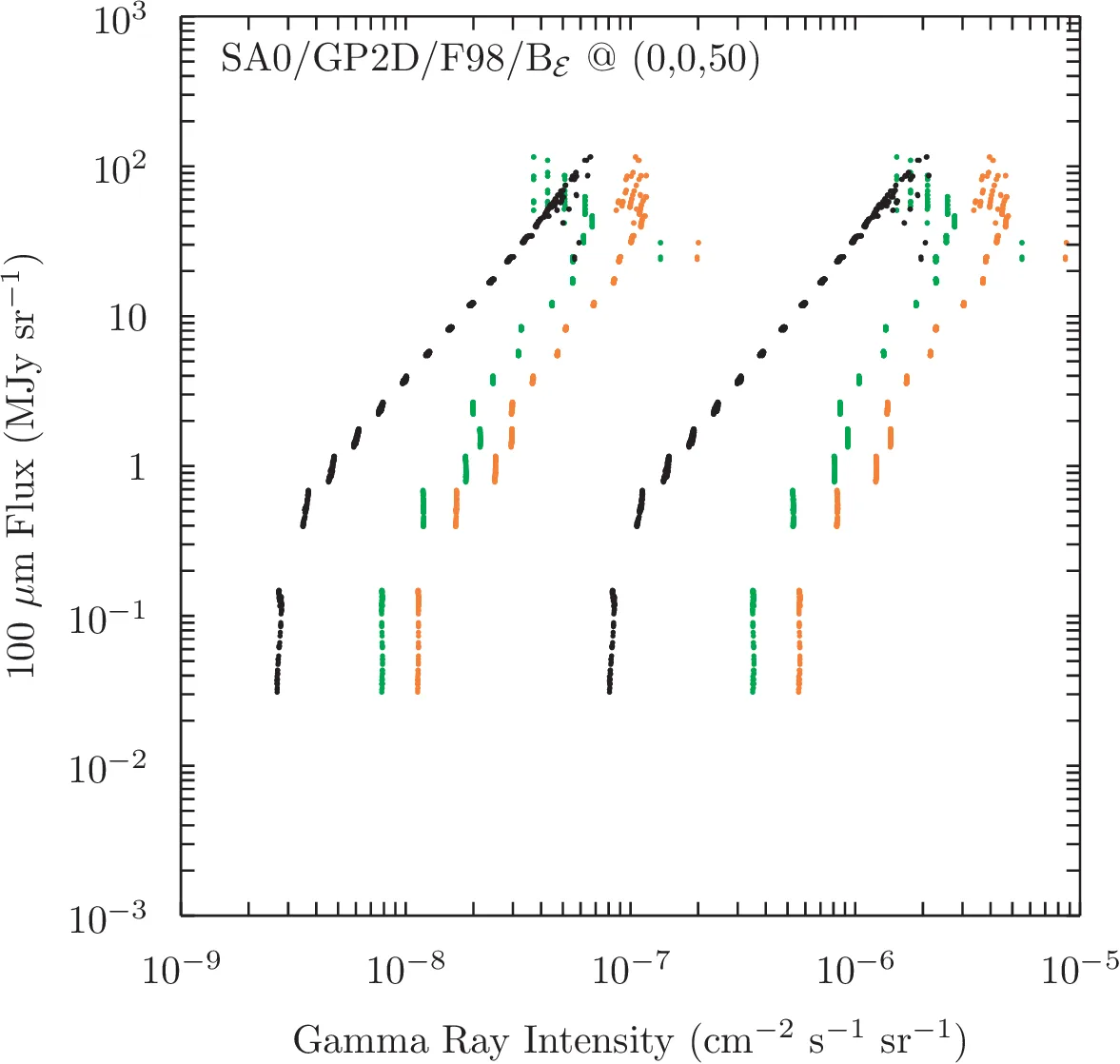
The authors built a three-dimensional model of our Galaxy with different distributions of gas, magnetic fields, and cosmic-ray sources. Then they "looked" at it from outside at various angles. It turned out that the familiar linear relationship between radio signal and gamma-ray flux is almost an inevitable consequence of geometry: the emission comes from a huge volume where bright and faint regions are averaged along the line of sight. Tilting the disk barely affects the picture, but turn the galaxy exactly edge-on, and the neat line falls apart.
This approach turns the scatter of points in radio–gamma-ray plots into a tool. Instead of looking for signs of a "calorimeter" for cosmic rays, one can reconstruct the galaxy's shape and how easily particles escape its bounds. This is especially valuable for distant systems where structural details cannot be seen directly. And so a distant pancake, turned toward us at an unknown angle, begins to reveal a bit more about itself.
Cosmic rays are not rays in the usual sense, but atomic nuclei accelerated to speeds close to the speed of light. One such particle carries the energy of a flying tennis ball.
In Arthur C. Clarke's novel "Rendezvous with Rama," geometry plays a key role: the cylindrical alien ship reveals its secrets only under certain lighting and viewing angles.