The Dark Sector on a Seesaw: A Scalar Spring Solves Cosmological Puzzles ✛
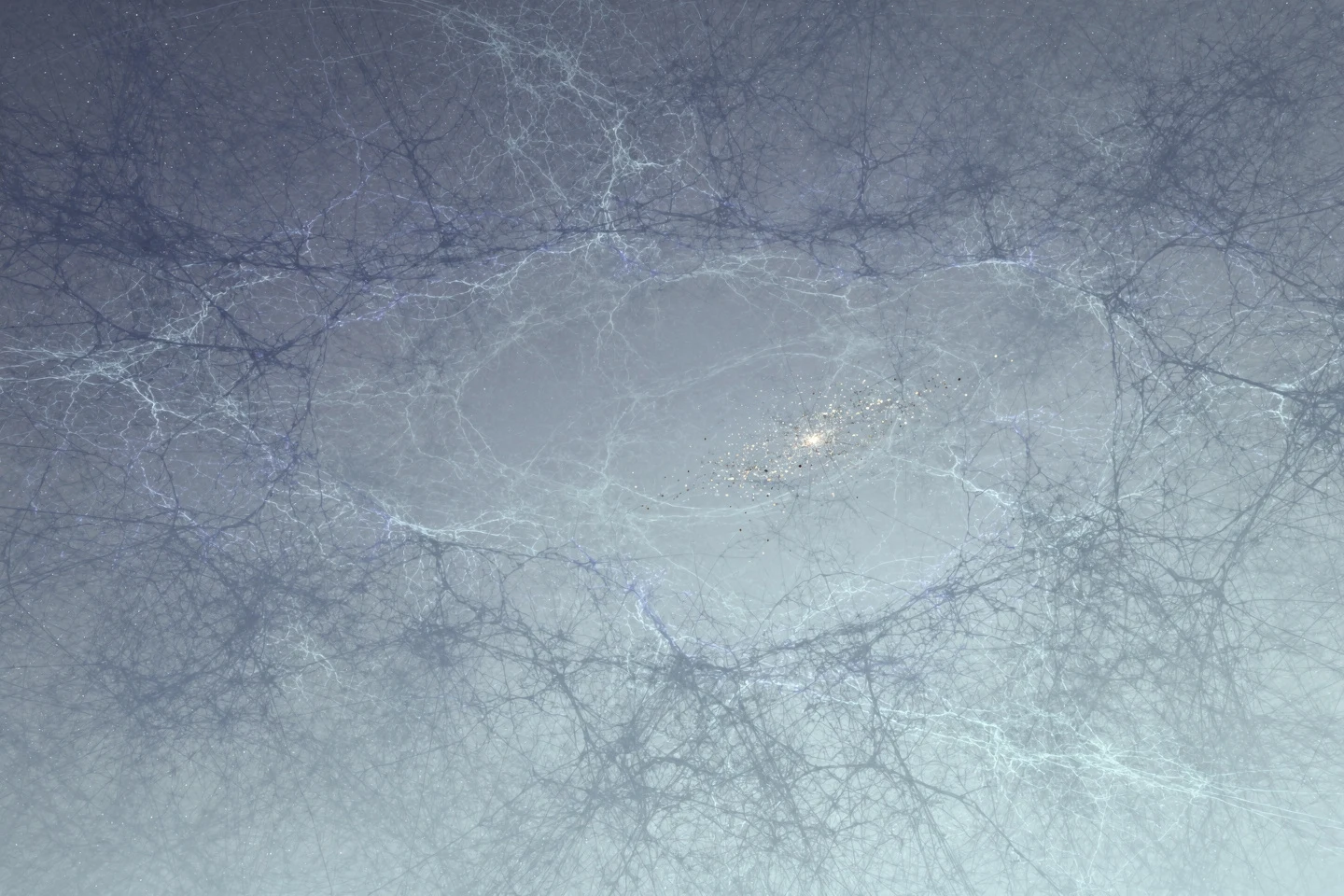
Two telescopes look at the same Universe and see different expansion rates. Local measurements from supernovae give 73.04 ± 1.04 km/s/Mpc, while cosmic microwave background data within the standard model predict 67.36 ± 0.54. The 5.7σ discrepancy is not a fluke—it's the Hubble tension, a crack in cosmology's foundation.
The dark sector on a seesaw—that's the metaphor for the new model. A scalar spring compresses and releases, changing the rules of the game for the entire Universe. Shortly after the Big Bang, the dark sector undergoes a phase transition, an abrupt change in the state of matter. Self-interacting dark radiation is born, and the fermionic multiplet of dark matter gets a mass splitting. As the Universe cools, the interaction between dark matter and radiation switches off. This mechanism is called Dark Radiation Matter Decoupling (DRMD).
Previously, it was unclear how to reconcile local measurements with cosmic microwave background data without violating constraints on dark radiation from nucleosynthesis. Now it's clear: the dynamical decoupling of the interaction, triggered by the phase transition, allows the Hubble tension to be completely resolved within a microscopic model. The authors built a model with gauge symmetry, spontaneous breaking, and a fermionic multiplet, then tested it against Planck, DESI, and Pantheon+ data. The result: agreement with the local H0 value at the 1.4σ level, and a χ² improvement of −33.3 compared to the standard model.
The model makes concrete predictions for future sky surveys such as DESI and Euclid, and for gravitational-wave experiments. The phase transition should generate gravitational waves that could be detected by pulsar timing arrays. This would distinguish DRMD from other solutions to the Hubble tension. The seesaw has stopped, and the Universe shows the same face to every observer.
The mass splitting between dark matter components in the DRMD model is only about 0.1% of the mass, but this tiny difference determines when dark matter stops interacting with radiation, which is critical for resolving the Hubble tension.
The idea of a dark sector with its own particles and interactions echoes the concept of 'dark life' from science fiction, for example in Liu Cixin's novel 'The Dark Forest', where dark matter plays a key role in cosmology.