Quantum Filter: How Entanglement Pierces Murky Media ✛
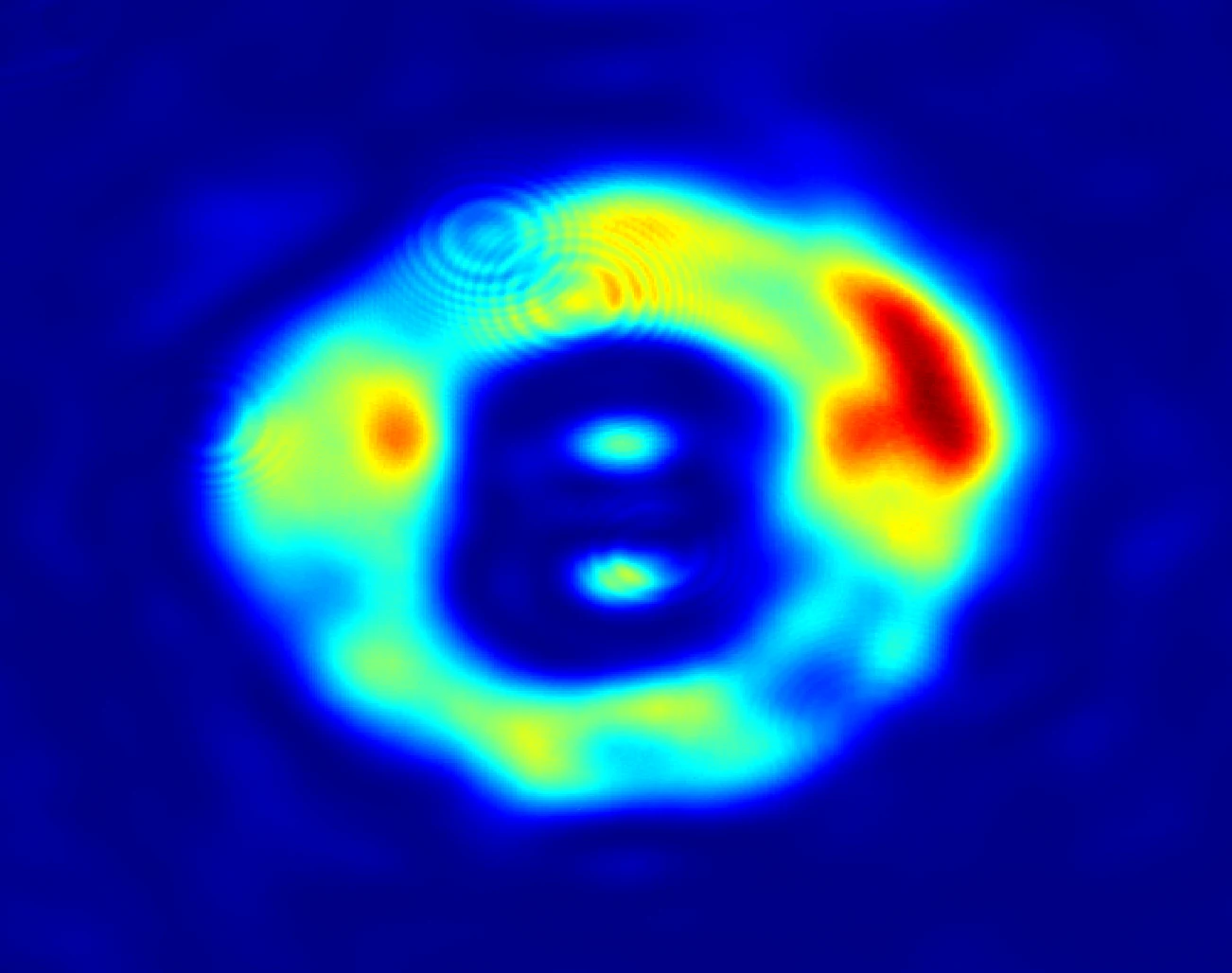
When light passes through biological tissue or frosted glass, it scatters and loses the image. Researchers at the Paris Institute of Nanosciences have shown that a scattering medium can be tuned to transmit images encoded in the correlations of entangled photons while remaining opaque to classical light. To do this, they used a spatial light modulator that adjusts a phase mask preserving quantum correlations. As a result, the medium becomes a quantum-classical filter: the quantum channel stays open, while the classical one is blocked. This paves the way for secure information transfer and new imaging techniques in complex media.
The experiment is based on spontaneous parametric down-conversion: an ultraviolet laser with a wavelength of 405 nm illuminates a nonlinear crystal of beta-barium borate, which generates pairs of entangled photons with a wavelength of 810 nm. The object is encoded in the spatial correlations of these pairs: the image is reconstructed from photon coincidences detected by a camera with nanosecond time resolution. The complex medium consists of a spatial light modulator and a layer of parafilm. To find the appropriate phase mask, the researchers numerically optimized the correlation image using the measured scattering matrix and an entangled state as a guide. In the classical regime, the same object was illuminated by a superluminescent diode, and the image was recorded with a conventional camera.
After optimization, the medium became transparent to the correlation image of entangled photons, but the classical image remained completely blurred. In numerical simulations with 50 different nonclassical solutions, the average transmission fidelity for the entangled state was 0.92, while for the classical state it was only 0.25. The key result: an image encoded in the correlations of a separable (non-entangled) two-photon state was also not transmitted. This proves that the filtering is sensitive specifically to entanglement, not merely to the presence of correlations. Experiments with different media, including a random phase mask, a 1 cm thick layer of polydimethylsiloxane, and a numerically simulated thick medium, confirmed the method's universality.
This work introduces a conceptual shift: a complex medium can not only be compensated for, but also used as an active programmable component of quantum technologies. Unlike related studies, which either investigate the propagation of entangled photons through scattering media or use quantum entanglement to enhance classical imaging, here the medium itself becomes a quantum-classical filter. This is the first experimental demonstration of selective image transmission based on the physical distinction between entangled and classical states, rather than on computational processing. The method could be extended to dynamic media, such as biological tissues, if the optimization and correlation acquisition are accelerated. Theoretically, it has been shown that for arbitrary entangled states and arbitrarily complex media, nonclassical solutions always exist, implementable via multi-plane wavefront shaping. This opens the way to quantum imaging in real-world conditions where the medium changes over time.
Acquiring a single correlation image required up to 30 seconds of accumulation, whereas a classical image was recorded in tens of milliseconds. Meanwhile, the entangled photons passed through a layer of parafilm, the ordinary film used to seal laboratory glassware.