Entropic time in cold atoms ✛
Context
The problem of time in canonical quantum gravity is this: the Wheeler–DeWitt equation contains no external parameter that would order changes, and all fundamental theories lack a built-in arrow of time. The only reliable asymmetry is the growth of coarse-grained entropy according to the second law of thermodynamics. This work stands alongside cold-atom studies that have already reproduced Hawking radiation, cosmic expansion, and false vacuum decay, but here, for the first time, relational time built from entropy is tested quantitatively.
Methods
The experiment uses a Bose–Einstein condensate of about 24,000 rubidium-87 atoms in a conservative optical trap with a thin barrier that splits the system into a dark (unobserved) and a bright (observed) sector. Over 120 ms, every 2 ms, they record the density profile, measuring the atom number, the center-of-mass position, and the entropy of the bright sector. Entropic time is defined as an integral of the entropy change along the trajectory of the scalar-field analog, which guarantees monotonicity as long as entropy and field change in the same direction.
Results
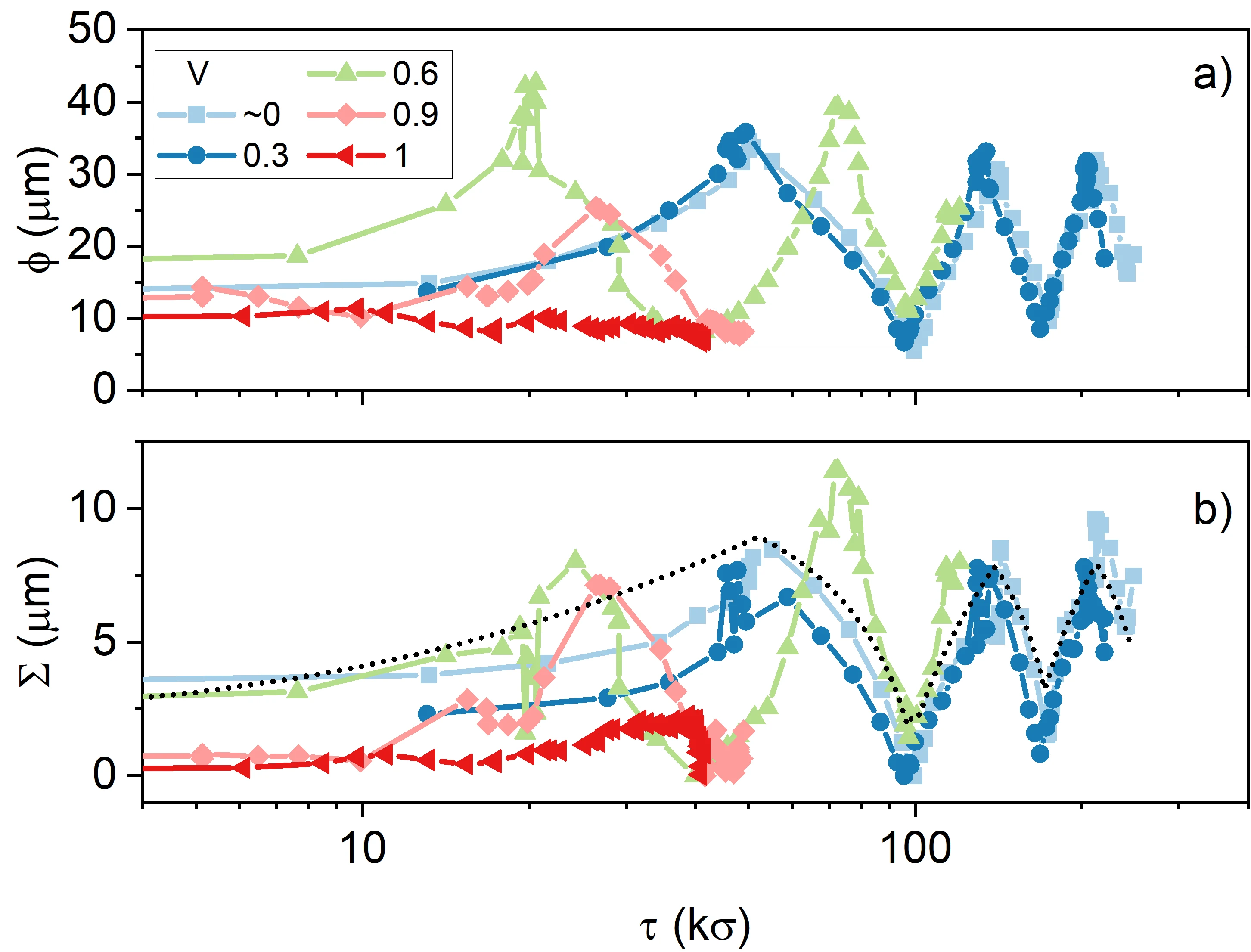
Entropic time grows almost monotonically for all barrier heights, and its rate is set by the entropy flow: time runs faster when entropy is exchanged and stops when it is not. The total entropy of the mini-universe remains constant within uncertainty. Data ordered by entropic time reproduce the expansion–contraction cycles of the bright sector, and at high barrier the system approaches a 'heat death' where time halts. The derived Schrödinger equation with entropic time numerically reproduces the measured evolution of the condensate width with excellent agreement.
Implications
Unlike neighboring analog-gravity works, where time remains an external laboratory parameter, here an internal time is built experimentally from entropy exchange between subsystems. This provides an operational analog of Wheeler–DeWitt timeless descriptions and a testable realization of the entropic arrow of time in a closed system. The result shows that relational constructions of time can be tested quantitatively, not just discussed theoretically.
Future development
The cold-atom platform allows varying the Hamiltonian and testing different scenarios: choice of internal clock, behavior near singularities, reversibility via Loschmidt echo, analog black holes, and Vilenkin-type tunneling. Entropic time can be generalized to more complex models with many degrees of freedom, up to midisuperspace.
Impact
The results provide an experimental testing ground for quantum cosmology and quantum gravity, as well as for thermodynamics of small systems and quantum information.
Next steps
Check the consistency of time arrows under more general dynamical conditions and compare entropic time with the thermal time hypothesis of Connes and Rovelli.
Key open problems
This work directly addresses the unresolved problem of time in quantum gravity and the origin of the arrow of time from the second law of thermodynamics, offering an experimental way to test relational constructions.
The knowledge machine's view
This section is addressed to the author of the paper and their colleagues. Neighbouring works were found by meaning-based search across our archive, not by word overlap. We do not review: we show the field around the work.
What the work does
The authors created a miniature universe analog from ultracold atoms, split into an observable and an unobservable sector, and showed that the entropy flow between them sets a monotonic arrow of time. The entropy time they constructed orders the dynamics of the sector and allows deriving the Schrödinger equation with this time, which numerically reproduces the measured evolution. The experiment provides a controlled platform for testing relational time constructions from quantum cosmology.
Where its strength is
For the first time, an internal time has been experimentally constructed from entropy exchange between subsystems, providing an operational analog of Wheeler–DeWitt timeless descriptions and a testable realization of the entropic arrow of time in a closed system.
Where it could go next
- It might be interesting to compare the constructed entropy time with how our archive treats the emergence of past and future in a timeless world: they propose a similar construction but with a different mechanism.based on: How a Timeless World Gains a Past and a Future arXiv:2605.17935
- A nearby paper explores quantum gravity on a single atom; perhaps their approach to extracting internal time via entanglement could suggest ways to reduce the role of external laboratory time in your scheme.based on: A Bridge from a Single Particle to a Pair: How Existing Experiments Can Prove Quantum Gravity arXiv:2508.03052
- The archive contains an analysis of how entropy builds a black hole; one could see whether their method of linking entropy to geometry transfers to your miniature universe for interpreting expansion–contraction cycles.based on: How Entropy Builds a Black Hole arXiv:2608.07046v1
Worth trying
- Consider applying the time construction from paper 2605.17935 to your data to compare predictions for the evolution of the bright sector.
- Assess whether entanglement between sectors could serve as an additional marker of entropy time, following the idea in 2508.03052.
- Check whether your system exhibits an analog of 'heat death' with time stopping, as in the scenario from 2608.07046v1 for black holes.
Why this may matter
This is the first experimental realization of entropy time in a controlled quantum system, opening a path to testing fundamental ideas of quantum gravity without resorting to Planck-scale energies and potentially clarifying the origin of the arrow of time in closed systems.
Nearby works in our archive
- A Quantum Dot That Entangles Lightsimilarity 0.56
- How a Timeless World Gains a Past and a Futuresimilarity 0.55
- A Bridge from a Single Particle to a Pair: How Existing Experiments Can Prove Quantum Gravitysimilarity 0.55
- Clocks That Tick Quantumlysimilarity 0.54
- How Entropy Builds a Black Holesimilarity 0.53
The archive is sparse around this work: the closest review is only 0.56, against a usual 0.64. It looks like few have drilled nearby.
At a barrier height close to maximum, entropic time in the bright sector completely stops, even though 120 ms have passed on the laboratory clock: the system has reached an analog of heat death.
Key numbers
- atom number: 2.4×10⁴
- observation time: 120 ms
- trap frequency: 2π×(25,70,70) Hz
- barrier width: 8 μm
- maximum binding energy: kB×255 nK