A cup of coffee with a drop of cream is a vivid illustration of ergodicity. Before the spoon intervenes, the trajectories of the cream molecules intertwine with the water, and soon all the liquid becomes homogeneous. In the 1870s, Ludwig Boltzmann hypothesized that the trajectory of each particle in a gas is so tangled that it passes through all accessible positions and velocities. This conjecture was called the ergodic hypothesis. A rigorous proof was provided by John von Neumann (1932) and George Birkhoff (1933): for a wide class of systems, the time average of an observable equals the average over phase space. Thus, statistical mechanics gained a solid foundation, and the coffee analogy acquired precise mathematical meaning. One minute and a cup are the anchors: the relaxation time is typically on the order of seconds, and the volume is a couple of hundred milliliters.
History
Ludwig Boltzmann introduced the ergodic hypothesis in 1871 to explain irreversibility; he assumed that the trajectory of a closed system passes through all accessible phase space. Josiah Willard Gibbs later formulated the concept of statistical ensembles, distinguishing between time and phase averages. The rigorous mathematical foundation was laid by John von Neumann (1932, mean convergence) and George Birkhoff (1933, pointwise convergence). Subsequently, the theory was extended to stationary stochastic processes through the work of Andrey Markov and Alexander Khinchin. Today, the ergodic theorem is a cornerstone not only of physics but also of billiard dynamics, chaos theory, and economics.
How it works
Ergodicity allows computing the thermodynamic potentials of real substances using molecular dynamics methods: the motion of several thousand particles is simulated, and time averages over nanoseconds yield values of energy and pressure that match experiments. In game theory, ergodic processes are used to analyze long-term strategies. Limits of applicability: the system must be metrically transitive; many physical systems (such as glasses or integrablemodels) are not ergodic due to broken symmetry or additional integrals of motion, leading to broken thermalization and the appearance of anomalously slow relaxation.
In practice
Meteorologists predict the weather by averaging thousands of virtual scenarios instead of waiting millions of years. The ergodic hypothesis allows replacing a single long-term forecast with an ensemble of short simulations.
Fun fact
Casinos operate on ergodicity: the roulette wheel turns so many times in an evening that the ball manages to visit all sectors, and the player's average winnings are strictly predictable. Randomness guarantees income for the house, not luck.
Picture a flock of birds gathering around a feeder that no one built. Each bird searches for food on its own, yet they all end up together. Usually, such behavior is explained by social instinct: birds want to be near their kin. But what if the flock is simply a side effect of greed?
Every winter, hospitals fill up, and by summer they seem to empty. Epidemics breathe like the tide. But why do waves of disease keep rolling in, even without new mutations? Mathematicians found an answer in a tug-of-war between two strains.
Within a single epidemic, two virus variants often coexist.
A mail carrier delivers letters along one-way streets. As long as he only drives forward, the route is simple and predictable. But if U-turns are suddenly allowed, he'll start doubling back, crossing his own tracks, and the delivery pattern gets tangled. That's roughly how an infection behaves when people can get sick more than once.
In a vast hall, billiard balls are scattered about. At first they lie sparsely, each on its own. Then someone adds more, and suddenly the balls compress into dense clusters. This is a phase transition — the moment when matter abruptly changes its state.
Physicists have long described such a picture with the hard-sphere model: particles are identical balls that cannot overlap.
Soil is not a solid sponge but a labyrinth of pores of various sizes. After rain, water does not fill them all at once: first the narrowest ones, then the wider ones. Physicists built a theory of this process based on a simple image — a set of communicating vessels.
Spacetime isn't a flat sheet, but a crumpled fabric: stars and planets leave creases on it. Information is written into every crease, and to erase it, heat would have to be released — that's how Landauer's principle works. Thus, the 'crumpledness' of space can be measured through entropy — the universal measure of disorder.
The deepest equations of physics, like the Wheeler–DeWitt equation, contain no time. Past and future are scrambled within them, like frames on a film reel with no arrow indicating which way to play it. This symmetry is not a flaw but a feature.
At the heart of an active galaxy, where interstellar gas spirals into a dazzling accretion disk around a supermassive black hole, a boundary is born through which even sound cannot break. This acoustic horizon was long considered frozen ripples on water.
A balloon in your hand springs back equally in all directions. But a bottle of soda behaves differently: along the neck it is stiff, while across it is easily squeezed. This is roughly how pressure works inside some stars: it can be unequal in different directions. Such stars are called anisotropic, and their behavior has so far been described by disparate methods.
Hot tea cools down, and its temperature is the same throughout the cup. But in many systems (for example, in the rarefied gas between stars or in plasma) temperature is not uniform: in one place particles are faster, in another slower. Physicists call such systems "superstatistical": it's as if the tea consisted of many small regions, each with its own temperature.
Water can be ice, liquid, or steam. Physicists call these states phases. In theory, each phase has its own measure — a way to describe how likely it is. But not every measure you can imagine occurs in nature. Some phases are real, while others are just mathematical illusions.
Scientists have found a simple criterion that separates reality from mirage.
A film of a shattered cup played backward looks absurd: shards don't spontaneously reassemble. This intuitive sense of irreversibility is tied to the increase of entropy — a measure of disorder in a system. The second law of thermodynamics states that the entropy of an isolated system never decreases, setting time's direction from past to future.
For a long time, cosmologists could not peer beyond the starting point — the infinitely dense singularity of the Big Bang, where the equations of general relativity by Einstein lose their predictive power.
In the 19th century, James Clerk Maxwell imagined a tiny demon. It knows the speed of every gas molecule and opens a door: fast ones to the left, slow ones to the right. This creates a temperature difference without expending energy, seemingly violating the laws of physics.
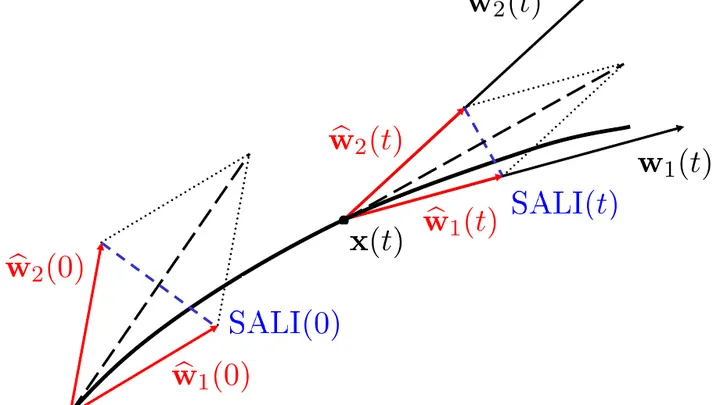
Drop a stone into a calm pond — the ripples spread evenly. Drop it into a churning stream — the water swirls unpredictably. Scientists have long wrestled with a similar question: how can you tell from a single particle's path whether its motion is chaotic? Previously, this meant comparing the particle's path with neighboring ones, which is complicated and time-consuming.
Drop honey onto a sponge. It lazily creeps, avoiding the voids. But if the honey becomes thinner under pressure, the flow gets trickier. Liquid with variable thickness in an uneven labyrinth of pores — a problem that had defied calculation. The authors of the new work averaged the chaos of microchannels into simple equations.
In the lab, time usually ticks on the wall: hands, digits, a frequency standard. But for the Universe, there are no external clocks. The Wheeler–DeWitt equation, the main law of quantum gravity, contains no time at all, and all fundamental theories lack an inbuilt arrow of time.
The ocean doesn't always stick to the same schedule. Sometimes the warm El Niño current strengthens, sometimes it weakens, and each regime dictates its own reaction speed to the past. These hidden regimes are like shifts in currents that remember their path with different depths.