The Red Dwarf Oxygen Trap express
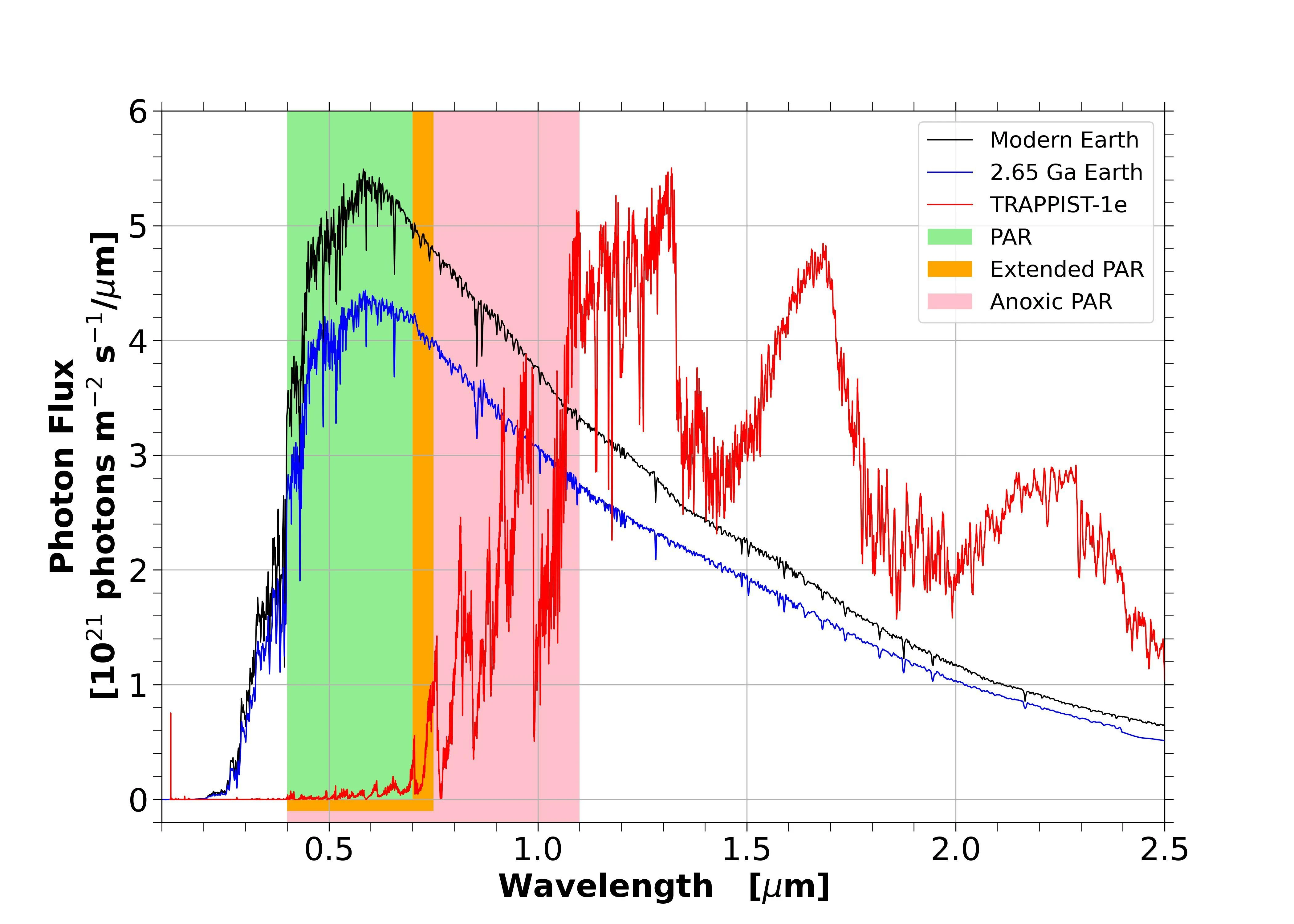
At TRAPPIST-1, oxygenic photosynthesis loses the race. This dwarf star shines mostly in infrared, not visible light like the Sun. Earth’s plants, capturing light of specific colors, built up oxygen, but here such rays are pitifully scarce. Done solo, the process would take 63 billion years — longer than the age of the universe. Accounting for excess light damaging cells and a wider viable range, that shrinks to 1–5 billion years. But then bacteria enter the race — ones that produce no oxygen but brilliantly see infrared light up to 1100 nanometers. At TRAPPIST-1, infrared is 22 times more abundant than visible light. They’ll take over the oceans, cutting off resources for the competition. Instead of green, purple seas. Without oxygen, the Cambrian explosion, an avalanche of complex organisms, won’t happen. So most Earth-like planets around red dwarfs, discovered thanks to William Borucki and David Charbonneau, will forever remain microbial worlds. The fate of a biosphere isn’t decided just by distance from its star, but by the color of its light.
Original abstract
as written by the authors arXiv:2601.02548v1
The rise of oxygen in the Earth's atmosphere during the Great Oxidation Event (GOE) occurred about 2.3 billion years ago. There is considerably greater uncertainty for the origin of oxygenic photosynthesis, but it likely occurred significantly earlier, perhaps by 700 million years. Assuming this time lag is proportional to the rate of oxygen generation, we can estimate how long it would take for a GOE-like event to occur on a hypothetical Earth-analog planet orbiting the star TRAPPIST-1 (a late M star with Teff 2560 K). Although in the habitable zone, an Earth-analog planet located in TRAPPIST-1e's orbit would receive only 0.9% of the Photosynthetically Active Radiation (PAR) that the Earth gets from the Sun. This is because most of the star's light is emitted at wavelengths longer than the 400-700 nm PAR range. Thus it would take 63 Gyrs for a GOE to occur. But the linear assumption is problematic; as light levels increase, photosynthesis saturates then declines, an effect known as photoinhibition. Photoinhibition varies from species to species and depends on a host of environmental factors. There is also sensitivity to the upper wavelength limit of the PAR: extending just 50 nm increases the number of photons by a factor of 2.5. Including these and other factors greatly reduces the timescale to roughly 1-5 Gyrs for a GOE. However, non-oxygenic photosynthetic bacteria can thrive in low-light environments and can use near-IR light out to 1100 nm, providing 22 times as many photons. With this huge light advantage, and because they evolved earlier, anoxygenic photosynthesizers would likely dominate the ecosystem. On a late M-star Earth-analog planet, oxygen may never reach significant levels in the atmosphere and a GOE may never occur, let alone a Cambrian Explosion. Thus complex animal life is unlikely.
On Earth, purple sulfur bacteria that use infrared light still live in hot springs — perhaps this is what life looked like in ancient oceans before the oxygen revolution.