Oxygen Dead End in a Red Dwarf System express
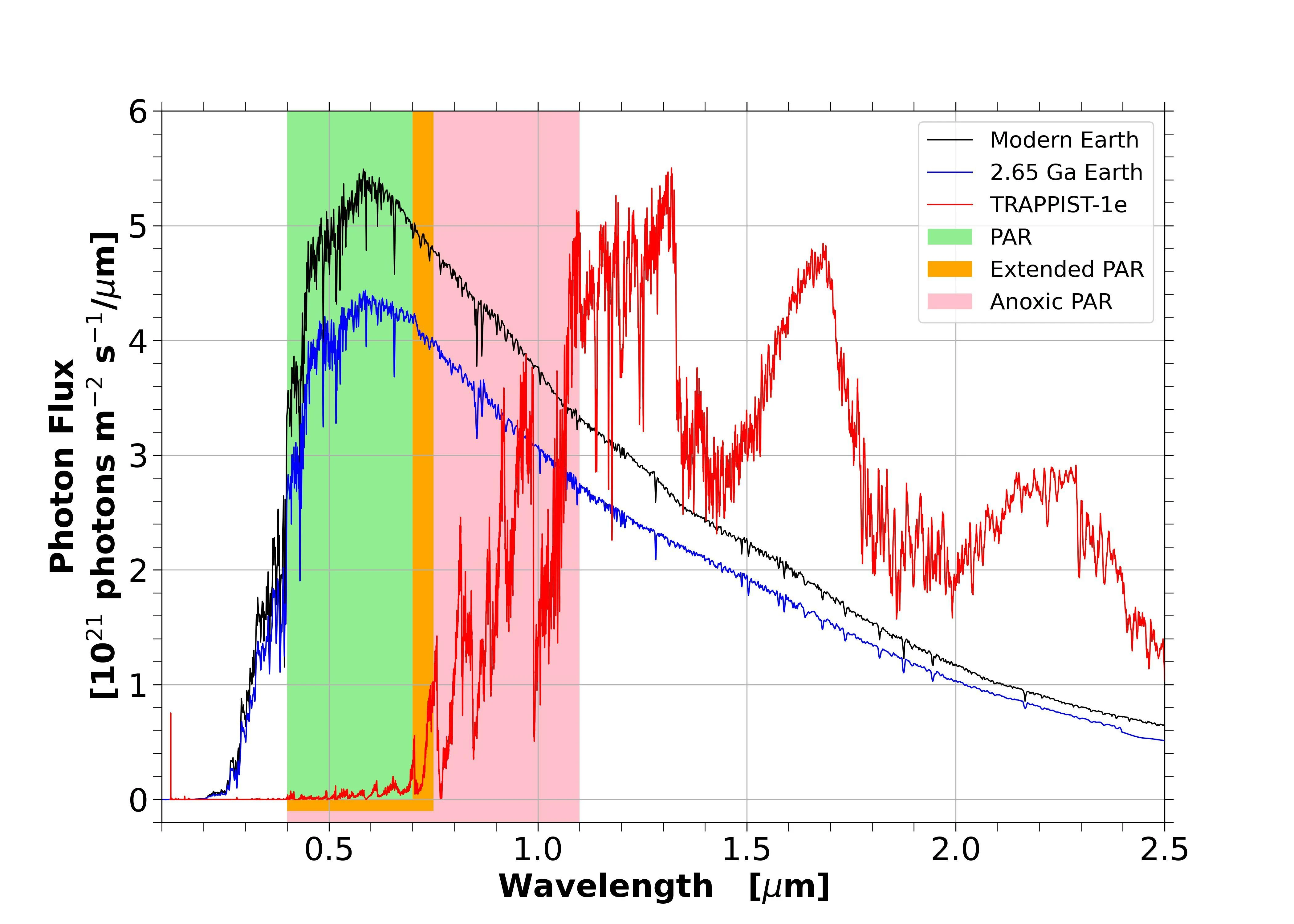
On the exoplanet TRAPPIST-1, oxygenic photosynthesis, the process by which light energy is converted into chemical energy with oxygen as a byproduct, is losing the race for survival. This M-dwarf star emits mostly in the infrared, not in the visible range like the Sun. Earth's plants, capturing light at specific wavelengths (mainly the red and blue parts of the spectrum), accumulated oxygen in the atmosphere over billions of years, but TRAPPIST-1 provides precious little of those rays. If this process ran on its own, ignoring other factors, it would take about 63 billion years — longer than the age of the Universe. Accounting for the fact that excess light damages cellular structures and that the allowable wavelength range for photosynthesis is somewhat broader, the estimated time shrinks to 1–5 billion years, but even that is an enormous stretch by geological standards.
However, bacteria that do not produce oxygen but are perfectly adapted to capture infrared light up to a wavelength of 1100 nanometers enter the race. Around TRAPPIST-1, infrared radiation is 22 times more abundant than visible light. These microorganisms, using their pigments, can efficiently absorb energy where conventional photosynthesizers are helpless. They will take over the oceans, blocking access to resources, dissolved nutrients and light, for their competitors. Instead of the familiar green of chlorophyll, the seas will turn purple, the hue typical of bacteriorhodopsin-based systems. Without oxygen accumulation, the Cambrian explosion, that avalanche of complex multicellular organisms that gave rise to most modern animal phyla about 540 million years ago, will not happen. Therefore, most Earth-like planets around red dwarfs, discovered thanks to transit photometry methods to which William Borucki and David Charbonneau contributed, will likely remain microbial worlds forever. The fate of a biosphere is decided not only by the distance to the star, which sets the temperature, but also by the spectral composition of its light: that is, its color.
On Earth, purple sulfur bacteria that use infrared light still thrive in hot springs — perhaps this is what life looked like in ancient oceans before the oxygen revolution.