Liquid Crystal from Helium express
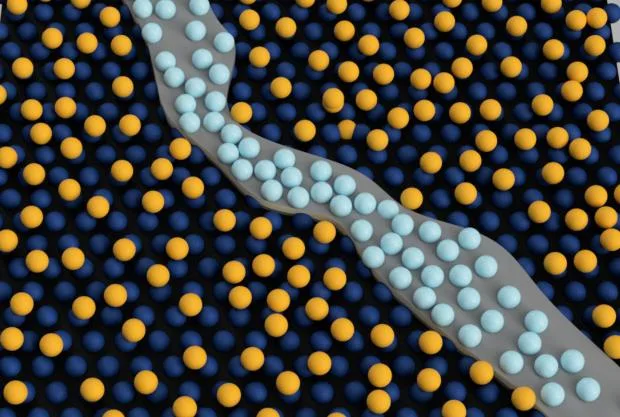
Helium on graphite behaves like an acrobat who simultaneously slides along a tightrope and holds a pose. At temperatures of 30 millikelvin (a hundred times colder than outer space), the second layer of helium on graphite acquired new properties: it began to flow without friction while resisting compression, like thick honey. Previously, such measurements were made on different samples, and the results did not match. Now, on the same piece of graphite, they simultaneously measured how helium oscillates and how it absorbs heat. It turned out that the new phase exists only in a narrow range of density, like a shelf in a cupboard that can hold only a certain number of books.
This discovery supports the hypothesis of a superfluid liquid crystal: a substance that combines the fluidity of a liquid with the order of a crystal, like a troop of soldiers marching in step. The scientists also analyzed why the superfluid density changes with temperature according to a logarithmic law. It turned out that defects on the graphite surface are to blame — tiny irregularities that act like a random network of weak bonds. This is like a floor with small pebbles: you can roll on it, but you bounce slightly.
Such a phase of helium is a rare example of a quantum state that can be studied in the laboratory. It might help understand how superfluid liquids behave in porous materials or even in neutron stars, where matter is under extreme conditions. And the acrobat on the tightrope continues to surprise: it doesn't just slide, it also keeps its balance.
A temperature of 30 millikelvin is -273.12°C, just 0.03 degrees above absolute zero. At such a temperature, even light seems to slow down.
In Greg Egan's novel "Schild's Ladder," superfluid liquids are used to create quantum computers capable of existing in multiple states simultaneously.