Night Watchman for Cosmic Flashes express
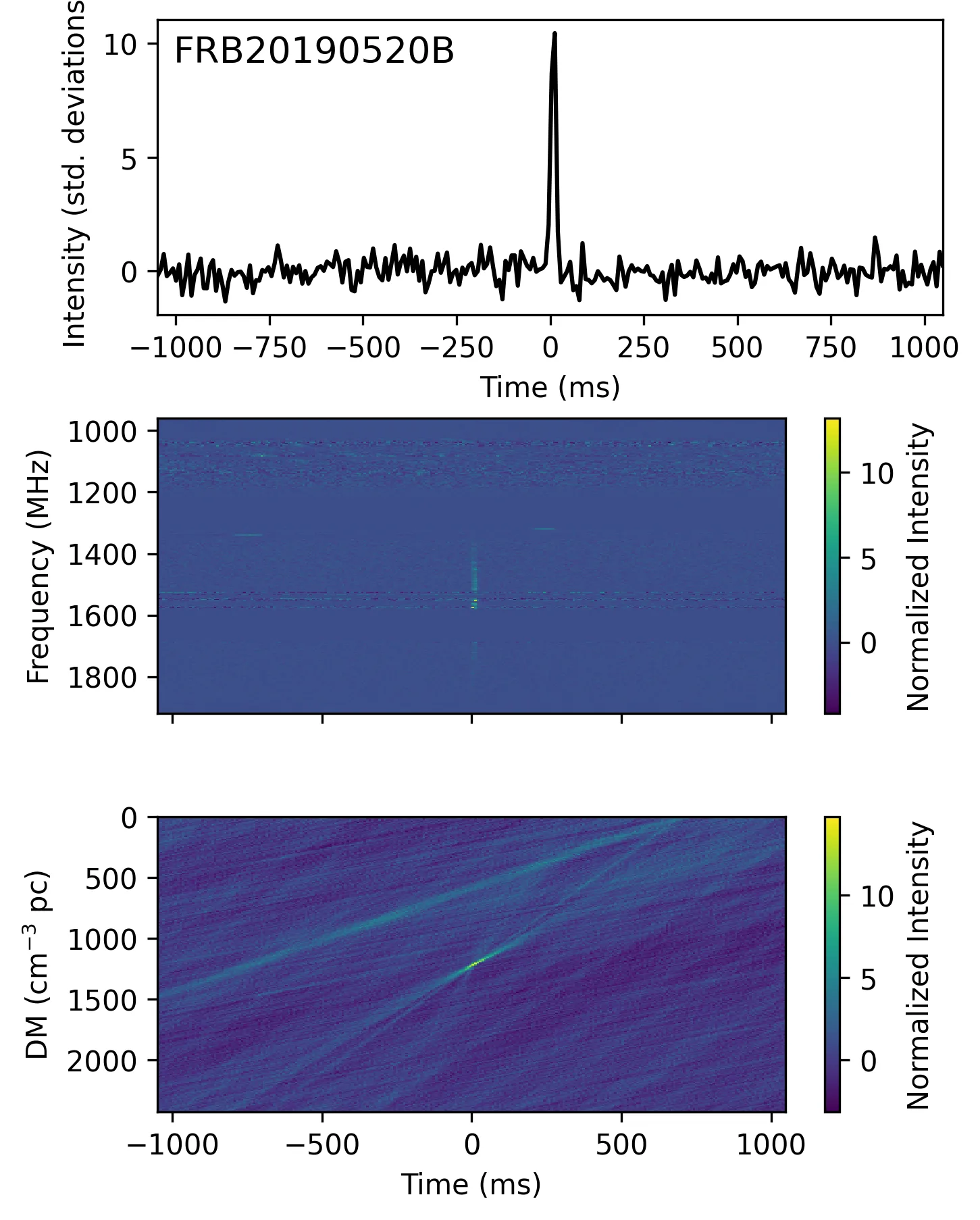
At night, while most people sleep, the giant dish of the Green Bank radio telescope in West Virginia keeps listening to the sky. Over 24,186 hours, that's nearly three years of continuous observation, it caught 50 pulsars and three fast radio bursts. Fast radio bursts are short but incredibly powerful radio pulses from distant galaxies. They last only a few milliseconds, but in that time they release as much energy as the Sun emits in several days.
Among the pulsars caught, dead stars that spin and send out radio beams like lighthouses, was one completely new. It's named PSR J0039+5407. It rotates once every 2.2 seconds — slower than most known pulsars. But the strangest thing: this pulsar goes silent 70–80% of the time. Astronomers call this behavior 'nulling'—as if the lighthouse turns its light on and off without any visible reason.
The three fast radio bursts the telescope caught turned out to be from already known sources: they had been observed before. The main difficulty in finding new bursts is the telescope's single beam. It looks at only one point in the sky, and earthly interference (from radars, satellites, microwave ovens) can easily masquerade as cosmic signals. One such case is particularly telling: a pulse passed all the filters, but on closer inspection turned out to be part of a longer narrowband signal of unknown origin. It's unclear whether it's earthly or celestial.
The telescope keeps listening. Perhaps the next fast radio burst will be a new one, and then we'll learn more about what's happening in distant galaxies.
Original abstract
as written by the authors arXiv:2601.20143
In addition to fast radio burst (FRB) searches carried out using dedicated surveys, a number of radio observatories take advantage of commensal opportunities with large facilities in which observations for other projects can be searched for FRBs and other transient sources. We present the results from one such effort, the first 24,186 hours of the GREENBURST search for dispersed radio pulses with the Green Bank Telescope (GBT). To date, GREENBURST has detected a total of 50 pulsars and three FRBs. One of the pulsars, PSR J0039+5407, has a period of 2.2 s and was previously unknown. Using follow-up observations with the Canadian Hydrogen Intensity Mapping Experiment, we found a timing solution for this pulsar which shows it to have a characteristic age of 2 Myr. Additional GBT observations show the pulsar has a very high nulling fraction ($$\sim70-80\%$$). All three of the FRBs are repeating sources that were previously known and were being monitored by the GBT as part of other projects. A major challenge for GREENBURST in the discovery of new FRBs is its single beam. This makes it hard to distinguish some of the pulses from sources of radio frequency interference. We highlight this problem with a case study of an FRB-like pulse that initially passed our interference filters. Upon closer inspection, the event appears to be part of a longer-duration narrow-band source of unknown origin. Further observations and monitoring are required to determine whether it is terrestrial or celestial.
A fast radio burst lasts about a millisecond, but in that time it releases as much energy as the Sun does in several days.
In Carl Sagan's novel 'Contact,' radio telescopes pick up a mysterious signal from space — though there it turns out to be a message from an alien civilization, not a natural burst.