A Solar Flare in Three Dimensions express
A solar flare is like a giant spring that gets twisted and twisted, and then suddenly snaps. The energy stored in the magnetic field is unleashed into space within minutes, heating plasma to millions of degrees. But what exactly happens inside that loop of superheated gas has until now been visible only in flat projections.
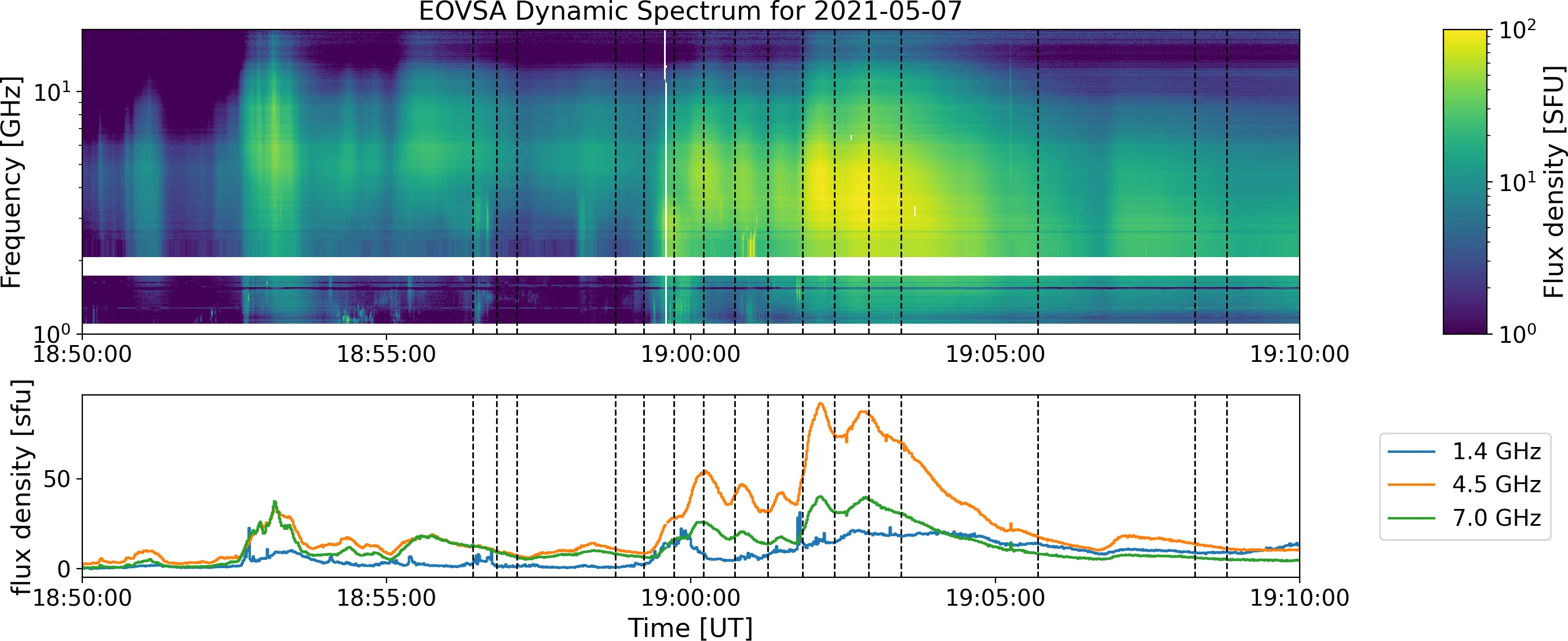
Now astronomers have assembled a three-dimensional picture. On May 7, 2021, a flare erupted on the Sun, and several instruments watched it simultaneously. The ground-based EOVSA radio telescope array in California caught microwave radiation — which tells us about the magnetic field and fast electrons. Two spacecraft, Japan's Hinode and Europe's Solar Orbiter, observed the same flare in X-rays from different vantage points. Combining these observations, scientists obtained a volumetric map: where the magnetic field is strong, how much hot plasma is there, and how fast it moves.
Such a map is not just a pretty picture. It shows where magnetic lines break and reconnect, releasing energy. Previously, this was only described in theories; now calculations can be checked against real measurements. And this is a step toward predicting solar storms — the very ones that knock out satellites and power grids on Earth.
Original abstract
as written by the authors arXiv:2602.11853
Diagnosing solar flare conditions is essential for understanding coronal energy release. Using combined microwave and X-ray data, we reconstruct three-dimensional maps of the magnetic field and plasma parameters in the SOL2021-05-07 flare. We use imaging spectroscopy from the Expanded Owens Valley Solar Array (EOVSA) to derive spatial maps of the magnetic field strength, thermal and nonthermal electron densities, and the power-law index of nonthermal electrons through gyrosynchrotron modeling. Simultaneous X-ray observations from Hinode/XRT and Solar Orbiter/STIX, obtained from different vantage points, enable a stereoscopic reconstruction of the flaring loop. By correlating the positions of microwave and thermal X-ray sources, we associate the three-dimensional coordinates with the microwave-derived plasma parameters. We derive observational three-dimensional maps of magnetic field strength, Alfv\'en speed, and plasma beta in the flaring volume, revealing a magnetically dominated environment. These spatially resolved diagnostics provide valuable constraints for models of magnetic reconnection and flare dynamics and represent a step toward a realistic three-dimensional characterization of energy release in solar eruptive events.
A solar flare releases as much energy in a few minutes as all of humanity would consume over millions of years.
In the movie "Star Trek: Nemesis," a solar flare is used as a weapon to disable an enemy ship.