A Solar Flare in Three Dimensions express
A solar flare is like a giant spring that gets twisted and twisted, and then suddenly snaps. The energy stored in the magnetic field is unleashed into space within minutes, heating plasma to millions of degrees. But what exactly happens inside that loop of superheated gas has until now been visible only in flat projections.
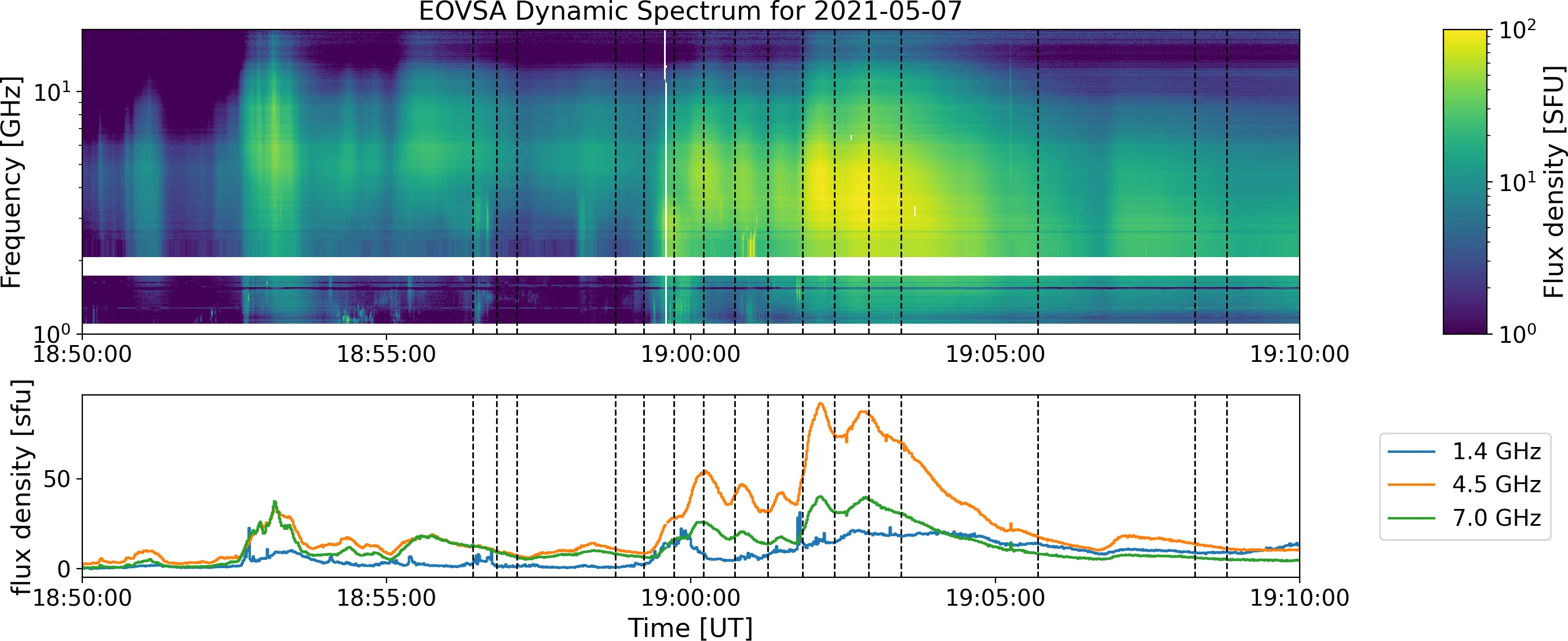
Now astronomers have assembled a three-dimensional picture. On May 7, 2021, a flare erupted on the Sun, and several instruments watched it simultaneously. The ground-based EOVSA radio telescope array in California caught microwave radiation — which tells us about the magnetic field and fast electrons. Two spacecraft, Japan's Hinode and Europe's Solar Orbiter, observed the same flare in X-rays from different vantage points. Combining these observations, scientists obtained a volumetric map: where the magnetic field is strong, how much hot plasma is there, and how fast it moves.
Such a map is not just a pretty picture. It shows where magnetic lines break and reconnect, releasing energy. Previously, this was only described in theories; now calculations can be checked against real measurements. And this is a step toward predicting solar storms — the very ones that knock out satellites and power grids on Earth.
A solar flare releases as much energy in a few minutes as all of humanity would consume over millions of years.
In the movie "Star Trek: Nemesis," a solar flare is used as a weapon to disable an enemy ship.