Sijie Yu

6 articles · 30 co-authors · latest: 2026-06-03
64 citations · h-index 4 · 35 papersData: Semantic Scholar

We have retold 6 papers by this author. 2 of them with a full read. most often about: solar corona, fast radio burst, electromagnetic radiation. 30 co-authors across our retellings.

Links in the knowledge graph
Stellar2025-09-193 minarXiv:2509.16453
Fireflies in a Solar Cloud
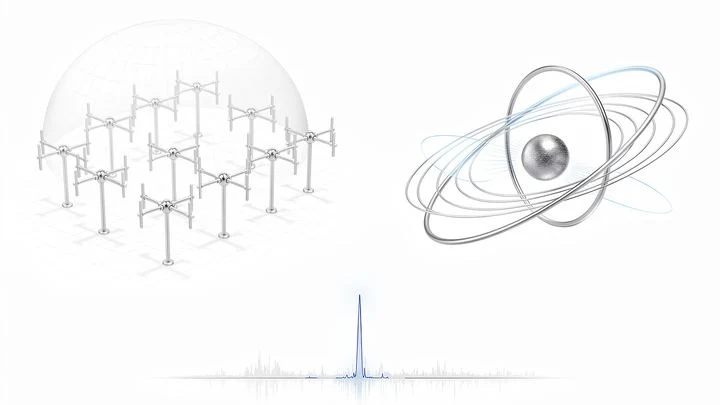
On the night of March 9–10, 2024, a cloud of plasma ejected by the Sun raced away from the star. It had already passed a distance of five solar radii when a ground-based array of 352 antennas in California's Owens Valley caught a brief radio signal from it.
Stellar2026-02-012 minarXiv:2602.01323express
The Solar Flare Mystery: Light That Shouldn't Have Been There
A solar flare is like an explosion in the atmosphere: bright, fast, with different 'voices.' X-rays come from electrons that have been accelerated and then abruptly slowed down, losing energy. But in 2017, detectors on the Fermi satellite caught a different signal — gamma rays that didn't fit this picture.
Stellar2026-02-042 minarXiv:2602.05024express
Solar Flare: How the Magnetic Field Loses Its Strength
A solar flare is like a tightly coiled spring suddenly uncoiling. In the Sun's corona, energy accumulates in the twisted magnetic field, and then it is abruptly released, accelerating particles and heating plasma.
Stellar2026-02-101 minarXiv:2602.09819express
The Solar Corona: A New Way to Measure Its Density
The solar corona, the Sun's outer atmosphere, stretches millions of kilometers, yet it's visible only during a total eclipse or with specialized instruments. Typically, we gauge the corona's density by how it scatters white light, but that method relies on simplifications that can skew the results.
Stellar2026-02-121 minarXiv:2602.11853express
A Solar Flare in Three Dimensions
A solar flare is like a giant spring that gets twisted and twisted, and then suddenly snaps. The energy stored in the magnetic field is unleashed into space within minutes, heating plasma to millions of degrees.
The Universe's Radio Concert: How 30 Seconds of Silence Are Changing Physics
Listening to the cosmos requires patience and a finely tuned ear. Astronomers chose the most sensitive low-frequency instrument for this: the OVRO–LWA antenna array — 352 dipole antennas scattered across two and a half kilometers of California desert.