Magnetic Resonance for Electrons express
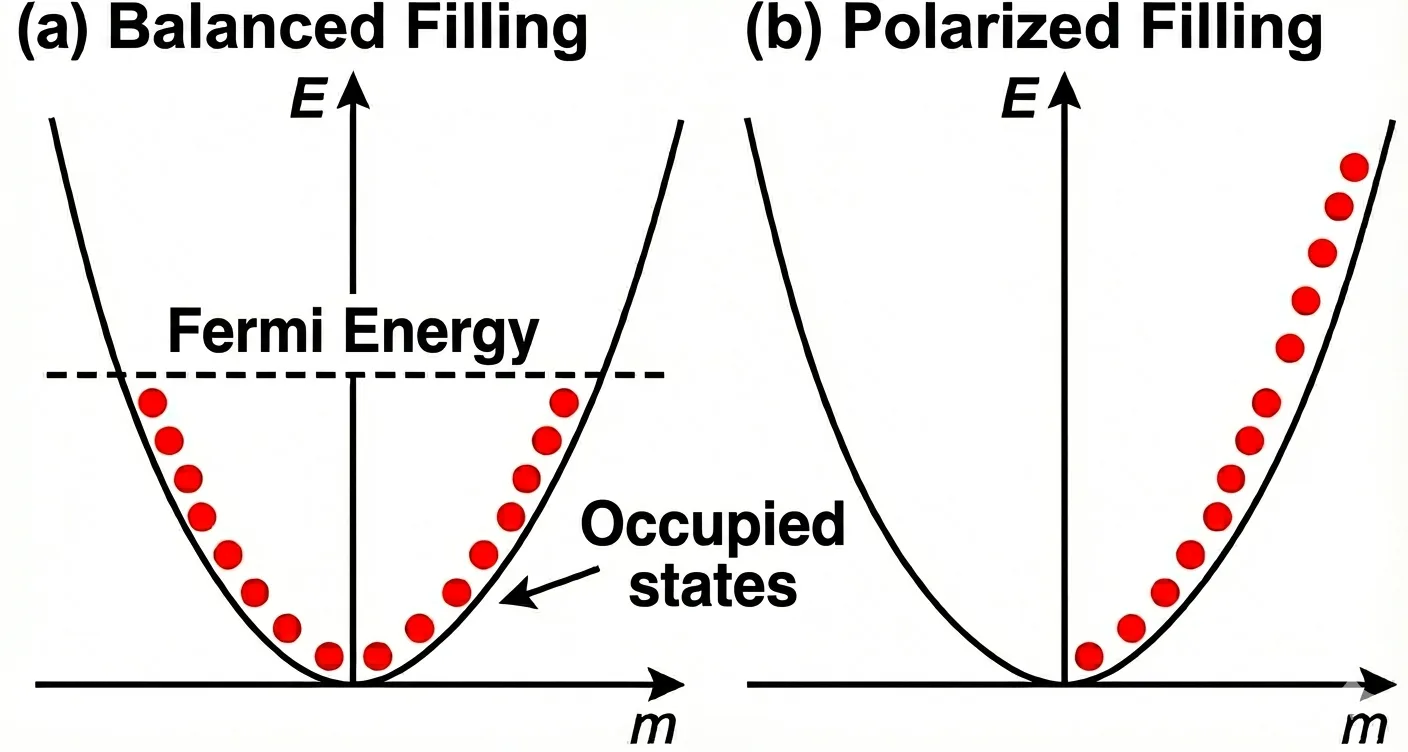
Electrons in a conductor behave like a crowd on an escalator: each one moves on its own, but together they create a flow. If you make them circle around a ring, their angular momentum (a measure of rotation) can couple to a magnetic field, like gears in a clock. The new work examines exactly this coupling: a quantized magnetic field in a miniature circuit (an LC resonator) acts on electrons, forcing them to synchronize.
At weak coupling, electrons move chaotically, but as the interaction strengthens, a sharp transition occurs: all spins (magnetic moments) align in one direction. This is like a disorderly crowd suddenly starting to march in step. This behavior is called Stoner instability and resembles the phase transition in a ferromagnet when a piece of iron becomes magnetized.
By adding a Josephson junction to the circuit, a nonlinear element whose properties change with current, the authors obtained an even richer picture. New phases emerge where photons (field quanta) dress the electrons, altering their effective mass. This is reminiscent of a swimmer moving through water, dragging some of the fluid along and slowing down. Such effects are important for quantum circuits where precise control of particle states is needed.
In the end, the model, which can be solved analytically, serves as a testing ground for studying complex quantum phenomena without heavy computations. It links condensed matter physics with quantum optics and may suggest new ways to manipulate quantum information.
In a regular ferromagnet, like iron, electrons align due to Coulomb repulsion, but in this model, they align due to interaction with the magnetic field, making the system more controllable.