How Calcium Is Born in Stellar Explosions express
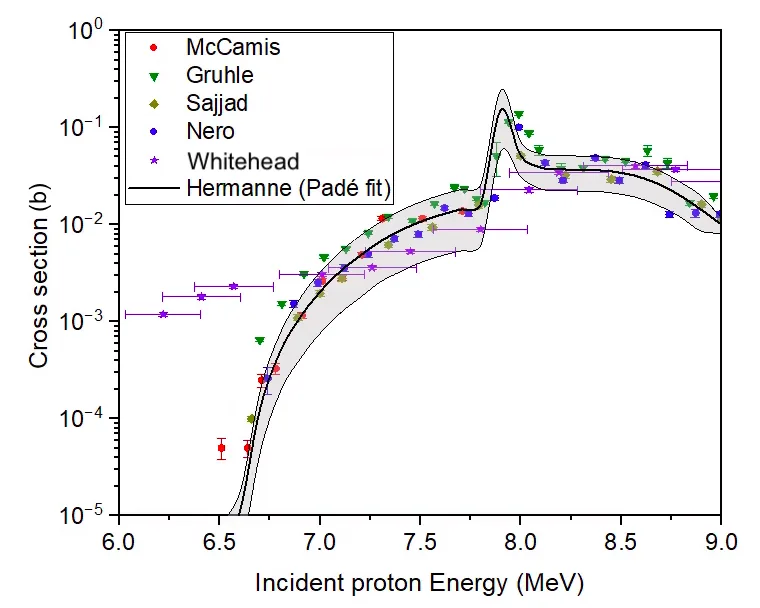
Deep inside a dying star, just before it goes supernova, nuclear reactions determine which chemical elements will be scattered across the cosmos. One such reaction is the collision of an oxygen nucleus with a proton, producing a nitrogen nucleus and an alpha particle (a helium nucleus). The rate of this reaction controls how much calcium and sulfur are produced — elements astronomers use to infer the composition of the progenitor star.
For a long time, data from different experiments contradicted each other: some measurements gave a reaction rate seven times higher than the standard value, others lower. To sort it out, physicists used the MUSIC detector, which catches particles right inside a gas chamber, like a microphone picking up sound. The new measurement at energies typical of an explosion showed the reaction rate is 1.5 times higher than the REACLIB reference, but not seven times. The scatter in the old data has been greatly reduced.
But even with the new reaction rate, we still can't explain why supernova remnants of different ages have different calcium-to-sulfur ratios. That means the answer lies in other oxygen-burning reactions — for instance, the fusion of two oxygen nuclei, or oxygen with carbon. Improving the precision of those measurements is what future experiments need to do to understand how stars forge elements.
The MUSIC detector works like a gas chamber where particles leave tracks, letting physicists literally 'hear' each nuclear collision.
In Stanisław Lem's novel 'Solaris', the planet's ocean changes its orbit by manipulating gravity — much like nuclear reactions in supernovae govern the chemical makeup of entire galaxies.