How to Hear Ultra-Low Frequencies Without an Antenna express
Radio waves that oscillate less than once per second pass through the earth and water with almost no loss. Such signals are used to communicate with submarines and to search for minerals. But a conventional antenna for them would need to be hundreds of meters long, and its sensitivity leaves much to be desired. Physicists have proposed replacing the antenna with a cloud of rubidium atoms in a glass cell.
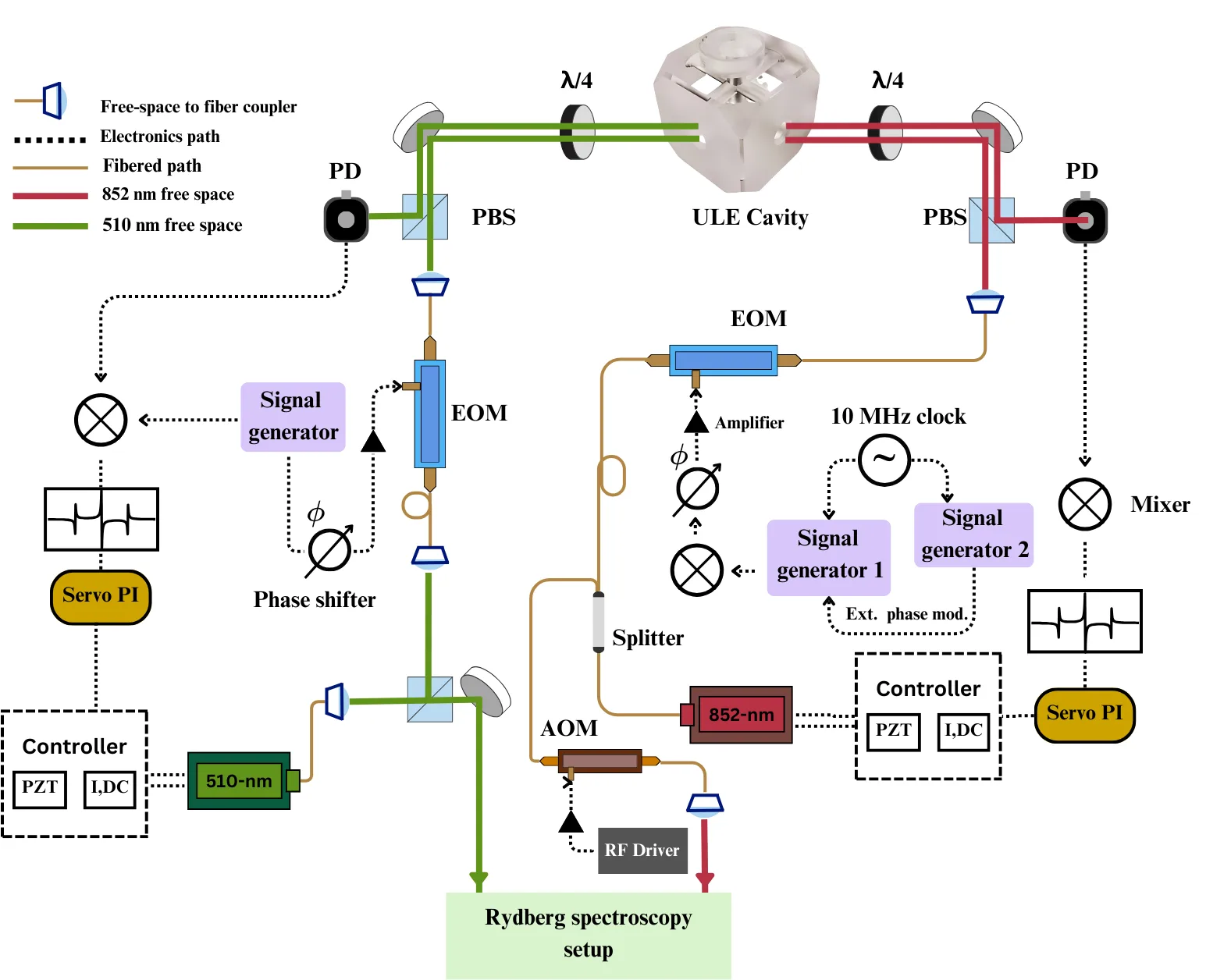
Rubidium atoms can sense electric fields: the field slightly shifts their internal energy levels. A laser beam illuminates the atoms, and by measuring changes in light absorption, one can infer the field. The problem is that the glass of the cell shields slow oscillations, just as a metal mesh blocks long waves. The researchers coated the cell walls with a thin layer of paraffin. When atoms collide with the paraffin, they do not lose sensitivity, and the field penetrates inside almost undistorted.
To extract the weak signal from the noise, the physicists added a modulating field and a lock-in detector, like tuning a radio to a station, but instead of turning a knob, they use an auxiliary oscillation. As a result, the sensor works in the range from 0.5 hertz to 10 kilohertz. At 1 hertz, the sensitivity is 819 microvolts per centimeter per root hertz — meaning that a field weaker than that from a battery at arm's length can already be detected.
This sensor requires no metal electrodes and operates at room temperature. It could be made as small as a matchbox. In the future, such devices could help listen to the Earth's 'pulse'—slow electric oscillations caused by magma movement, tides, or storms beyond the horizon.
A frequency of 0.5 hertz means one oscillation every two seconds. Such waves would be longer than the distance from Earth to the Moon if they propagated in a vacuum.
In the series 'The Expanse', underwater bases communicate with ships in orbit using ultra-long waves — now such a channel could fit in your pocket.