Two-Faced Graphene express
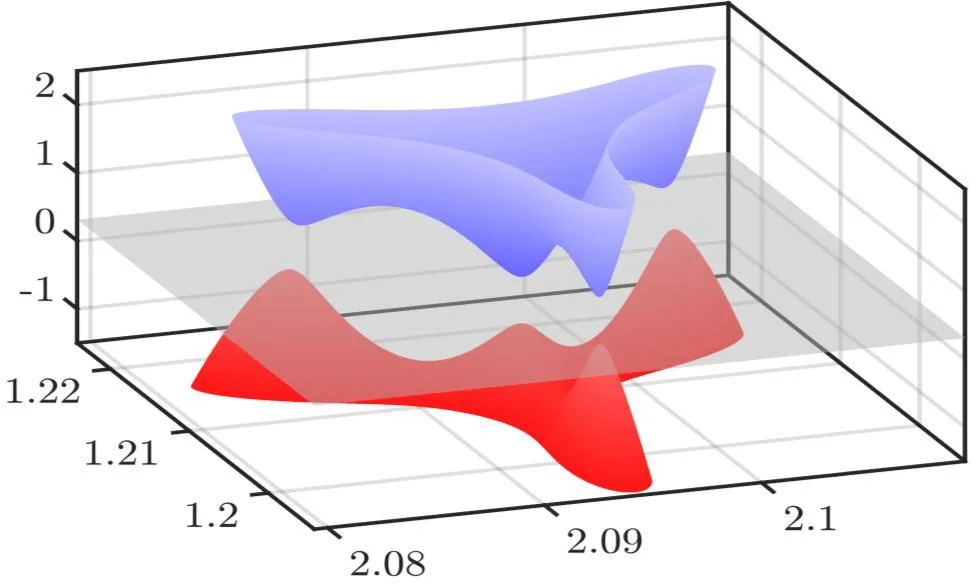
A sheet of graphene one atom thick is like a flexible metal mesh through which electrons zip almost unimpeded. Stack two such sheets with a slight twist, and the material's properties change dramatically: it can become an insulator that blocks current. In a new study, physicists showed that this role reversal can be triggered by weak fields if you account for a tiny asymmetry in the atomic arrangement.
In a previous study, the authors found that applying a magnetic field along the layers and an electric field across them turns an insulator into a metal, but that required enormous magnets. Now they added to their calculations the so-called trigonal warping — a slight skew in the energy bands that was previously ignored. It turns out that in a tiny region of momentum space (about one hundredth of the entire Brillouin zone), this skew causes two types of particles, electrons and holes, to cancel each other out, and the material spontaneously becomes a semimetal even without external fields.
Next, the physicists applied a weak transverse electric field, just 0.6 millivolts, which is thousands of times less than the voltage of a typical battery. That was enough to open a gap and turn the material into an insulator. But when they added a moderate magnetic field of about 10 tesla (roughly 200,000 times stronger than a fridge magnet), the gap closed and graphene became conducting again. Previously, such a transition required a field several times stronger.
This result is not just a theoretical exercise. It means that switching the state of bilayer graphene can be achieved with fields available in an ordinary laboratory. And since graphene is a material of the future for electronics, understanding its behavior under fields brings us closer to creating transistors and sensors based on it.
Trigonal warping in graphene arises because the carbon atoms in the lattice are not perfectly symmetrically arranged: when layers are shifted, additional bonds appear that slightly "skew" the energy bands. It's like a barely visible ripple on a flat surface that changes the path of rolling marbles.