Popular

Dance of Ions: How Quantum Vortices Are Born ⚡ экспресс

Original: "Experimental realisation of topological spin textures in a Penning trap"
arXiv:2604.13872 · 2026-04-15 · CC BY-SA 4.0 · ⏱ 1 min · Quantum Physics Atomic Physics
Physicists for the first time twisted 150 ions into a quantum vortex and examined in detail each spin of this whirl.
Abstract

Researchers have for the first time deterministically created topological spin textures—skyrmions (vortex-like magnetic structures)—in a two-dimensional crystal of over 150 trapped ions. Using globally applied spin-dependent forces, they shaped skyrmion configurations and reconstructed the full spin vector field with single-ion resolution. The key parameter—the winding number—was 0.99±0.02, and the local reproduction fidelity reached 87%. They also demonstrated control of individual ions to create domain walls. This platform paves the way for exploring non-equilibrium dynamics in long-range interacting systems, much like a swirling dance of particles coalescing into a stable vortex.

Links in the knowledge graph 1

📄 Showing the "Simple" version — "Popular" is not ready yet. Add it to favorites to help prioritize it.

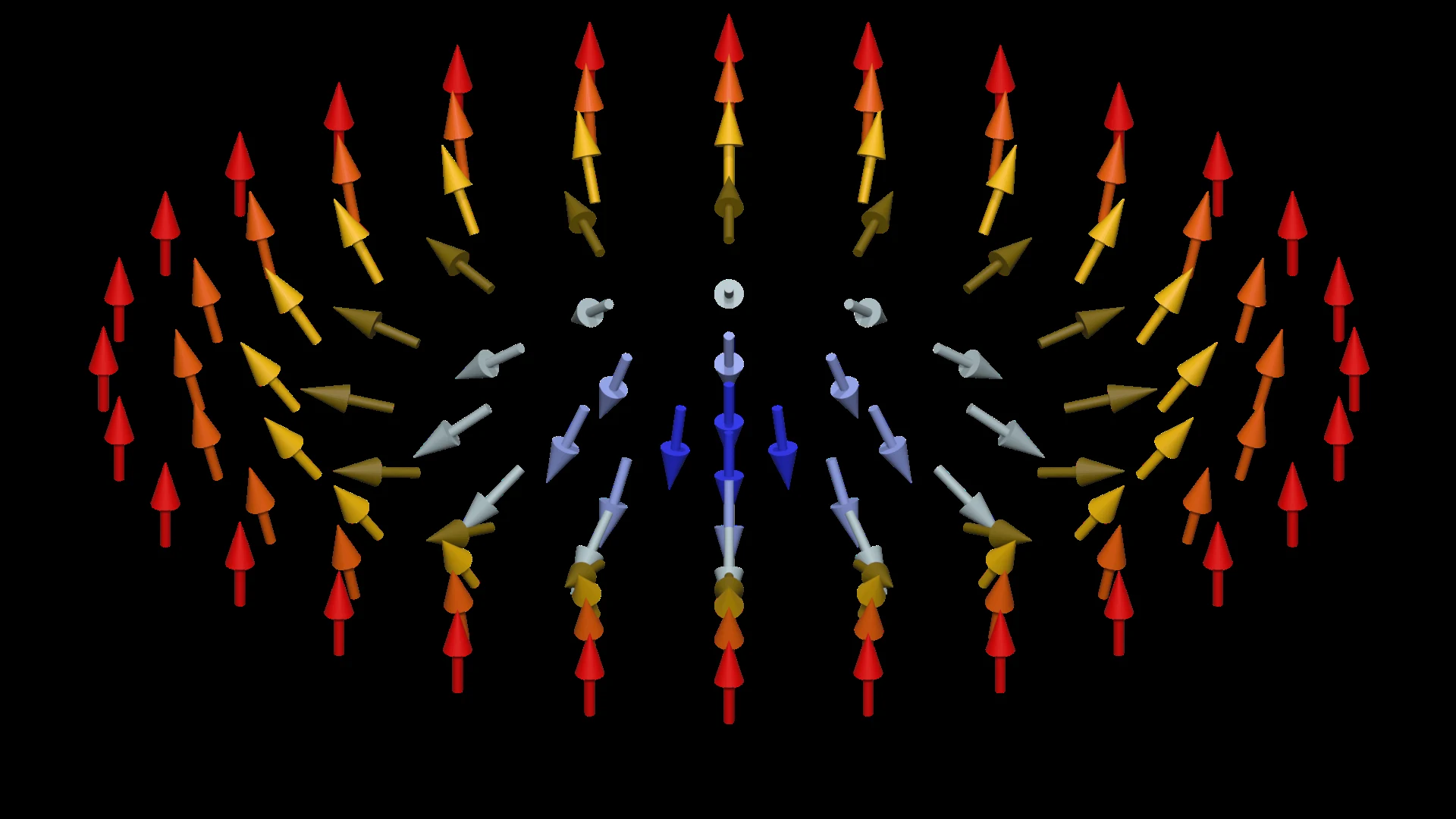
In a field trap, scientists assembled a crystal — 150 ions at ultra-low temperature. Each ion behaves like a tiny magnet, capable of rotating in any direction. By controlling forces that depend on this rotation, physicists made all the magnets swirl into a common vortex called a skyrmion. This whirl, resembling a miniature galactic arm, has a spiral structure.

To see the pattern, the ions were illuminated with a laser — a spectroscopy method. If a particle glowed, its orientation was known. The reconstructed vortex turned out to be almost perfect: the winding number is 0.99 (for an ideal vortex it's 1.0). The accuracy of the spin pattern reproduction is 87%.

Skyrmions are stable, like a funnel in a flow. Their special topology could turn the vortex into a cell for ultra-dense memory.

Scientists also created domain walls — boundaries between differently magnetized regions. The platform opens the way to studying systems where particles influence each other at a distance.

🎯 The name 'skyrmion' comes from British physicist Tony Skyrme, who proposed these vortices as a model for nuclear forces in the 1960s.

Scientists
Christian DopplerD. B. McLaughlinDidier QuelozMichel MayorR. A. RossiterJames Clerk Maxwell
Tags
spectroscopy Water galaxy
Laws
Doppler effectMaxwell's equationsPlanck's lawPlanck–Einstein relationWien's displacement lawRydberg formula
Original: arXiv:2604.13872 · CC BY-SA 4.0 · bridge42worlds