Dance of Ions: How Quantum Vortices Are Born express
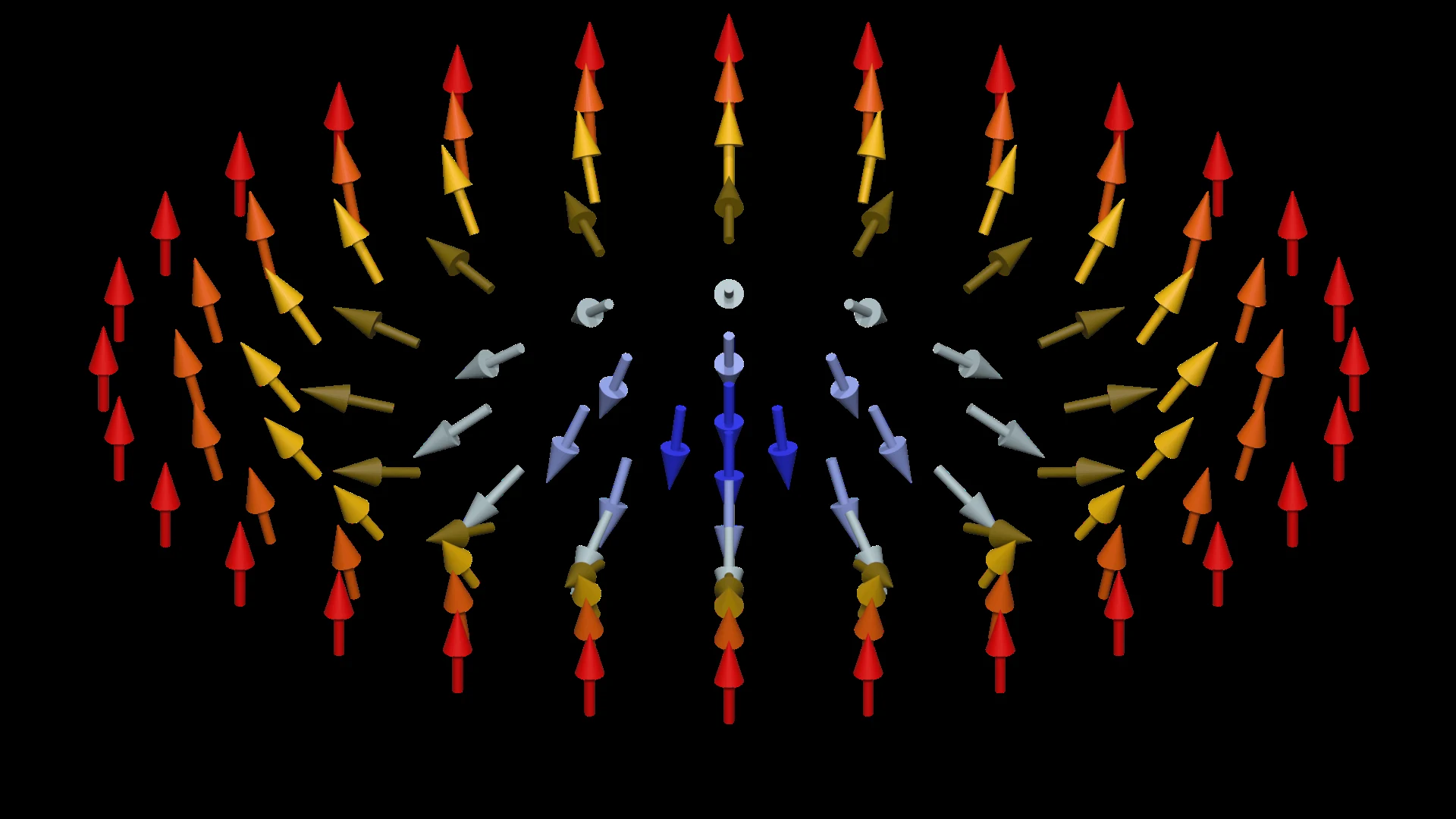
In a field trap, scientists assembled a crystal — 150 ions at ultra-low temperature. Each ion behaves like a tiny magnet, capable of rotating in any direction. By controlling forces that depend on this rotation, physicists made all the magnets swirl into a common vortex called a skyrmion. This whirl, resembling a miniature galactic arm, has a spiral structure.
To see the pattern, the ions were illuminated with a laser — a spectroscopy method. If a particle glowed, its orientation was known. The reconstructed vortex turned out to be almost perfect: the winding number is 0.99 (for an ideal vortex it's 1.0). The accuracy of the spin pattern reproduction is 87%.
Scientists also created domain walls — boundaries between differently magnetized regions. The platform opens the way to studying systems where particles influence each other at a distance.
The name 'skyrmion' comes from British physicist Tony Skyrme, who proposed these vortices as a model for nuclear forces in the 1960s.