Cosmic Whirlpools, Painted by a Neural Network express
Toss a handful of glitter into a river, and some flakes will drift straight while others spin in tiny eddies. Galaxies in the universe do something similar: they don't just recede due to cosmic expansion: they also swirl in giant currents, like wood chips caught in invisible whirlpools. These whirlpools, the vorticity of cosmic gas and dark matter, are a crucial trace of how the universe grew and became more complex. But seeing them directly is nearly impossible: that would require knowing the sideways motion of galaxies, whereas telescopes only measure velocity "toward us" or "away from us."
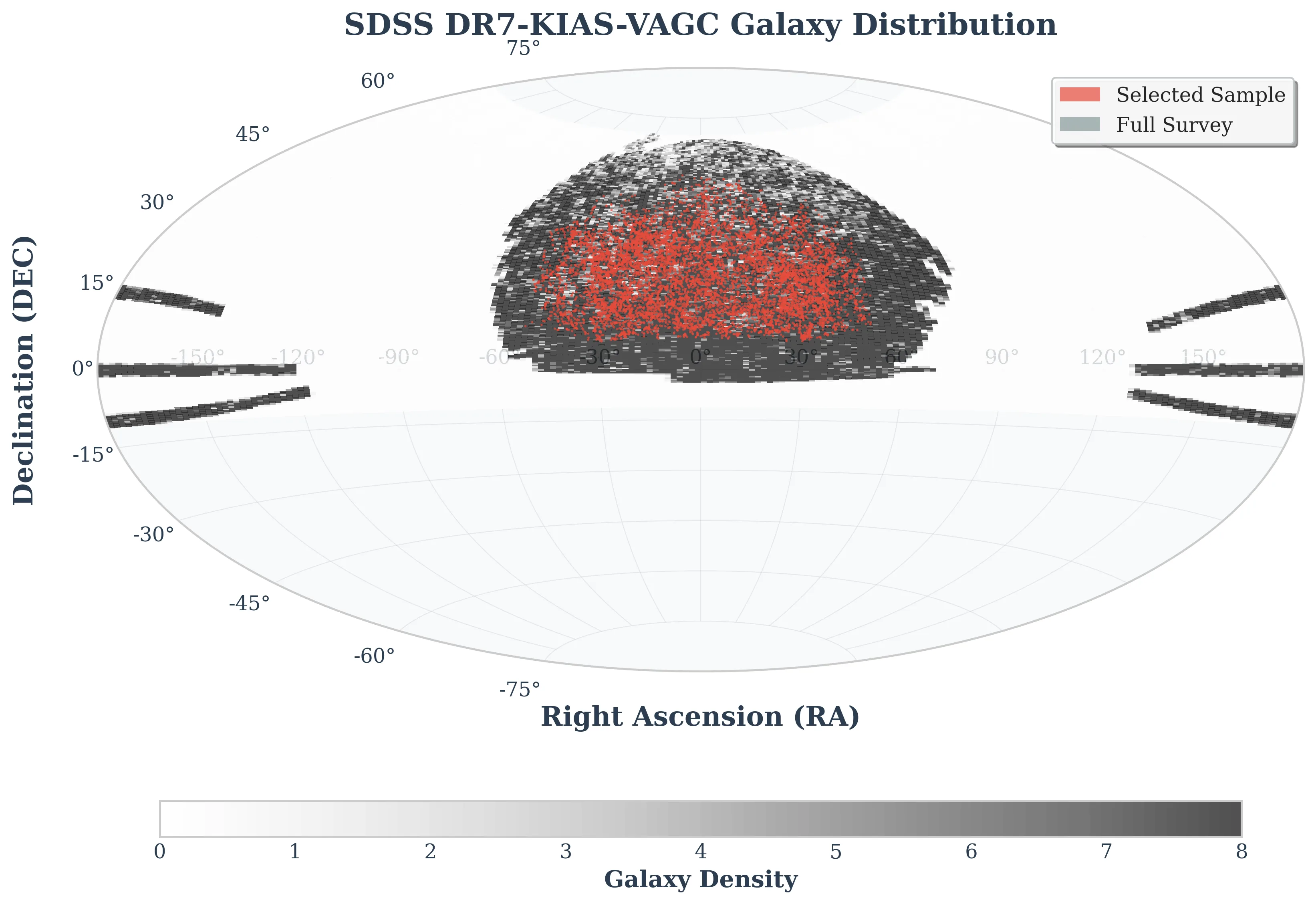
The authors of the new work took a roundabout route. They used detailed computer simulations, where every motion is known in advance, and trained a neural network to infer the three-dimensional flow from a flat map of galaxies. Then they fed it real data from the Sloan Digital Sky Survey — a vast census of one and a half million galaxies. The network reconstructed the velocity field and, for the first time, produced a map of cosmic vorticity. Familiar features emerged: filaments, clusters, and voids, but now highlighted by motion — spiral flows in clusters, whirlpools in voids.
The verification showed that the reconstructed picture is statistically indistinguishable from the predictions of the standard model. Moreover, when these velocities were used to remove the distortions caused by cosmic expansion, the three-dimensional map of galaxies became almost perfectly homogeneous — exactly as expected. This is independent confirmation that our model of the universe is correct.
So the invisible whirlpools have become visible. The neural network acted as a translator, converting the flat language of photographs into the three-dimensional language of the forces that shape the cosmic web. And it turns out that this web doesn't just hang there: it flows, winding galaxies into slow, majestic spirals. Astronomers now have a new tool to look where only formulas could reach before.
Original abstract
as written by the authors arXiv:2604.14653
The cosmic vorticity field, an essential tracer of nonlinear structure formation, has remained observationally inaccessible because transverse galaxy motions are difficult to measure and analytic models struggle to capture shell-crossing. Here we report an empirical reconstruction of this field by applying an artificial intelligence framework trained on simulations of the concordance LambdaCDM model to Sloan Digital Sky Survey galaxies. The recovered three-dimensional velocity and vorticity fields reveal coherent vortical structures, including spiral flows in clusters, filaments, and voids, and the cosmic web inferred from vorticity closely matches that derived from density segmentation. The power spectra of the reconstructed velocity and vorticity fields agree statistically with LambdaCDM predictions, and the inferred velocity field effectively removes redshift-space distortions, yielding an almost isotropic clustering signal. These converging lines of evidence, obtained from an independent perspective, reinforce the concordance cosmological model. By closing a long-standing observational gap, our results highlight the potential of AI-driven reconstruction to access otherwise unobservable quantities and to address fundamental questions in cosmology and galaxy formation.
The largest cosmic whirlpools found in this work stretch across hundreds of millions of light-years — thousands of times larger than our own galaxy.