A Carbon Footprint in an Invisible Atmosphere express
A world that for years refused to show its face. Planet GJ 1214 b is exactly such a case. It is larger than Earth but smaller than Neptune, and its dense envelope made the atmosphere invisible to telescopes: starlight passed through it without leaving clear traces. But astronomers' persistence and a new sensitive instrument provided the first clue.
Using the CRIRES⁺ spectrograph on the Very Large Telescope in Chile, scientists observed the planet passing in front of its star eight times. This is like a sunset: light grazes the edge of the atmosphere and carries away imprints of gases, like colored bands on a photograph. A special program cleaned the signal from interference by Earth's air and the star's own "breathing." Then they looked for traces of water, carbon monoxide, methane, hydrogen sulfide, ammonia, and carbon dioxide.
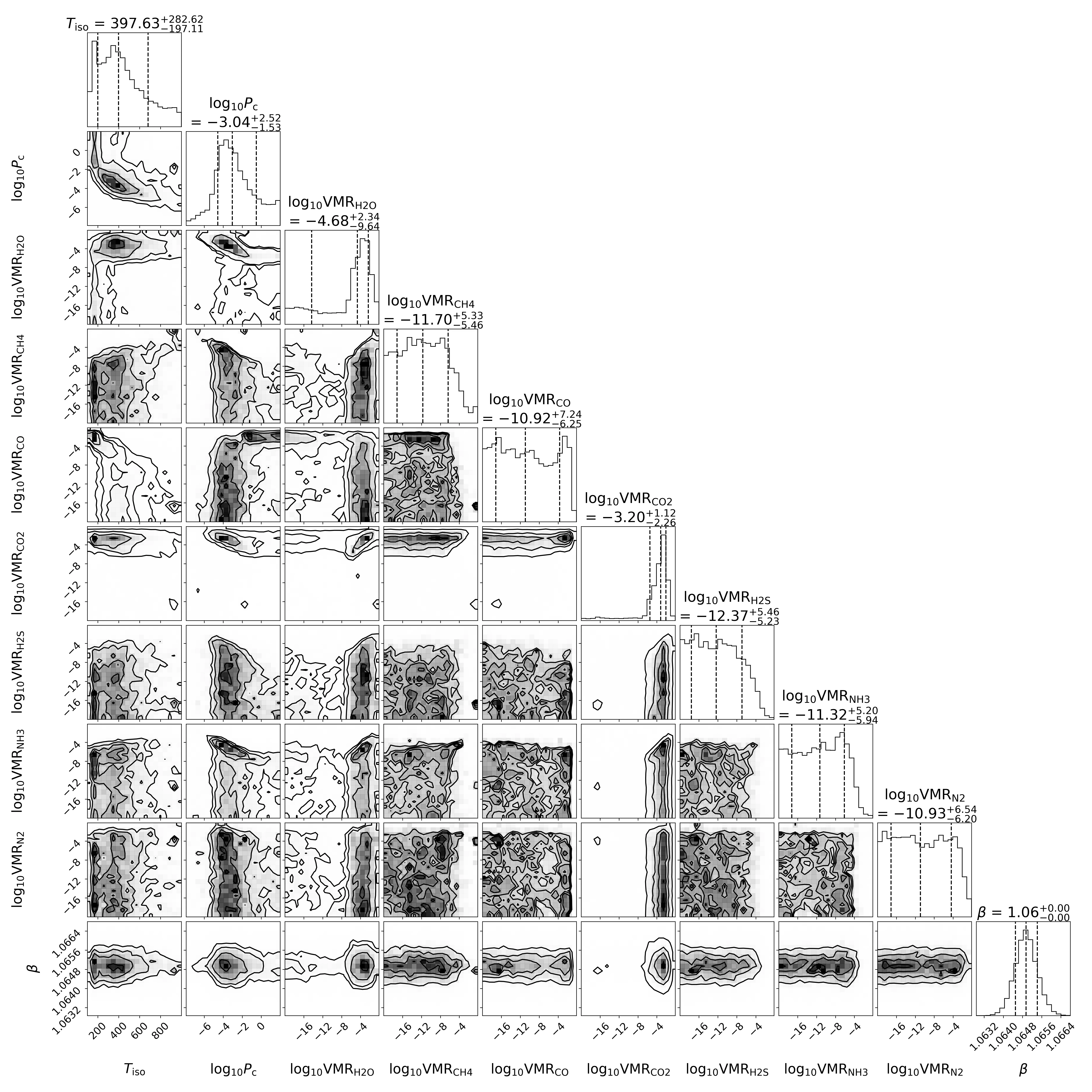
Only carbon dioxide gave a weak but noticeable voice. The signal was on the edge of randomness, but additional checks showed it appears exactly when the planet blocks the star, not at other times. The probability that this is just a coincidence is less than one percent. Further analysis allowed a rough estimate of the atmosphere's composition: it is likely rich in heavy elements (like metals in a star), has a layer of clouds or haze at a certain depth, and the temperature there is about 400 kelvins, like in a very hot oven.
This result does not shout; it whispers. It does not contradict earlier observations by the James Webb Space Telescope, which also hinted at carbon dioxide. Now scientists need more data to turn the whisper into a confident statement. If carbon dioxide is confirmed, GJ 1214 b will cease to be a faceless ball and will tell us how planets intermediate between rocky worlds and gas giants form and live.
Original abstract
as written by the authors arXiv:2604.15292
Sub-Neptune exoplanets frequently exhibit muted transmission spectra, with GJ 1214 b being the most prominent example. Following years of intense observing campaigns yielding featureless planetary spectra, recent observations with JWST revealed the first possible atmospheric signatures. We present high-resolution transmission spectroscopy of GJ 1214 b based on eight transits obtained with the CRIRES$$^+$$ spectrograph in the K band. We used SYSREM to remove telluric and stellar signals and searched for signatures of H2O, CO, CH4, H2S, NH3, and CO2 using the cross-correlation technique. We obtained non-detections for the first five molecules and used injection recovery tests to derive upper limits on the atmosphere. For CO$$_2$$ we measure a CCF signal at S/N ~ 3.6, with a detailed investigation showing no obvious indication that it is caused by correlated noise. A Welch t-test confirmed the in-trail and out-of-trail distributions to be different at $$3.4 \sigma$$ confidence. A Bayesian retrieval framework with free chemistry, resulted in volume mixing ratios corresponding to a metallicity of $$[\mathrm{M/H}]=0.48^{+0.89}_{-1.70}$$, an opacity deck pressure of $$\log_{10}(P_\mathrm{c}) = -3.04^{+2.52}_{-1.53}$$ and a planet temperature of $$T_\mathrm{iso}=398^{+283}_{-197}$$ K, consistent with a value intermediate between the day- and night-side T-p's derived from JWST data. While these values correspond to relatively large signal amplitudes predicted for CO2 features in the mid-infrared, they are compatible with JWST NIRSpec observations within the models' $$1.5\sigma$$ uncertainties. Further modelling and additional data are required to confirm the atmospheric signatures and obtain a comprehensive interpretation of low- and high-resolution data. Overall, our results support previous findings that CO2 is likely to be a significant component of the atmosphere of GJ 1214 b.
Carbon dioxide is not just an exhaled breath or a greenhouse gas. In the atmospheres of distant planets, it can be a major component, like nitrogen is for us, and may indicate a turbulent geological past.
In Stanislaw Lem's novel "Solaris," the ocean-planet also long resisted being understood, until it began interacting with researchers — though not with carbon dioxide at all.