How Invisible Hydrogen Is Rewriting the Chemistry of Space express
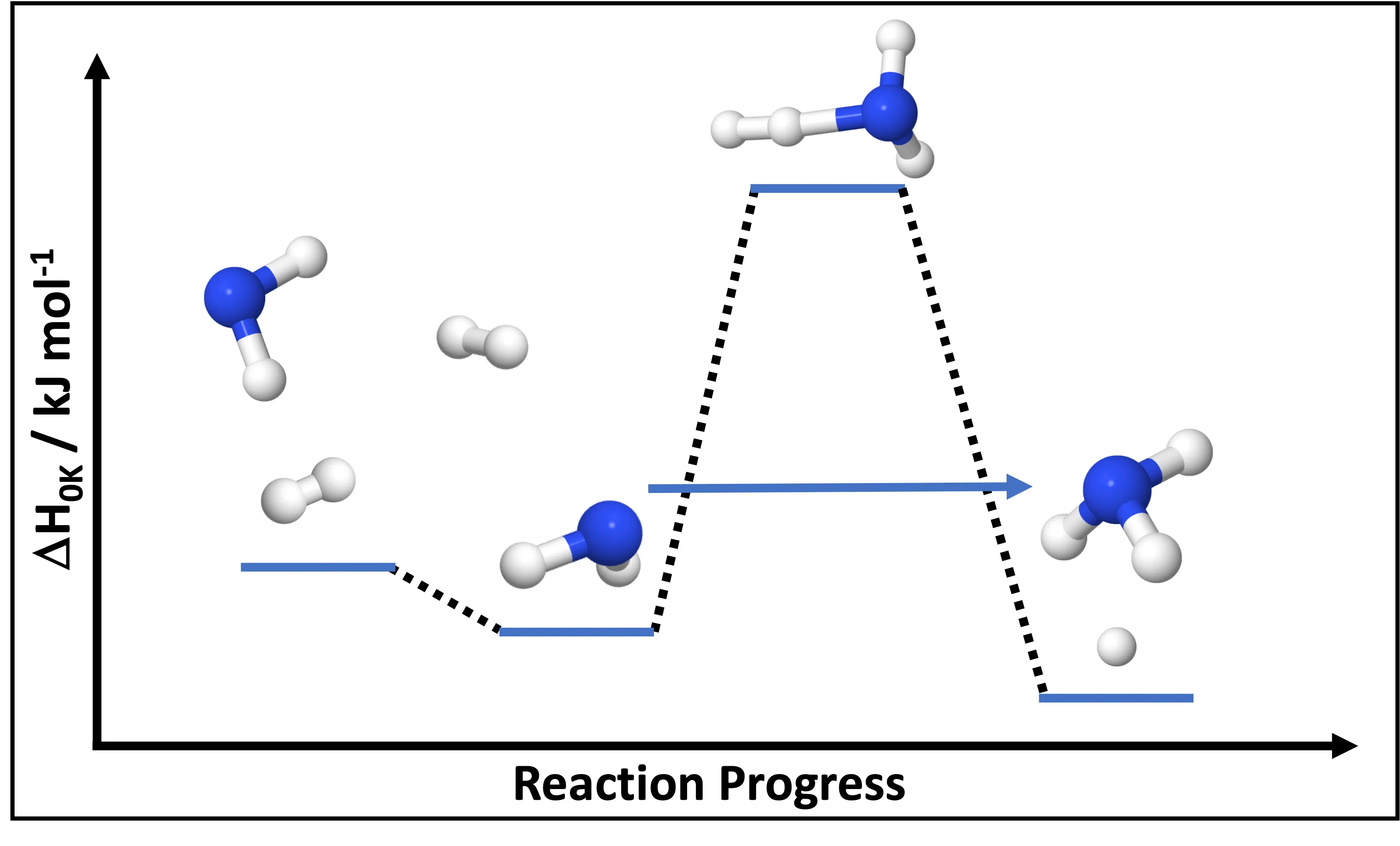
A ball rolls up a hill, but it doesn't have enough energy, so it rolls back down. That's classical mechanics for you. But in the quantum world, a tiny particle can sometimes pass right through the hill, as if the barrier weren't there. This trick, tunneling, is business as usual for a light atom like hydrogen.
In cold interstellar clouds, temperatures drop to about ten degrees above absolute zero. There's barely enough energy for chemical collisions, yet this is exactly where complex molecules are born — including aromatic ones, similar to benzene rings. The authors of this study checked how often a hydrogen atom pulls off its quantum stunt to speed up reactions with molecular hydrogen, H₂. They sifted through the large KIDA database and found 64 reactions where tunneling could play a role.
They studied the four most interesting reactions using new calculations of potential energy surfaces and the RRKM method. For the radicals C₂H, OH, and CN, the rates came out to 1.66×10⁻¹⁵, 8.17×10⁻¹⁶, and 3.15×10⁻¹⁶ cm³/s — vanishingly small numbers. But because H₂ is so abundant, these reactions still manage to process a significant fraction of the radicals and compete with other processes. For NH₂, however, tunneling didn't help: the rate is too slow even for cosmic scales.
The researchers then modeled how these accelerated reactions affect the abundance of aromatic molecules. They paid special attention to the cyclopropenylidene ion c-C₆H₅⁺—a key player in forming benzene rings. By varying the rates of reactions involving it, they obtained upper and lower bounds for aromatic concentrations in a typical molecular cloud. Hydrogen tunneling can noticeably shift these estimates, so our models of interstellar chemistry need updating to understand where complex organic molecules come from in space.
Original abstract
as written by the authors arXiv:2604.21892
Hydrogen atom tunneling likely plays a substantial role in the gas-phase chemistry of astrochemical environments. To determine the potential effect that it has on the chemical modeling of aromatic molecules, we screened the kida.uva.2024 network, and our own expanded network to find reactions which could be significantly accelerated by hydrogen atom tunneling in the ISM. In total, 64 reactions were identified. The hydrogen abstraction reactions from H$$_{2}$$ to four key interstellar radicals (C$$_{2}$$H, OH, CN, and NH$$_{2}$$) were studied further using newly calculated potential energy surfaces and RRKM analyses to determine rate coefficients for a temperature of 10 K and a density of 2 $$\times$$ 10$$^{4}$$ cm$$^{-3}$$. Despite having low rate coefficients of 1.66 $$\times$$ 10$$^{-15}$$, 8.17 $$\times$$ 10$$^{-16}$$ and 3.15 $$\times$$ 10$$^{-16}$$ $$\mathrm{cm^{3}\,s^{-1}}$$ the C$$_{2}$$H, OH, and CN reactions are competitive in the ISM, due to large overall rates caused by the high abundance of molecular hydrogen. The calculated value for the NH$$_{2}$$ reaction, however, was much smaller and found to be inefficient at ISM conditions. The possible effects of all other considered reactions were studied with simulations using calculated collision limit rate coefficients. Upper and lower bounds were then placed on modeled aromatic abundances using the most significant reactions. Due to the dependence of calculated aromatic abundances on reactions involving c-C$$_{6}$$H$$_{5}^{+}$$ and the recent questions surrounding its reactivity, we also explored the abundance variations caused by reactions leading to or involving c-C$$_{6}$$H$$_{5}^{+}$$.
At 10 K, most chemical reactions grind to a halt, but tunneling allows a hydrogen atom to seep through an energy barrier like water through cracks in stone — slowly, but inexorably.
In Peter Watts's novel Blindsight, alien life forms use quantum effects to survive in extreme environments — much like tunneling hydrogen helps build molecules in deep space.