A Black Hole's Shadow Depends on Polarization ✛ ✦
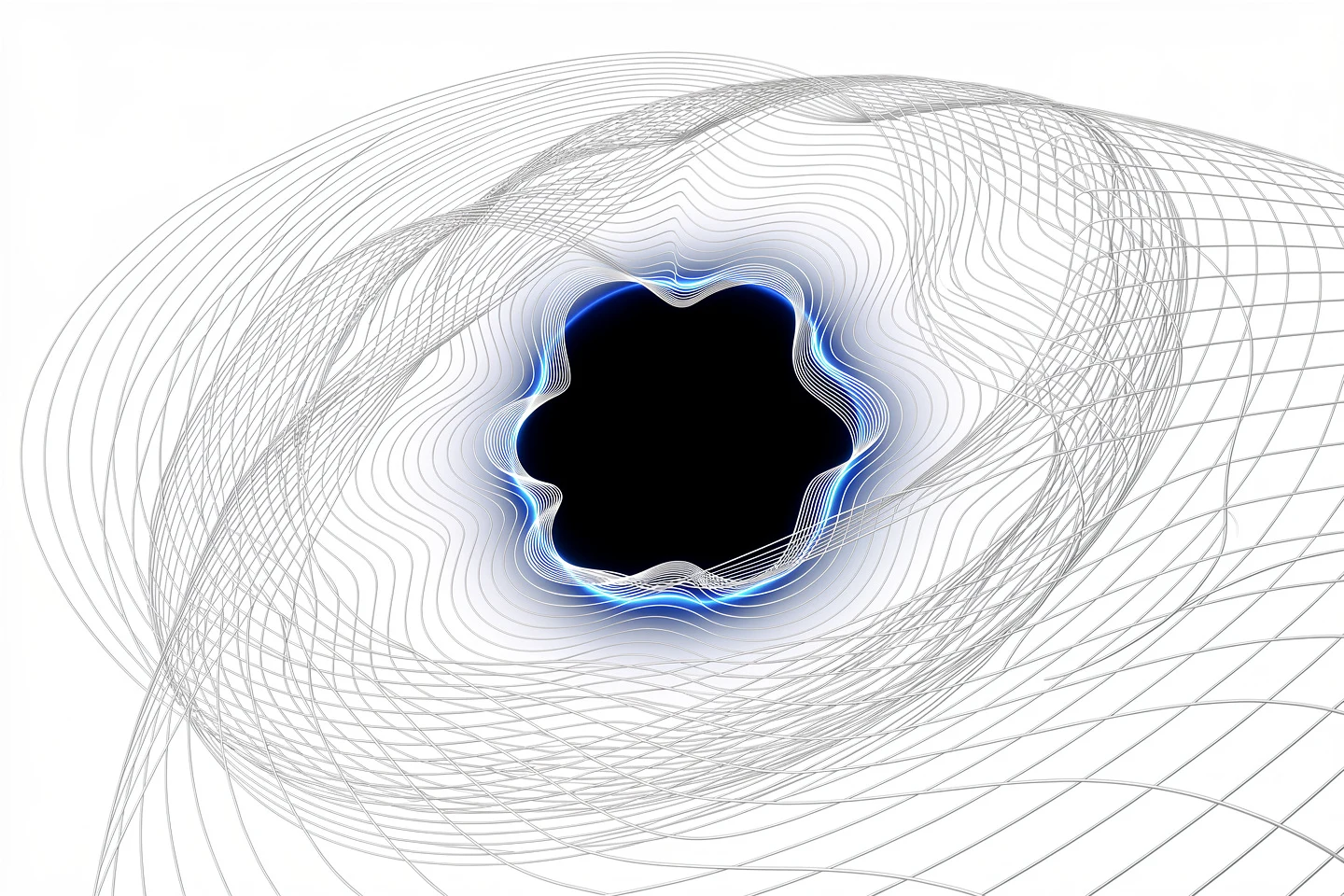
A black hole's shadow is a dark pit against the backdrop of gas, where gravity traps light. Light is a wave, like a rope shaken up and down or side to side. The direction of its oscillations is its polarization. A spinning black hole twists space into a whirlpool, and this whirlpool affects the wave differently depending on polarization: the shadow shifts. For a non-spinning hole, described by Schwarzschild, there is no shift — everything is symmetric.
The shift is tiny — about one ten-thousandth of the shadow's diameter, but for a real black hole, that's tens of kilometers, the size of a city. Computer simulations show that future radio telescope networks like VLBI (Event Horizon Telescope) will be able to capture it. Then the polarization pattern on the shadow will reveal the spin of black holes in the centers of galaxies. A similar effect in labs shifts laser beams by nanometers — that's the spin Hall effect. Thus, the ideas of Einstein add detail to the images obtained by Kip Thorne and colleagues.
In labs, this same effect shifts a laser beam by nanometers. The astronomical version shifts a black hole's shadow by tens of kilometers, comparable to the size of a city.
In the movie Interstellar, the shadow of the black hole Gargantua already reflects spin. Our finding opens up something new: polarization imposes an invisible pattern on the shadow, affecting its shape.