Simple

The Universe accelerates by devouring infant worlds

Original: "Can a late-time cosmological model based on baby universe absorption explain the z-variation of w?"
· Jan Ambjorn, Yoshiyuki Watabiki
arXiv:2605.15045v1 · 2026-05-14 · CC BY · ⏱ 1 min · General Relativity Cosmology HEP Theory
The accelerating expansion of the universe explained by swallowing other universes — as if the cosmos were a predator gaining mass with each victim.
Abstract

Our Universe may be expanding by swallowing tiny 'daughter' universes—like a large droplet absorbing smaller ones. This explains the accelerating expansion of the cosmos without mysterious dark energy. What's more, in the distant past, the expansion was even more unusual. Where do these baby universes go?

Links in the knowledge graph 1

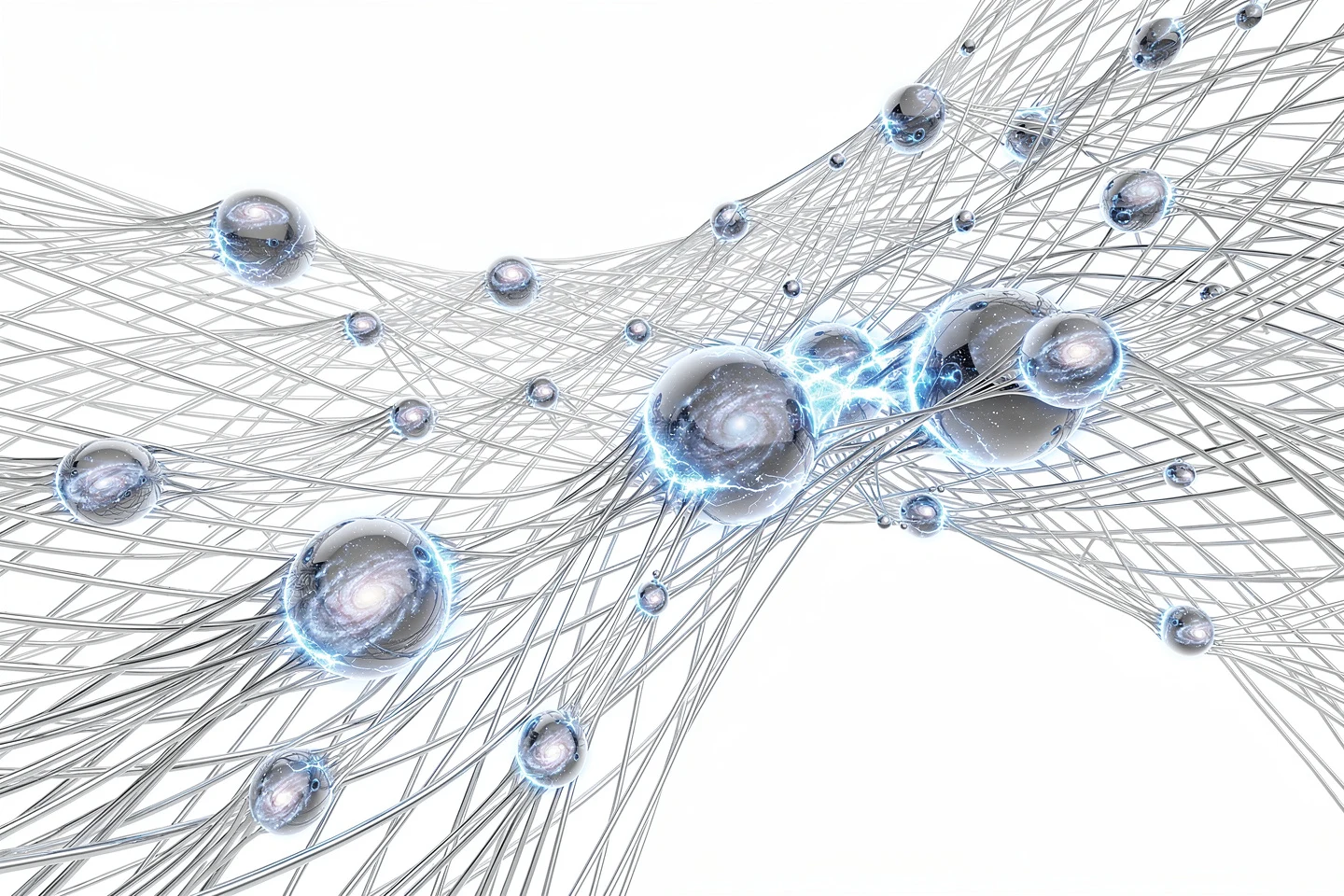
In the 1920s, Edwin Hubble noticed: distant galaxies are fleeing, the faster the farther they are — the Universe is expanding. The acceleration was attributed to dark energy. But a new model offers an alternative: our world is a cosmic predator, consuming infant universes from quantum foam. Each absorption adds volume, speeding up growth — like a predator bulks up with each prey.

This naturally explains the change in expansion rate: it shows in the reddening light of galaxies (redshift), supernova explosions, and the afterglow of the Big Bang (cosmic microwave background). The 'Hubble tension' — the discrepancy between local measurements by Adam Riess and predictions from the early Universe — is resolved. The idea isn't new: Stephen Hawking pondered quantum birth of worlds; now the model rests on quantum field theory and string theory. Gravity — mere spacetime curvature — describes motion in this feast. Even dark matter doesn't clash.

A surprising detail: calculations show mergers may occur every few seconds, each event imperceptibly stretching space.

🎯 According to calculations, right now somewhere in the depths of space our Universe is swallowing yet another microscopic world — and this happens every few seconds.

🎬 The idea echoes Isaac Asimov's novel 'The Gods Themselves,' where an interaction with another universe alters the laws of physics.

\left(\frac{\dot{a}}{a}\right)^2 = \frac{\kappa \rho(v)}{3} + \frac{\kappa \rho_f(v)}{3}
The expansion rate is determined by ordinary matter and the effective density from the merger of universes.
w_f = \frac{P_f}{\rho_f} = \frac{f(p)\left(\frac{2}{3}f''(p) - 1\right)}{\frac{1}{3}(f'(p))^2 - f(p)} - 1
Expression for w via the absorption function f(p); its evolution mimics dark energy with w < –1.
Scientists
Alan GuthAndrei LindeGeorges LemaîtreJames PeeblesAdam RiessBrian Schmidt
Tags
dark energy expansion of the universe redshift spacetime curvature supernova cosmic microwave background Quantum Field string theory big bang gravity dark matter
Laws
Friedmann equationsHubble's lawgravitational lensingNoether's theoremEinstein field equationsPlanck's law
Original: arXiv:2605.15045v1 · CC BY · bridge42worlds