The Devourer Universe: Dark Energy from World Mergers ✛ ✎ ✦
Cosmology is going through strange times. On one hand, the standard model with dark matter and dark energy beautifully describes the large-scale structure. On the other, it's cracking at the seams. Local measurements of the expansion rate using supernovae (the group of Adam Riess) give H₀ ≈ 72.6 km/s/Mpc, while the cosmic microwave background insists on 67. This 'Hubble tension' is not just a numerical disagreement but a gaping crack in the foundation. The latest data from the DESI survey add fuel to the fire: the equation of state of dark energy w seems to change with redshift z and dives below –1 in the past. The eternal and unchanging cosmological constant Λ is starting to look like a naive fairy tale.
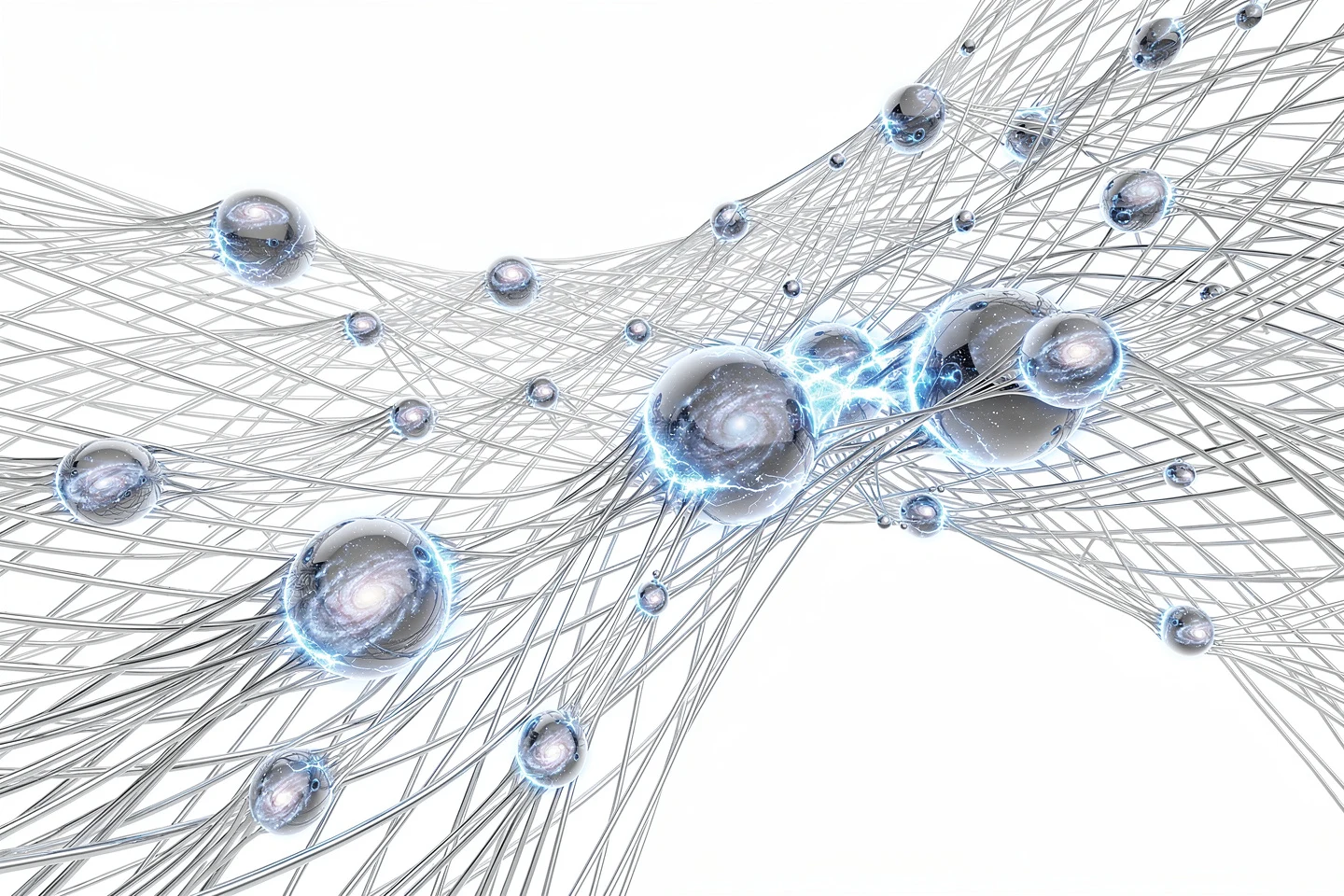
And then the image of a devourer universe takes the stage. Imagine space not as a passively growing bubble, but as an eternally hungry predator in the ecosystem of the multiverse. It grows not from within, but from without: it devours countless 'baby universes'—tiny closed worlds that quantum foam births in a continuous stream. This act of cosmic cannibalism is what we call dark energy. At the core of the model is a generalized Friedmann equation, where a term with the function f(p) describing absorption appears on the right:
Here $ρ_f$ is the effective density born from the merger of worlds. No Λ. Expansion accelerates because the universe constantly gains the flesh of others. The coupling constant g, calibrated by the local H₀, determines the appetite of our cosmic Leviathan.
What does such an exotic diet yield? Numerical solutions show that the effective parameter $w_f$(z) monotonically drops from –1.5 at high z to –1 in the future. The shape of the curve is surprisingly close to what is reconstructed from DESI data. The model works especially well at z > 0.8, where w becomes noticeably less than –1—exactly what observations hint at. However, at low z the predictions diverge from reality; fine-tuning is needed, perhaps by accounting for topological corrections in the spirit of the string coupling constant $G_s$. But the coincidence in shape is not an accident; it hints at a deep connection between the quantum birth of worlds and the fate of the cosmos.
Such a picture overturns the notion of dark energy. It ceases to be a fundamental constant or a property of the vacuum: it's a collective effect of interaction with the multiverse. The cosmological constant problem is naturally resolved: the observed dark energy density is small not because Λ is fine-tuned, but because the absorption intensity g is determined by quantum-gravitational processes like those described by string theory or quantum gravity. Our Universe is not an isolated island, but a node in a network of mutually devouring worlds. And its expansion is not the measured breath of the vacuum, but the predatory growl of a well-fed beast. Perhaps the most sensitive instruments will one day catch echoes of these cosmic feasts in the spectrum of the cosmic microwave background.
Ahead lies refining the model by including matter in the wave function calculation, deriving g from first principles, and joint analysis with baryon acoustic oscillations. Future missions like Euclid and the Roman Telescope will provide new data that will either strengthen this bold hypothesis or force us to seek other paths. But it's already clear: the key to the Big Bang theory and accelerated expansion may lie not within, but without — in how our world interacts with neighboring ones. And this forever changes the theory of gravity and our cosmic solitude — for now we have invisible neighbors that we devour every second.
If the model is correct, every second our Universe absorbs an unimaginable number of baby universes, and it's this continuous 'dinner' that makes it expand faster and faster.
The plot echoes Isaac Asimov's novel 'The Gods Themselves,' where contact with a para-universe gradually changes physical laws — though there it leads to catastrophe, here to accelerated expansion.