Catching a Sunset on a Distant Planet express
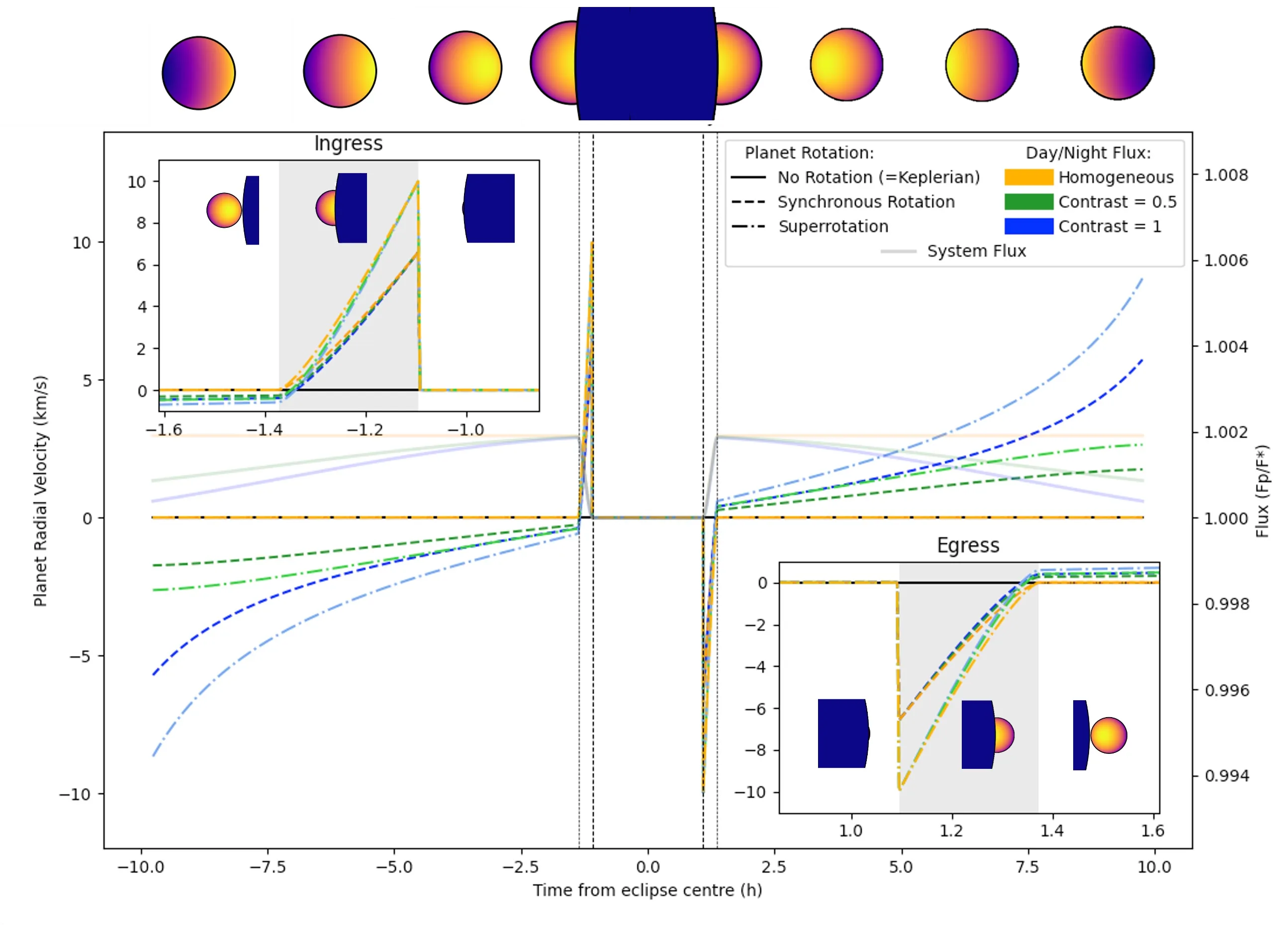
When a planet slips behind the edge of its star, the star backlights the planet's atmosphere, just as a setting sun illuminates clouds on the horizon. This brief moment, lasting only minutes, carries the imprint of the gases through which the starlight has passed. Astronomers pointed the SPIRou telescope at the WASP-33 system, where a scorching hot Jupiter completes an orbit in just 1.2 Earth days. To catch a faint hint of carbon monoxide (CO) in the spectrum, the star's light split into its component colors, they patiently waited through eight sunsets and sunrises.
Previously, such tricks were only possible with space observatories that look through broad color windows. Here, a ground-based instrument with high resolution did the job: it distinguishes shades as sharply as an artist distinguishes brushstrokes on a canvas. The price of detail is a weak signal. To amplify it, eight brief moments of ingress and egress were stacked together, like overlaying translucent images. And CO emerged. For the first time, from eclipse data alone, without hours of observing the full dayside.
This success is like a first tentative step toward three-dimensional atmospheric maps. So far, they've only managed to slightly better estimate the planet's rotation speed, but tests show that another fifteen or so such sunsets will yield a reliable number. And when next-generation telescopes come online, the method will allow us to peer into the cloud layers of dozens of hot Jupiters. The winds and chemical compositions of these worlds will be read from the edge of a dying star's light.
Original abstract
as written by the authors arXiv:2605.22931
In the last decade, ground-based high-resolution spectroscopy (HRS) has emerged as a powerful method to probe exoplanet atmospheres both in transit and thermal emission. With HRS science now maturing to reveal these planet's thermal, compositional, and dynamical structure in three dimensions, novel strategies will be key to extracting the maximal scientific output from these rich datasets. In this article, we investigate the potential of exploiting eclipses in order to retrieve spatial constraints on exoplanet dayside atmospheres with HRS, as has been successfully applied at lower spectral resolutions with space-based facilities. To attempt this, we obtained an observations of 8 eclipses (ingress and egress) of the ultra-hot Jupiter WASP-33b with SPIRou. We analysed these data with the publicly available ATMOSPHERIX pipeline, which we combined with the starry Python package to fit the eclipse mapping signal. Additionally, we performed injection-recovery tests on archival data to evaluate the detection limits that could be reached with further observations. From our data, we obtain the first tentative detection of CO from in-eclipse data alone, validating that ingresses and egresses may be stacked coherently to boost detection limits. In combination with longer phase-coverage dayside data, our eclipses marginally improve constraints on the planetary rotation velocity. Through injection recovery tests, we show that our results are scaling according to expectations for a synchronously rotating WASP-33b, implying that a further 15 eclipses with SPIRou would be required to measure the planet's rotation using this method. Finally, we present promising detection limits for this method on the population of hot-Jupiters with next generation telescopes, and highlight remaining challenges in data processing for short time series and/or slowly accelerating planets.
Carbon monoxide (CO) on Earth is a dangerous poison, colorless and odorless, but on scorching planets like WASP-33b, it becomes a handy marker: its signal in the star's spectrum is easy to distinguish and use to measure temperatures and atmospheric motions.