Cosmic Kitchen: How Neutron Star Collisions Cook Gold express
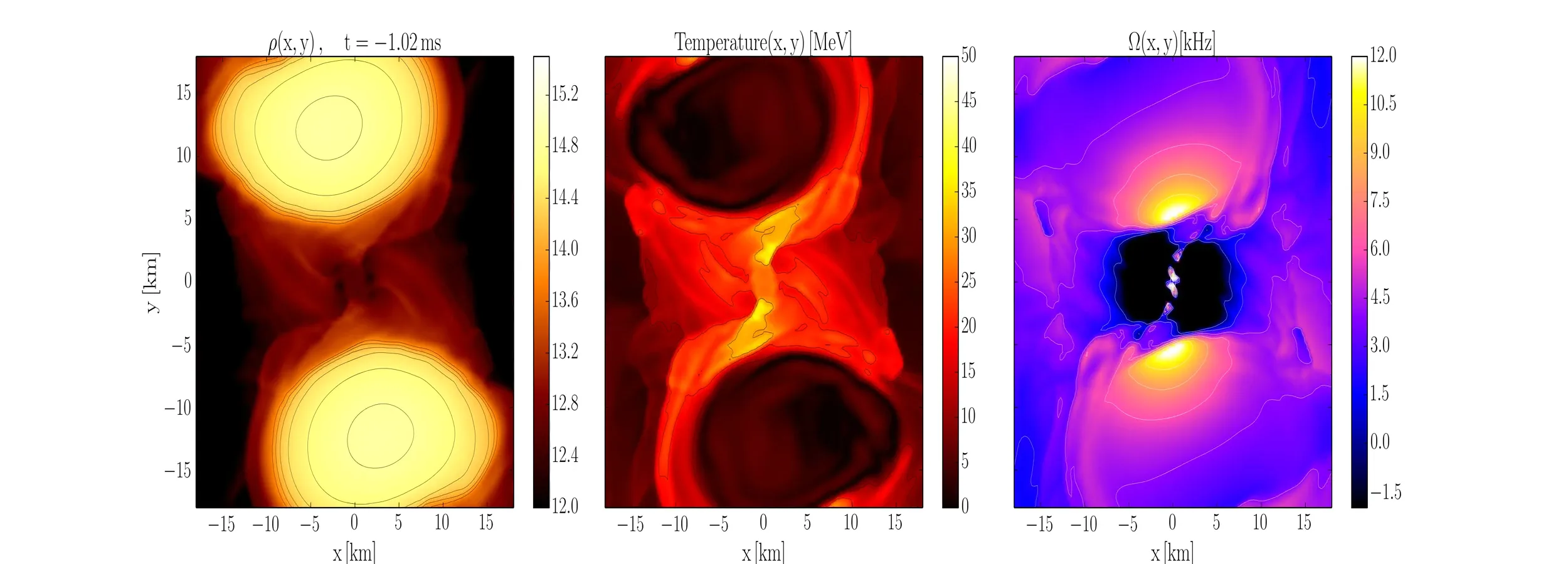
In 2017, detectors picked up a tremor in space — gravitational waves from the merger of two neutron stars. Telescopes immediately found a flash of light: a cosmic explosion astronomers dubbed a kilonova. In that fiery cauldron, it turned out, the heaviest elements of the periodic table are born — gold, platinum, uranium. But to understand exactly how that happens, we need to look inside matter itself.
A neutron star is a sphere the size of a city but with the mass of one and a half Suns. Its matter is packed so tightly that atomic nuclei are literally squeezed into each other. When two such stars spiral together, their material starts to flow and deform like putty under immense pressure. On the final orbits, tidal forces stretch each star, and the shape responds to the pull: this is called tidal deformability. It depends on how stiff or soft the matter inside the star is, i.e., on the equation of state — the master law describing superdense matter.
After the merger, a rapidly spinning blob remains — a remnant that can survive from milliseconds to a few seconds. Inside it, vortices rage, friction heats, and neutrino flows, ghostly particles that carry away energy, run wild. It is in these moments that the r-process kicks off: the rapid capture of neutrons by atomic nuclei. Neutrons pile onto a nucleus faster than it can decay, and step by step, the heaviest elements are built. The kilonova light we see is the glow of radioactive debris ejected by the explosion.
Today, physicists are assembling a mosaic from many pieces: gravitational-wave data, kilonova spectra, laboratory experiments with nuclei, and powerful computer simulations. All of it converges on one goal — to learn how matter behaves where even atoms cease to be themselves. And every new neutron star merger is another page in the Universe's recipe book.
A teaspoon of neutron star matter weighs about a billion tons — roughly the weight of all the cars on Earth squeezed into a single drop.
In Greg Bear's novel "The Forge of God," neutron stars collide, and a civilization tries to harness the process for travel across space and time.