Heavy Higgs Twin Hides in Four Jets express
Deep inside the detector at the Large Hadron Collider, protons collide, and for a fleeting moment something heavy is born. It instantly shatters into two Higgs bosons — particles that, like nesting dolls, each hide two pairs of b-quarks. Four streams of particles fly off in different directions, and the challenge is to recognize the trace of a single event among billions of similar ones.
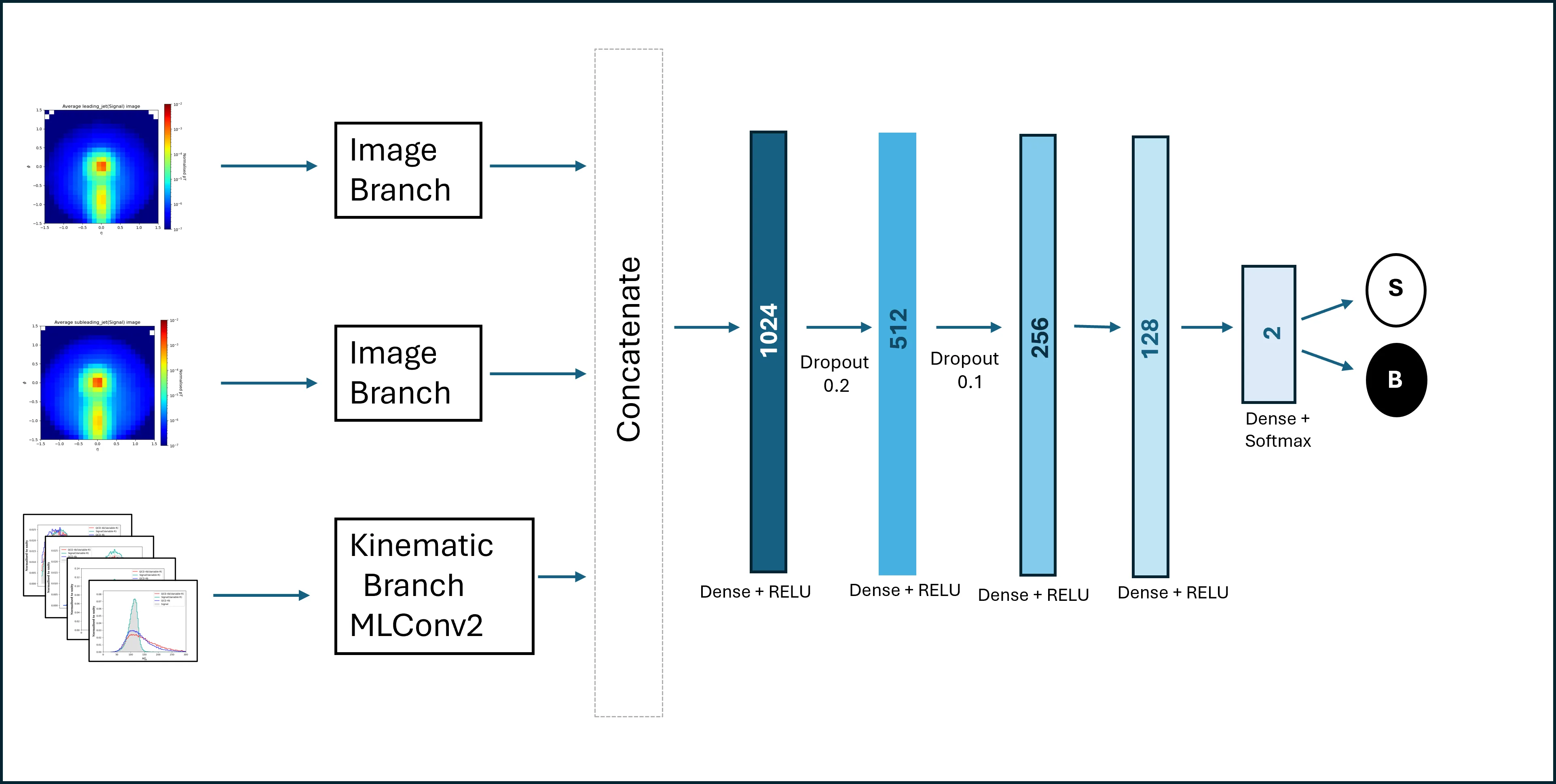
The authors chose a scenario where the production proceeds via vector-boson fusion (the carriers of the weak force). Two protons exchange these bosons and shoot forward light quarks, while a massive boson emerges between them. It belongs to an extended supersymmetric model, but what matters is not so much the specific variant as the search method. Instead of manually selecting events based on rigid criteria, the neural network learns directly from raw calorimeter data — the instrument that measures particle energies. It treats the energy deposition pattern as a whole, without discarding "extra" details.
This approach can pull the signal out of the noise where classical analysis might miss it. With an integrated luminosity of 300 inverse femtobarns (roughly corresponding to data collected over several years of collider operation), the statistical significance reaches 4.5 sigma — very close to the discovery threshold. The main achievement is not a specific number but the demonstration that deep learning can work directly with low-level detector information without losing sensitivity.
In the future, such a method could become a standard tool for searching for rare processes at colliders, where every extra signal is worth its weight in gold.
The Higgs boson is sometimes called the "God particle," but physicists themselves prefer the ironic "damn particle"—so hard was it to catch.
In Liu Cixin's novel "The Three-Body Problem," subatomic particles behave strangely due to the intervention of an extraterrestrial civilization, as if someone is tweaking the rules of the Standard Model.