An Invisible Speck Can Blow Up a Star ✛ ✦
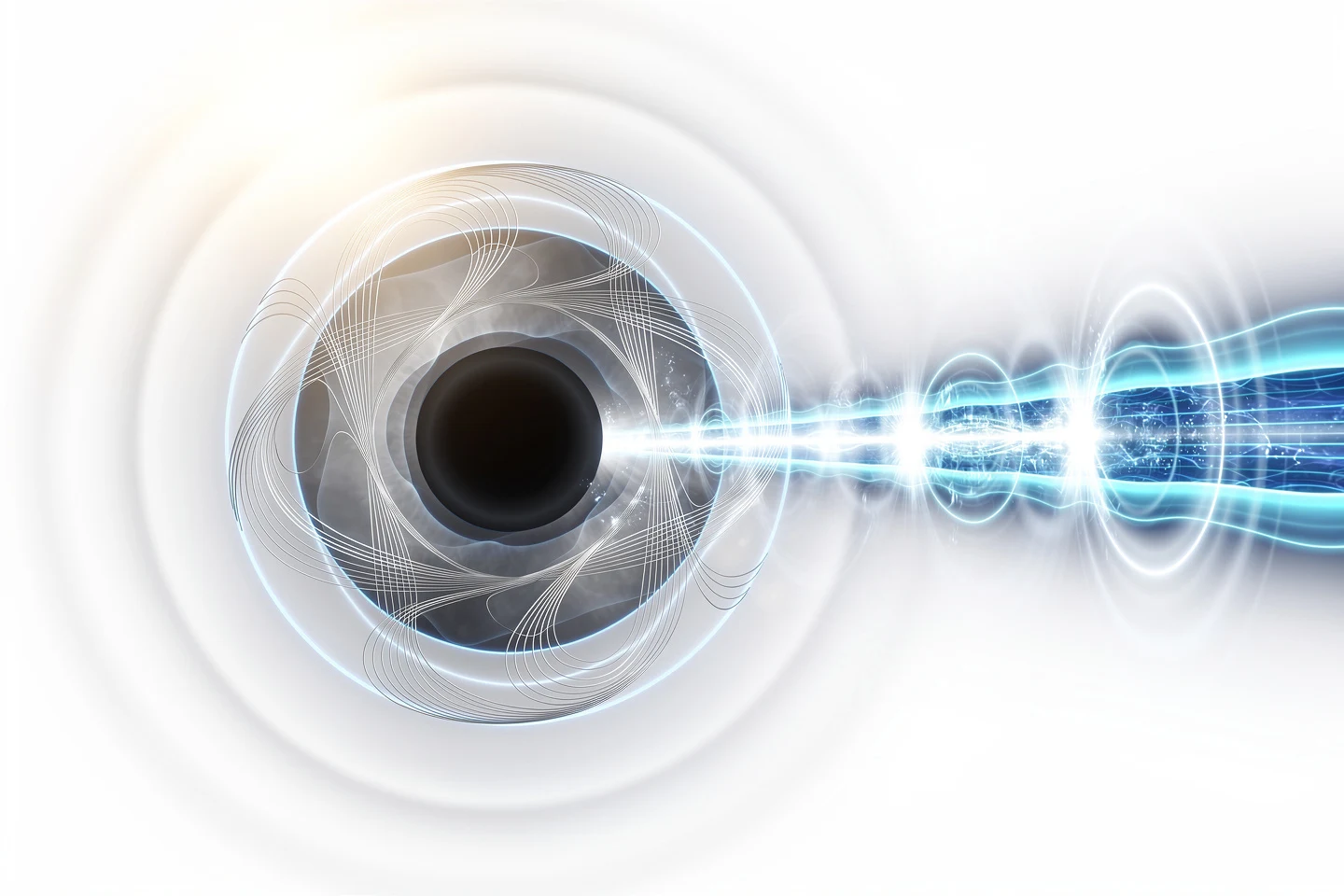
Almost all the matter in the Universe is invisible dark matter. A hunch by Stephen Hawking suggests it might be a swarm of tiny black holes: each with the mass of a large asteroid but smaller than an atom. Occasionally, such a speck gets captured by a star, like a red dwarf or even the Sun. A giant planet, an exoplanet akin to Jupiter, helps: its gravity brakes the hole and steers it into the star's interior. The journey to the center takes billions of years, the age of the visible Universe, as measured by Edwin Hubble. Subrahmanyan Chandrasekhar showed how friction with stellar gas makes the hole sink slowly.
Inside, the star becomes a bloated balloon, and the hole a pin stuck into it. If the pin stays still, the balloon deflates quietly — the star fades unnoticed. But if the gas swirls and spins the hole, the pin twists, and the balloon bursts. In mere minutes, the erupting jets rip the star apart in a dazzling supernova without a lingering radioactive tail. Half of these duos die quietly, half blaze like fireworks. These flashes likely explain rare mysterious events, and their echoes, gravitational waves, are picked up by detectors such as LIGO. The most astonishing part: a fleeting flash from an atom-sized black hole can, for a moment, outshine an entire galaxy, betraying the secret of dark matter.
In just minutes, the jets from a baby black hole release more energy than the Sun will in its entire lifetime.
Science fiction has already played with this idea: in Arthur C. Clarke's 'Rendezvous with Rama,' aliens use a black hole as an engine.