Smoldering Ember in a Star’s Heart: Two Apocalypse Scenarios ✛ ✦
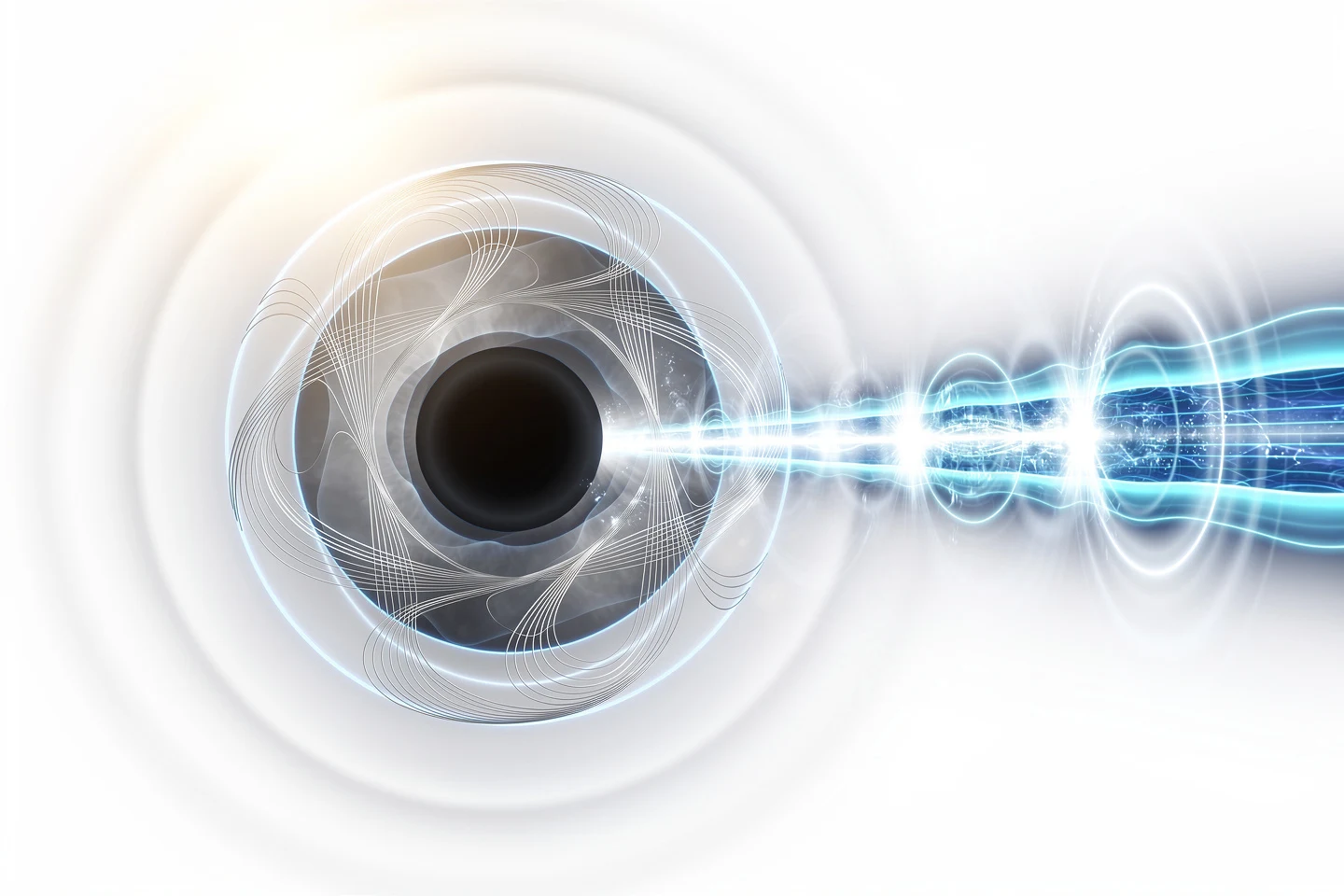
In the silent theater of the cosmos, a star’s life plays out over billions of years. But sometimes an invisible director sneaks onto the stage — a primordial black hole. This clump of dark matter, born in the first second of existence (as predicted by Stephen Hawking), with the mass of an asteroid and the size of an atom, can be captured by a star. Once inside, it slowly, like a smoldering ember beneath a velvet curtain, begins its journey to the core. Two finales await this stellar drama: a quiet fading or a deafening fireworks display that blows the roof off the theater.
Capture is a matter of chance and gravitational dance. Without a third partner — a giant planet (exoplanet)—the odds are negligible. Only the tidal forces of a gas world, like Jupiter, can slow down the wandering hole and lure it into the star’s gravitational trap. Then begins a slow migration to the center through dynamical friction — an effect mathematically described by Subrahmanyan Chandrasekhar. Over a timescale comparable to the Hubble time (discovered by Edwin Hubble), the hole reaches the core. In the core, the black hole triggers Bondi accretion: matter falls in almost spherically, but efficiency is low — the ember barely glows. If the hole doesn't gain enough angular momentum during the star's lifetime, the show ends without applause: the star quietly fades, and the hole remains in its remnants.
With the disk comes a magnetic field awakening, and jets ignite — relativistic plasma beams blasting along the spin axis. Their power, described by the Blandford–Znajek mechanism, reaches 10⁵⁰ erg/s — for a brief moment, brighter than an entire galaxy. In minutes, such a jet ejects more energy than the Sun will emit over its entire 10-billion-year life. The hole’s spin skyrockets to 0.8, and stellar matter scatters like a curtain ripped away by a hurricane. The flare is registered as a low-luminosity gamma-ray burst, with an ultraviolet peak and radio afterglow. No radioactive tail, typical of an ordinary supernova, just the clean signature of gravitational waves picked up by observatories like LIGO. Such a star death, ignited from within by dark matter, could explain some puzzling transients in astronomical archives.
This hypothesis weaves together three great mysteries: the nature of dark matter, the mechanisms of stellar explosions, and the origin of intermediate-mass black holes. If swarms of primordial black holes with asteroid masses indeed roam the Universe, then every red dwarf star or even our own Sun potentially carries such a parasite within. We may suspect nothing until next-generation gravitational-wave observatories hear the death chord of a star-devoured companion, and wide-field telescopes spot a flare where a harmless point of light shone just yesterday. The theater of the Universe is always full of invisible dramas: we just need to learn to watch and listen.
If a primordial black hole of 10¹⁶ g mass lurked in the Sun’s center, it would grow so slowly that the disk stage would only arrive after 10 billion years. We wouldn’t even notice — until the very finale.
The image of a star devoured from within echoes Arthur C. Clarke’s novel Rendezvous with Rama, where an alien ship uses a black hole as an engine. And in Star Trek (2009), red matter creates black holes inside planets, causing them to implode.