Record Silence in the Search for Dark Matter ✛ ✦
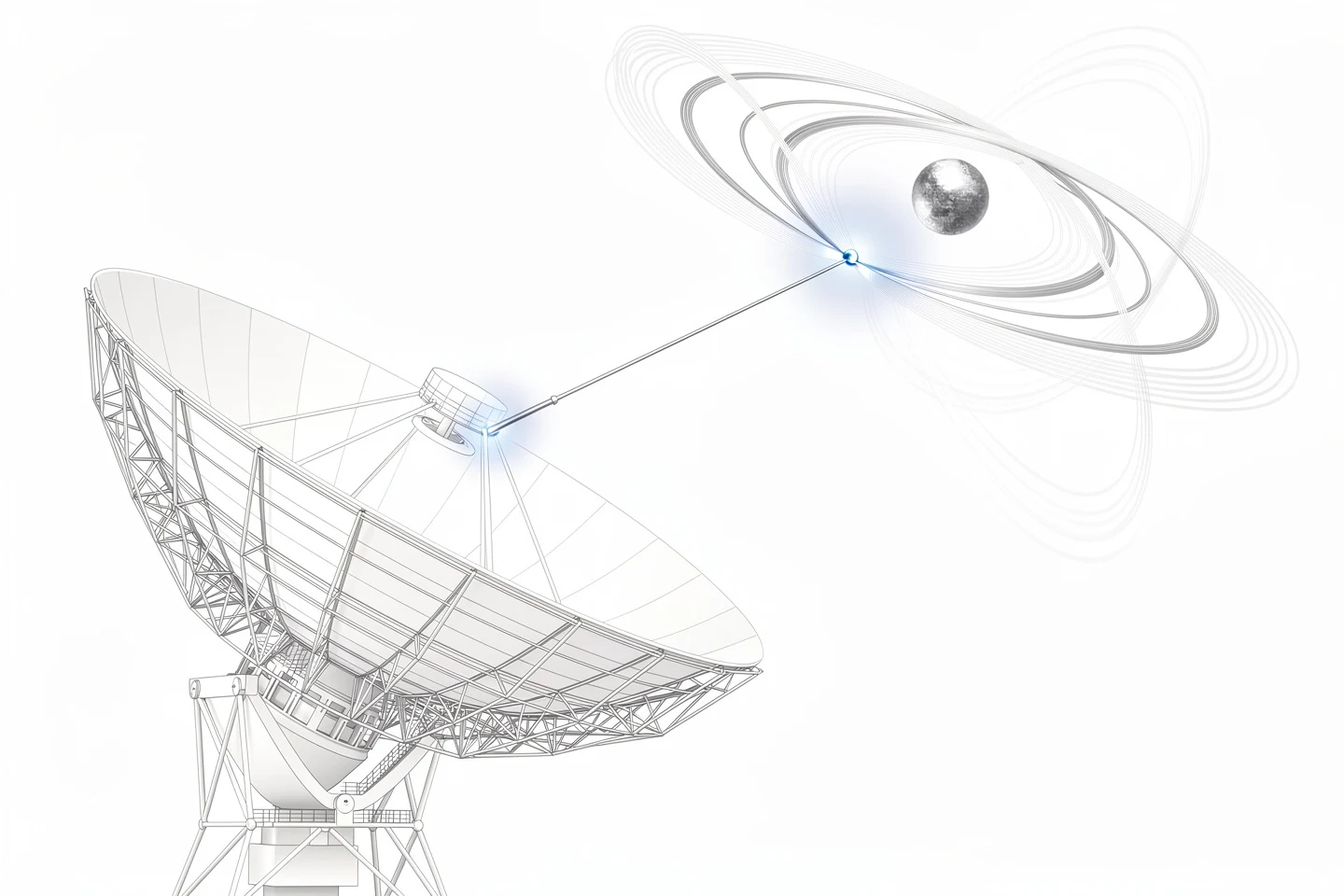
Dark matter is the invisible framework of the universe, five times more abundant than ordinary matter. Fritz Zwicky suspected its existence, and Vera Rubin proved it. One hypothesis suggests its particles might transform into radio waves as they fly through the powerful magnetic fields of neutron stars — the remnants of dead stars, discovered by Jocelyn Bell Burnell and compressed to the size of a metropolis.
Scientists decided to 'eavesdrop' on this whisper. The FAST radio telescope, so sensitive an 'ear' it could pick up a phone call from the Moon, was aimed at two neutron stars. Using spectroscopy (breaking the signal into notes, like in a musical score) they searched for a single faint 'note' at a known frequency.
The result was a deafening silence. Not a hint of a signal. But this very silence was the breakthrough: a record-low limit was set on the interaction of dark matter with light. This 'nothing' links quantum theory with observations of galaxies and hints that invisible particles, born in the Big Bang, still wander the cosmos, occasionally 'powering up' pulsars — spinning neutron star beacons.
Although dark matter is invisible, hundreds of its particles pass through every square centimeter of your palm every second — unnoticed by us.
The search for dark matter signals echoes the ideas of Liu Cixin's novel 'The Dark Forest,' where hidden forces influence the cosmos.