Hunting for Axions in the Magnetospheres of Neutron Stars with FAST ✛ ✦
Context
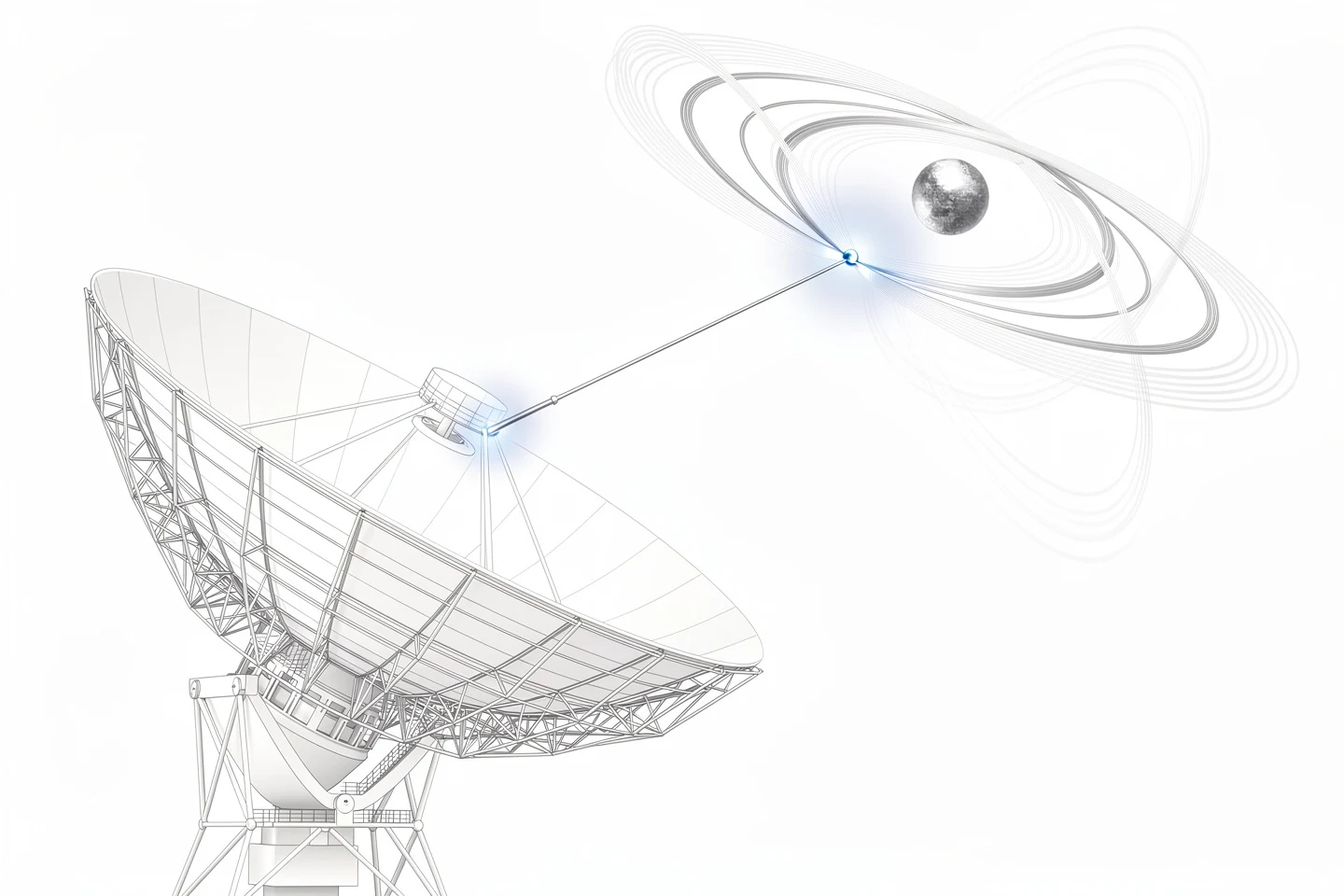
The nature of dark matter remains one of the biggest unsolved puzzles. Back in the 1930s, Fritz Zwicky noticed that galaxy clusters behave as if they contain far more mass than meets the eye, and later Vera Rubin confirmed this for galaxy rotation. One of the most elegant candidates is the axion—a featherweight particle emerging from the solution to the CP problem in quantum field theory. If axions make up the dark halo of our Milky Way, they could reveal themselves through a rare interaction with electromagnetism: in the ultrastrong magnetic fields of neutron stars, an axion can morph into a photon with a frequency matching its mass. The discovery of pulsars by Jocelyn Bell Burnell showed that neutron stars are ideal laboratories for extreme physics. This process, known as the Primakoff effect, offers a chance to ‘hear’ dark matter with radio telescopes.
Methods
For the axion hunt, the team used FAST, the world’s largest radio telescope with a 300-meter aperture. Its 19-beam L-band receiver was aimed at two X-ray-faint isolated neutron stars—RX J1605.3+3249 and RX J1308.6+2127—chosen for their maximum expected signal. Observations were carried out in the 1.0–1.5 GHz band using position-switching (‘on-off’): 5-minute alternating phases on the target and on a blank sky patch for precise background subtraction. After calibration, radio-frequency interference removal, and baseline fitting, a matched-filter technique with Gaussian templates was applied to pick out narrow spectral lines of axion origin. High-resolution spectroscopy (down to 0.48 kHz) enabled a search for the characteristic peaks of axion-photon conversion.
Results
Unfortunately, no clear signal above 5σ was spotted. But this non-detection allowed the team to set stringent new limits: the axion-photon coupling constant $g_{aγγ}$ is constrained to be less than 5×$10^{-12}$ GeV^{-1} for axion masses between 4.14 and 6.20 μeV (corresponding to the observation frequencies). The achieved sensitivity is the best among all studies using the axion-conversion-line method from neutron stars. For comparison, lab experiments like ADMX give tighter bounds, but the neutron star approach is completely independent and tests dark matter in its natural gravitationally bound habitat.
Implications
This result shrinks the allowed parameter space for axions and axion-like particles, constraining theoretical models of quantum field theory and the early universe. It confirms that radio spectroscopy with the largest telescopes can rival laboratory setups in the search for new physical interactions, and paves the way for combined data analyses across different observatories.
Future development
Looking ahead, longer observations are planned not only with FAST but also with the SKA, boosting sensitivity. Improving models of neutron star magnetospheres, accounting for general relativity and signal polarization, will help pinpoint the sought-after line. The search will also expand to other promising targets, including pulsars and magnetars, especially near the Galactic center where higher dark matter density is expected.
Impact
The work impacts cosmology, particle physics, and radio astronomy, demonstrating a powerful interdisciplinary approach to the hidden mass problem.
Next steps
The next step is joint data processing from multiple radio telescopes and the use of polarization measurements.
Key open problems
Beyond the nature of dark matter, axions are linked to solving the strong CP problem in quantum chromodynamics, and their presumed birth in the early universe makes them a crucial bridge between microphysics and cosmology.
The knowledge machine's view
This section is addressed to the author of the paper and their colleagues. Neighbouring works were found by meaning-based search across our archive, not by word overlap. We do not review: we show the field around the work.
What the work does
The study used the 300-meter FAST radio telescope to search for narrow spectral lines from axion-to-photon conversion in the magnetospheres of two isolated neutron stars. Observations in the L-band (1.0–1.5 GHz) with high spectral resolution and matched filtering revealed no signal above 5σ, allowing an upper limit on the axion-photon coupling constant g_{aγγ} < 5×10^{-12} GeV^{-1} for axion masses of 4.14–6.20 μeV.
Where its strength is
This achieves record sensitivity among radio astronomical searches for axion-conversion lines from neutron stars, demonstrating the potential of the largest radio telescopes for independent tests of axion models in astrophysical settings.
Where it could go next
- It might be interesting to compare the obtained constraints with predictions for axion-photon conversion over a broader parameter range, considering non-standard models discussed in the work on lensing in neutron star interiors.based on: A Lens in the Depths: Why the Axion Limit Isn't Afraid of Exotics arXiv:2606.07742v1
- A related approach uses laser experiments to search for axions via light-shining-through-walls; comparing sensitivities and potential synergies between methods could point to complementary parameter regions.based on: Laser Vortex Spawns Axions: When Light Vanishes in Air arXiv:2607.11589
- One could consider combining radio astronomical searches with neutrino observations, as in the work on neutrino telescopes and dark matter, for cross-checking signals from axion-like particles.based on: Symphony of Shadows: Neutrino Telescopes Catch the Whisper of Dark Matter arXiv:2607.05335v1
Worth trying
- Consider extending the search to other isolated neutron stars with known magnetic fields and distances, using X-ray source catalogs.
- Apply more sophisticated line profile models that account for stellar rotation and gravitational redshift to improve sensitivity.
- Investigate the possibility of stacking data from multiple neutron stars to enhance statistics.
Why this may matter
Such searches independently probe the existence of axions in a mass range that is difficult to access with laboratory experiments, and could play a key role in identifying dark matter if axions are detected.
Nearby works in our archive
- A Trap for Invisible Axions: A Magnetic Detectorsimilarity 0.66
- Listening for the Unseen: Hunting Axions in Stellar Cataclysmssimilarity 0.66
- A Levitating Dust Grain Hunts Invisible Mattersimilarity 0.64
- Laser Vortex Spawns Axions: When Light Vanishes in Airsimilarity 0.64
- How Solar X-rays Catch Invisible Particlessimilarity 0.64
- Dark Matter Speaks in Radio Wavessimilarity 0.63
- A Lens in the Depths: Why the Axion Limit Isn't Afraid of Exoticssimilarity 0.63
- Symphony of Shadows: Neutrino Telescopes Catch the Whisper of Dark Mattersimilarity 0.63
The closest work in the archive sits at 0.66 by meaning — the usual level for our corpus.
Original abstract
as written by the authors arXiv:2606.17067v1
The axion is a well-motivated dark matter candidate, which can convert into narrow radio spectral lines via the Primakoff effect in the strongly magnetized magnetospheres of neutron stars. This provides a novel astrophysical probe for axion searches that is complementary to laboratory experiments. Using FAST, the world's most sensitive single-dish radio telescope, we observed two X-ray dim isolated neutron stars (RXJ1605.3+3249 and RXJ1308.6+2127) within its sky coverage, which are predicted to yield the strongest axion-conversion spectral lines (ACL). Although no significant signal was detected at the 5 sigma confidence level, we establish new upper limits on the axion-photon coupling constant g_{a gamma gamma} less than or similar to 5 x 10^{-12} GeV^{-1} for axion masses ranging from 4.14 to 6.20 micro-eV corresponding to the 1.0-1.5 GHz observational band. This result constitutes the tightest constraint in this axion mass range among all existing studies employing the same ACL-based method.
FAST is so sensitive it could pick up a cellphone signal from the Moon — if it weren’t for all the radio interference.
The idea of catching dark matter turning into light resonates with Liu Cixin’s novel The Dark Forest, where fundamental interactions reshape the very fabric of reality.
Key numbers
- Upper limit on g_{aγγ}: ≲5×10-12 GeV^{-1}
- Axion mass range: 4.14–6.20 μeV
- Observation frequency range: 1.0–1.5 GHz
- Neutron star magnetic fields: >1013 G
- FAST sensitivity (system temperature): ≈20 K