Message from the Invisible World: FAST Listens to Axions ✛ ✦
The story began with a puzzle: in the 1930s, Fritz Zwicky noticed that clusters of galaxies behave as if an enormous invisible mass is hidden within them. Half a century later, Vera Rubin confirmed that stars on the outskirts of galaxies rotate too fast to be held by visible matter alone. Thus was born the mystery of dark matter — the invisible framework of the universe. Among the candidate particles, the axion stands out for its dual elegance: it solves the CP invariance problem in quantum chromodynamics and naturally arises in the right amount after the Big Bang, filling the universe with a cold, almost elusive gas. By some estimates, if they exist, trillions of these particles fly through every square centimeter of your body each second — without you noticing.
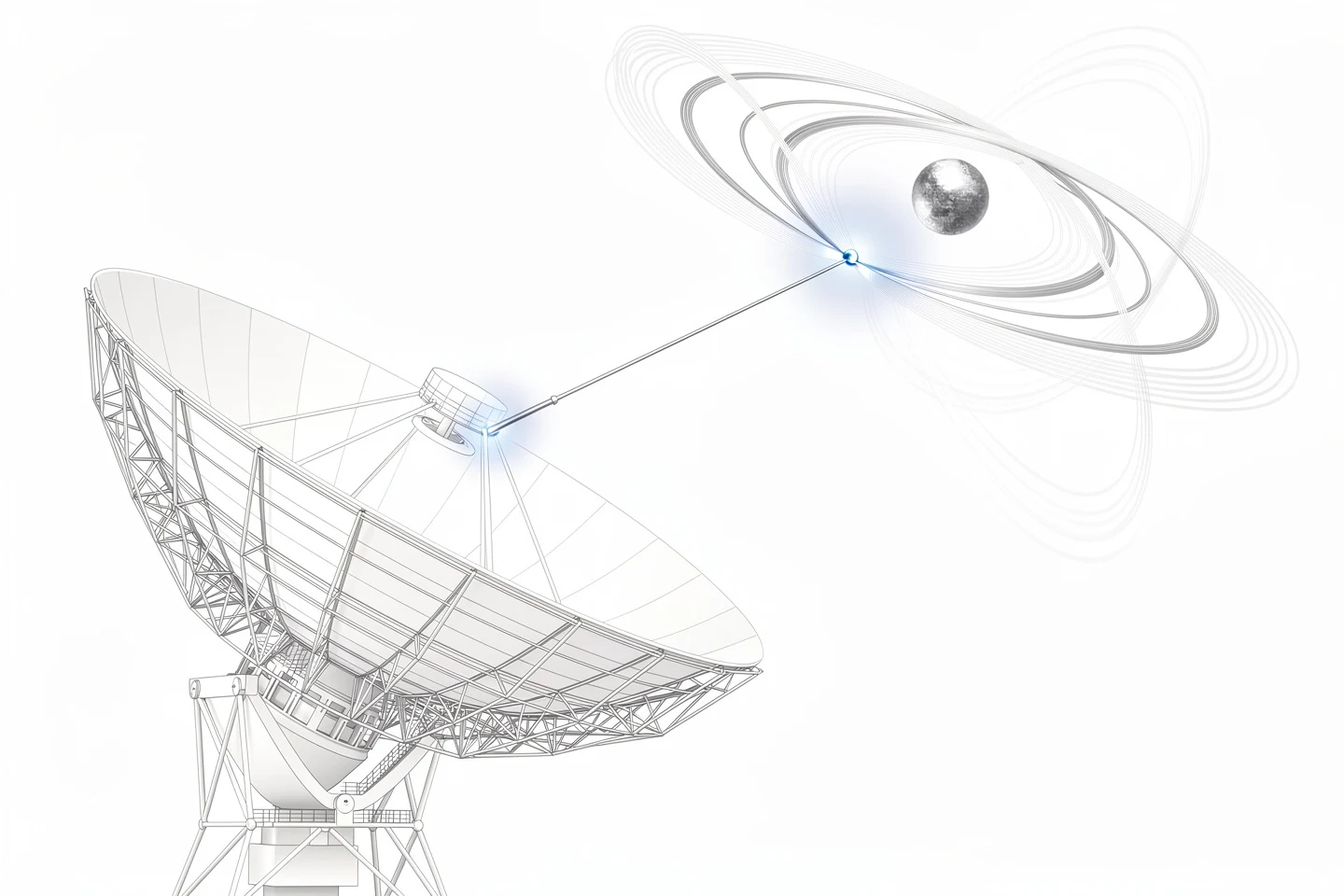
The universe stages a grand radio concert, and the lead is played by the silent orchestra of dark matter. Axions are its noiseless violins; their music is everywhere, but earthly antennas cannot catch it. However, nature has placed decoders: neutron stars. Discovered by Jocelyn Bell Burnell, pulsars showed that these are objects with monstrous magnetic fields, where axions can turn into photons of a strictly defined frequency. This effect is like an echo in a magnetic canyon: the silent whisper of the axion field, hitting a barrier, gains a voice — a narrow spectral line. It is this voice that radio spectroscopy tries to hear.
With its 300-meter dish, FAST is the world's most sensitive radio telescope. It targeted two isolated neutron stars — RX J1605.3+3249 and RX J1308.6+2127 — because their magnetospheres promised the loudest signal. A 19-beam receiver scanned them for hours, alternately listening to the target and the empty background to subtract all interference. Matched filtering scanned the spectrum for the finest peak — the axion's fingerprint. Result: silence at a significance level above 5σ. But this is dramatic silence. It allowed, for the first time, lowering the upper limit of the axion-photon coupling constant to 5×$10^{-12}$ GeV^{-1} in the mass range of 4.14–6.20 μeV — a record for astrophysical methods.
The result squeezes the space of allowed parameters where theories had hidden axions. It proves that radio spectroscopy competes on equal terms with laboratory setups like ADMX, but tests the hypothesis in natural conditions, where dark matter is held by gravity. Ahead are surveys with SKA, joint data analysis, and accounting for polarization, which might reveal a weak signal even in noise. Perhaps we are not just combing a cosmic haystack, but tuning a receiver to the frequency at which matter speaks with its dark twin. The next communication session lies beyond the horizon of current technology.
The FAST radio telescope is so sensitive that it could pick up a signal from a mobile phone operating on the Moon, were it not for radio frequency interference.
Capturing the conversion of dark matter into light is a plot worthy of Liu Cixin's novel 'The Dark Forest,' where fundamental interactions rewrite reality.