How Stratospheric Weather Alters Particle Counters Deep Underground express
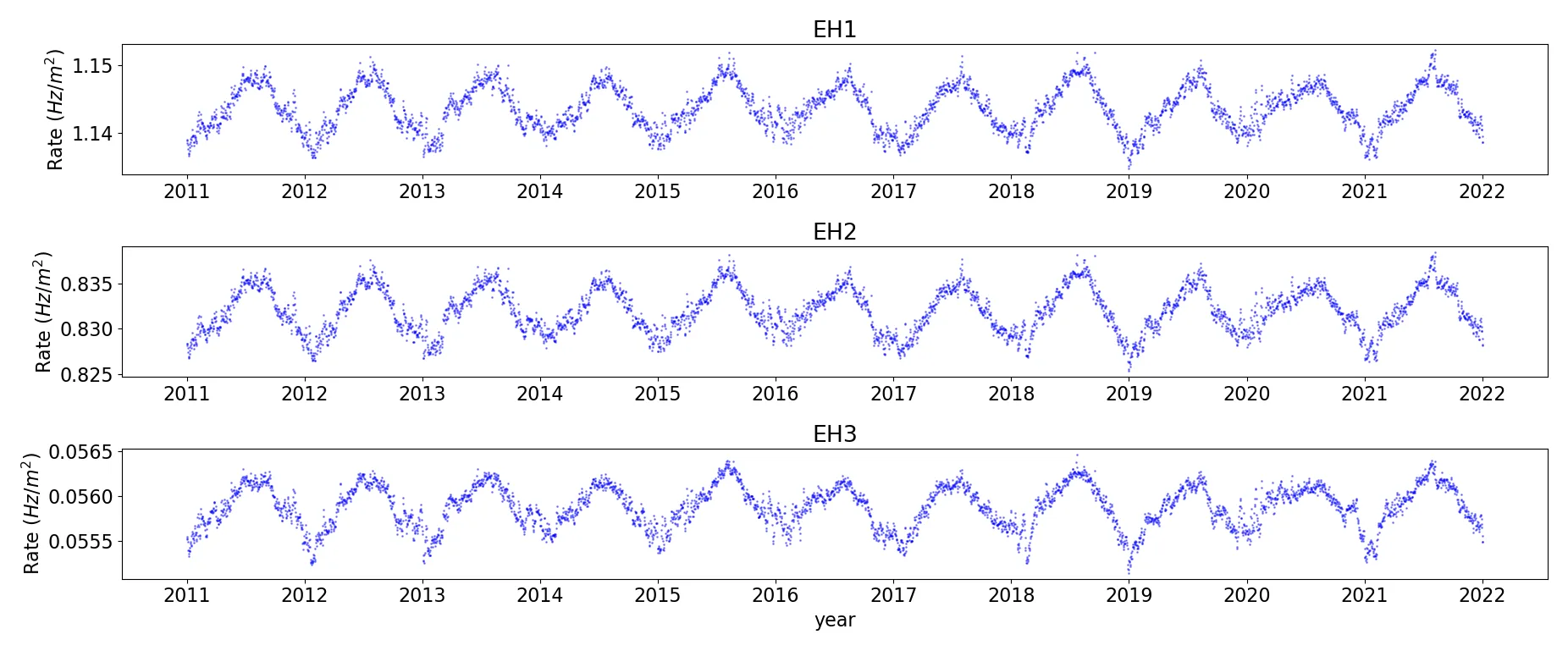
Deep underground, in the thickness of granite, detectors catch rare visitors from space — muons. These particles are born high in the atmosphere when cosmic rays slam into air nuclei. They make it to the underground lab thanks to their enormous speed, close to the speed of light. But the journey isn't easy: along the way, a muon loses energy and can decay before reaching the detector. And here's the surprise — a muon's chances of survival depend on the air temperature above.
Previously, this was explained simply: when the air warms, it expands, density drops, and muons are born a bit higher, where it's easier for them to accelerate. But in the Daya Bay experiment in China, a nonlinearity was seen — the graph didn't follow a straight line but had a kink. The authors of the new work realized that old calculations only looked at the "kitchen" where muons are prepared, forgetting about the "road" through the entire atmosphere. They accounted for how temperature changes with altitude and derived more general equations where each layer of air contributes its share.
To test the idea, the scientists used the MCEq program, which simulates the birth and passage of particles in the atmosphere, and fed it real temperature data from weather balloons. The result matched expectations: the dependence became straight, as theory predicted. This isn't just a mathematical exercise — many neutrino observatories, including IceCube at the South Pole, use similar corrections to separate signal from atmospheric noise. The new calculation scheme promises to be more accurate, and thus help hear the fainter whisper of distant supernovae or black holes.
The muon is a true champion of penetration: it can fly through a kilometer of rock before stopping. Every second, about one such "heavenly messenger" passes through your palm.