An Ion Beam Scalpel for Superconducting Circuits express
A potter uses a sharp stylus to trace a pattern on a still-damp clay tile. One wrong move, and the line blurs, the tile cracks. Physicists work with films of the high-temperature superconductor YBCO (a compound of yttrium, barium, copper, and oxygen) in much the same way. Only their stylus is an ultra-fine beam of helium ions, and the tile is a ceramic layer a few hundred atoms thick.
The authors of the new study watched what happens to such a film when it is bombarded for a long time with helium ions at 30,000 electronvolts. They measured electrical resistance and took X-ray and Raman spectra. It turned out that at low doses, point defects appear in the crystal — oxygen atoms are knocked off their sites but don't leave the material; instead, they get stuck in nearby voids. Such a defect is called a Frenkel pair. The number of charge carriers barely changes, but their mobility drops — electrons more often bump into disorder.
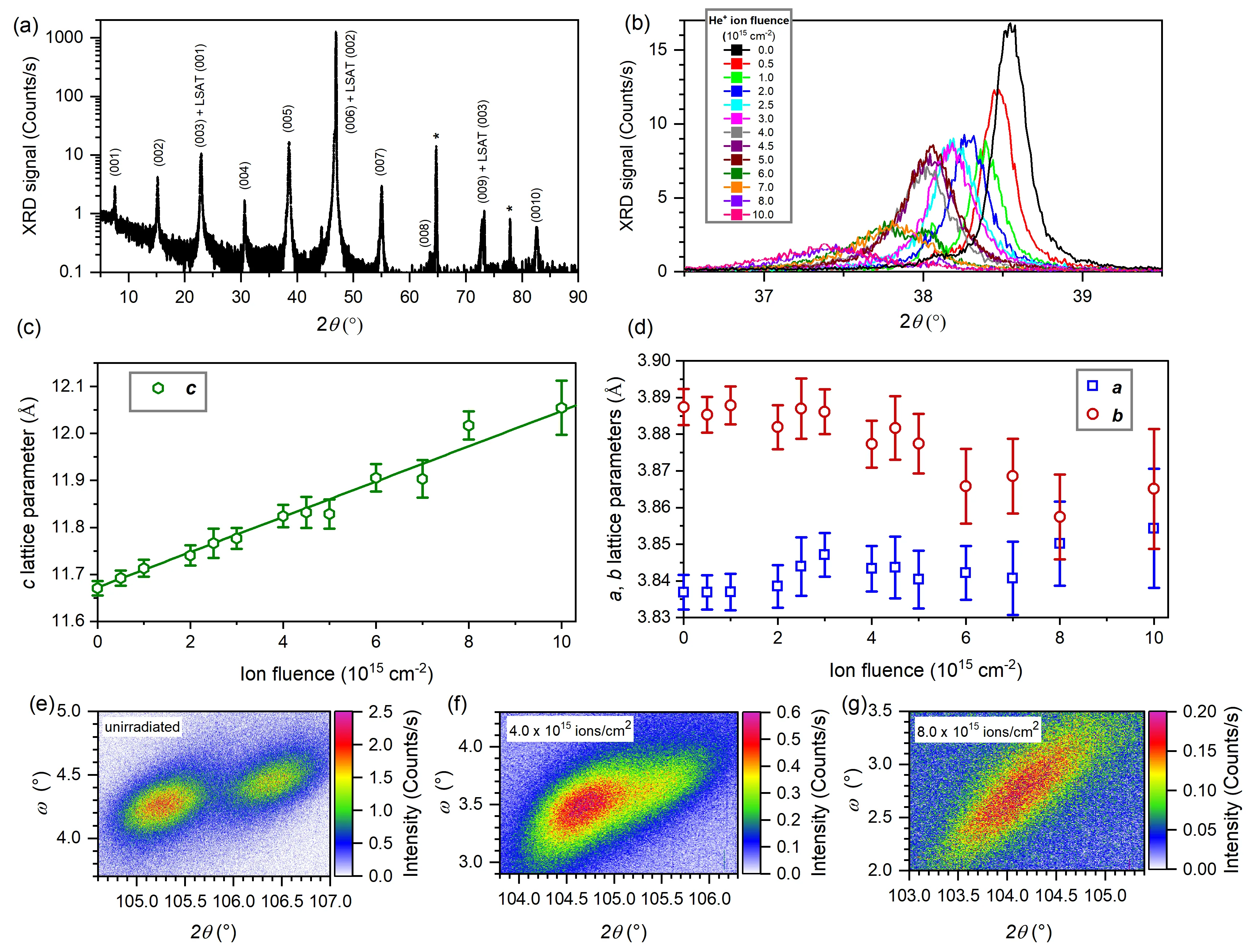
As the dose increases further, the crystal lattice loses its order: X-rays show the layers spreading apart, the unit cell going from rectangular to square, and at 10¹⁶ ions per square centimeter the film turns into amorphous glass. Electrical resistance in the normal state rises sharply, while the critical temperature falls according to a law derived half a century ago by Abrikosov and Gor'kov for the destruction of Cooper pairs by magnetic impurities. Interestingly, the anisotropy, the difference in properties along and across the layers, decreases here, whereas with simple oxygen deficiency it increases. So the beam doesn't just knock out oxygen; it creates a more complex kind of disorder.
This work isn't just physics for physics' sake. It gives engineers precise numbers: how much irradiation is needed to suppress superconductivity in the right places and create a quantum circuit without destroying the substrate. Without that knowledge, the stylus remains blind and the pattern unreliable.
The helium ion beam is focused to a spot less than ten nanometers in diameter — thousands of times thinner than a human hair.