Cosmic Accelerator Flirts with the Limit ✎ express

Original: "Extreme PeV accelerator associated with GRS 1915+105"
· Zhen Cao, F. Aharonian, Y. X. Bai, Y. W. Bao, D. Bastieri, X. J. Bi, Y. J. Bi, W. Bian, J. Blunier, A. V. Bukevich, C. M. Cai, Y. Y. Cai, W. Y. Cao, Zhe Cao, J. Chang, J. F. Chang, E. S. Chen, G. H. Chen, H. K. Chen, L. F. Chen, Liang Chen, Long Chen, M. J. Chen, M. L. Chen, Q. H. Chen, S. Chen, S. H. Chen, S. Z. Chen, T. L. Chen, X. B. Chen, X. J. Chen, X. P. Chen, Y. Chen, N. Cheng, Q. Y. Cheng, Y. D. Cheng, M. Y. Cui, S. W. Cui, X. H. Cui, Y. D. Cui, B. Z. Dai, H. L. Dai, Z. G. Dai, Danzengluobu, Y. X. Diao, A. J. Dong, X. Q. Dong, K. K. Duan, J. H. Fan, Y. Z. Fan, J. Fang, J. H. Fang, K. Fang, C. F. Feng, H. Feng, L. Feng, S. H. Feng, X. T. Feng, Y. Feng, Y. L. Feng, S. Gabici, B. Gao, Q. Gao, W. Gao, W. K. Gao, M. M. Ge, T. T. Ge, L. S. Geng, G. Giacinti, G. H. Gong, Q. B. Gou, M. H. Gu, F. L. Guo, J. Guo, K. J. Guo, X. L. Guo, Y. Q. Guo, Y. Y. Guo, R. P. Han, O. A. Hannuksela, M. Hasan, H. H. He, H. N. He, J. Y. He, X. Y. He, Y. He, S. Hernández-Cadena, B. W. Hou, C. Hou, X. Hou, H. B. Hu, S. C. Hu, C. Huang, D. H. Huang, J. J. Huang, X. L. Huang, X. T. Huang, X. Y. Huang, Y. Huang, Y. Y. Huang, A. Inventar, X. L. Ji, H. Y. Jia, K. Jia, H. B. Jiang, K. Jiang, X. W. Jiang, Z. J. Jiang, M. Jin, S. Kaci, M. M. Kang, I. Karpikov, D. Khangulyan, D. Kuleshov, K. Kurinov, Cheng Li, Cong Li, D. Li, F. Li, H. B. Li, H. C. Li, Jian Li, Jie Li, K. Li, L. Li, R. L. Li, S. D. Li, T. Y. Li, W. L. Li, X. R. Li, Xin Li, Y. Li, Zhe Li, Zhuo Li, E. W. Liang, Y. F. Liang, S. J. Lin, B. Liu, C. Liu, D. Liu, D. B. Liu, H. Liu, J. Liu, J. L. Liu, J. R. Liu, M. Y. Liu, R. Y. Liu, S. M. Liu, W. Liu, X. Liu, Y. Liu, Y. Liu, Y. N. Liu, Y. Q. Lou, Q. Luo, Y. Luo, H. K. Lv, B. Q. Ma, L. L. Ma, X. H. Ma, I. O. Maliy, J. R. Mao, Z. Min, W. Mitthumsiri, Y. Mizuno, G. B. Mou, A. Neronov, K. C. Y. Ng, M. Y. Ni, L. Nie, L. J. Ou, Z. W. Ou, P. Pattarakijwanich, Z. Y. Pei, D. Y. Peng, J. C. Qi, M. Y. Qi, J. J. Qin, D. Qu, A. Raza, C. Y. Ren, D. Ruffolo, A. Sáiz, D. Savchenko, D. Semikoz, L. Shao, O. Shchegolev, Y. Z. Shen, X. D. Sheng, Z. D. Shi, F. W. Shu, H. C. Song, Yu. V. Stenkin, V. Stepanov, Y. Su, D. X. Sun, H. Sun, J. X. Sun, Q. N. Sun, X. N. Sun, Z. B. Sun, N. H. Tabasam, J. Takata, P. H. T. Tam, H. B. Tan, Q. W. Tang, R. Tang, Z. B. Tang, W. W. Tian, C. N. Tong, L. H. Wan, C. Wang, D. H. Wang, G. W. Wang, H. G. Wang, J. C. Wang, K. Wang, Kai Wang, Kai Wang, L. P. Wang, L. Y. Wang, L. Y. Wang, R. Wang, W. Wang, X. G. Wang, X. J. Wang, X. Y. Wang, Y. Wang, Y. D. Wang, Z. H. Wang, Z. X. Wang, Zheng Wang, D. M. Wei, J. J. Wei, Y. J. Wei, T. Wen, S. S. Weng, C. Y. Wu, H. R. Wu, Q. W. Wu, S. Wu, X. F. Wu, Y. S. Wu, S. Q. Xi, J. Xia, J. J. Xia, G. M. Xiang, D. X. Xiao, G. Xiao, Y. F. Xiao, Y. L. Xin, H. D. Xing, Y. Xing, D. R. Xiong, B. N. Xu, C. Y. Xu, D. L. Xu, R. F. Xu, R. X. Xu, S. S. Xu, W. L. Xu, L. Xue, D. H. Yan, T. Yan, C. W. Yang, C. Y. Yang, F. F. Yang, L. L. Yang, M. J. Yang, R. Z. Yang, W. X. Yang, Z. H. Yang, Z. G. Yao, X. A. Ye, L. Q. Yin, N. Yin, X. H. You, Z. Y. You, Q. Yuan, H. Yue, H. D. Zeng, T. X. Zeng, W. Zeng, X. T. Zeng, M. Zha, B. B. Zhang, B. T. Zhang, C. Zhang, H. Zhang, H. M. Zhang, H. Y. Zhang, J. L. Zhang, J. Y. Zhang, Li Zhang, P. F. Zhang, R. Zhang, S. R. Zhang, S. S. Zhang, S. Y. Zhang, W. Zhang, W. Y. Zhang, X. Zhang, X. P. Zhang, Yi Zhang, Yong Zhang, Z. P. Zhang, J. Zhao, L. Zhao, L. Z. Zhao, S. P. Zhao, X. H. Zhao, Z. H. Zhao, F. Zheng, T. C. Zheng, B. Zhou, H. Zhou, J. N. Zhou, M. Zhou, P. Zhou, R. Zhou, X. X. Zhou, X. X. Zhou, B. Y. Zhu, C. G. Zhu, F. R. Zhu, H. Zhu, K. J. Zhu, Y. C. Zou, X. Zuo
arXiv:2606.25054 · 2026-06-23 · arXiv non-exclusive · independent analysis · 1 min
The microquasar GRS 1915+105 accelerates protons to energies beyond the reach of terrestrial accelerators.

In the constellation Aquila, about 40,000 light-years away, one of the most powerful natural accelerators in the Galaxy is at work. It's the microquasar GRS 1915+105—a pair consisting of an ordinary star and a black hole. The black hole pulls matter from the star and ejects it as two narrow jets, accelerated to nearly the speed of light.

New data from China's LHAASO observatory and the Fermi-LAT space telescope show that the gamma-ray emission from this system is not just present: it's offset by 0.13 degrees from the jets themselves. That's like a cannonball leaving a trail not at the muzzle but a dozen meters to the side. The emission spectrum bends smoothly downward, without a sharp cutoff — a sign that the parent protons reach energies beyond 5 PeV (peta-electronvolts). For comparison, the Large Hadron Collider accelerates particles to 7 TeV — hundreds of times weaker.

The acceleration efficiency here approaches the theoretical limit: several percent of the jets' total mechanical power goes into accelerating protons.

The picture that emerges is this: protons, escaping from the jets, slam into a dense cloud of interstellar gas. Showers of secondary particles and gamma-rays are born. That's what the detectors captured — not the jets themselves, but their 'exhaust' into the surrounding medium. This makes microquasars prime suspects in the case of the origin of the most energetic cosmic rays that roam our Galaxy.
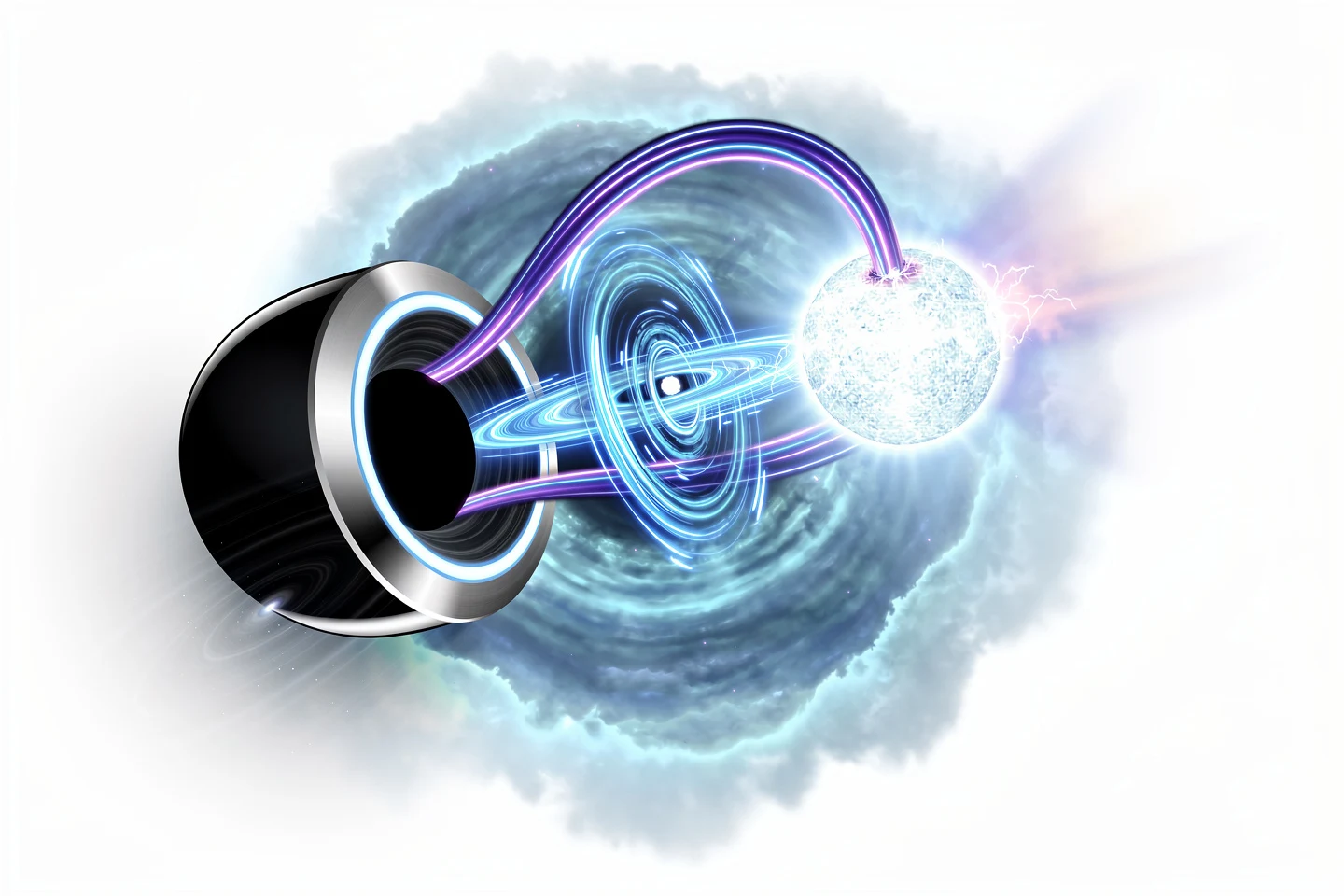
The energy of a single proton from GRS 1915+105 is comparable to the energy of a flying mosquito, but compressed into the volume of an atomic nucleus.

Scientists
Stephen HawkingJacob BekensteinFritz ZwickyBernhard RiemannJoseph WeberKarl Schwarzschild
Concepts
relativistic jets ultra high energy gamma ray cosmic accelerator microquasar ultra high energy cosmic ray source radio loud quasar particle acceleration fermi telescope laser plasma acceleration Gamma radiation central engine pierre auger observatory supernova jets radio galaxy pulsar particle accelerator lhaaso maser pulsar wind jwst red sources