Y. Xing

10 articles · 30 co-authors · latest: 2026-08-08
120 citations · h-index 5 · 22 papersData: Semantic Scholar

We have retold 10 papers by this author. most often about: supernova remnant, supernova, cosmic rays. 30 co-authors across our retellings.

Links in the knowledge graph
High Energy2025-10-302 minarXiv:2510.26112express
Stellar Explosions as Particle Accelerators of Record Energies
When a massive star exhausts its thermonuclear fuel, its core collapses, and the outer layers are ejected into space at speeds of thousands of kilometers per second. This is how a supernova remnant is born — an expanding cloud of shock-compressed gas spanning light-years.
High Energy2026-01-061 minarXiv:2601.02801express
Solar Storm Illuminated Magnetic Fields in Space
Cosmic rays are like a downpour pelting from all sides. But when the wind blows, the droplets change direction. In the same way, a solar storm, a cloud of magnetized gas from the Sun, bends the paths of these particles that normally rain down on Earth evenly. Cosmic rays are invisible messengers from distant galaxies.
HEP Experiment2026-01-161 minarXiv:2601.11296express
Hunting Dark Matter: A New Frontier
Dark matter is the invisible glue that keeps galaxies from falling apart. Back in the 1930s, Fritz Zwicky suspected its existence, and in the 1970s Vera Rubin proved that without it, stars would fly apart.
High Energy2026-02-132 minarXiv:2602.13411express
Three Years of Watching a Cosmic Beacon
For three years straight, every night, telescopes have stared at one point in the sky. There lies the galaxy Mrk 421, whose core shoots a jet of particles aimed almost exactly at Earth. Such objects are called blazars. A black hole at the galaxy's center spins matter into a disk, and some of it is ejected outward in two narrow beams.
HEP Experiment2026-03-121 minarXiv:2603.11981express
Underground Cosmic Ray Counter
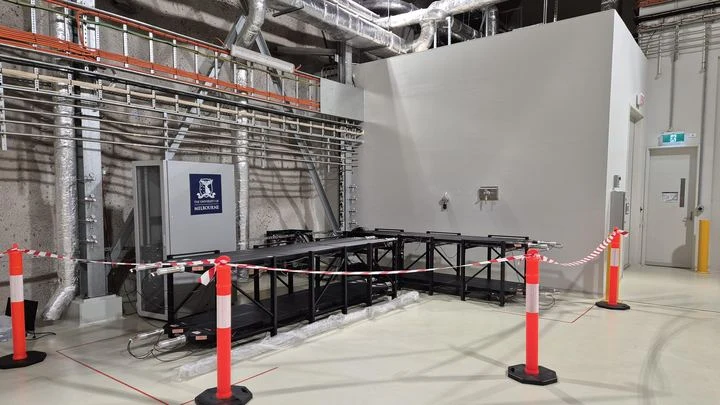
Deep underground, in a former gold mine in Australia, stands a laboratory where silence is broken only by rare flashes of light. These flashes are the traces of cosmic particles that punch through hundreds of meters of rock. Eight plastic panels, resembling large glowing sheets, catch these particles.
Neural Network Cleans Up Noise to Catch Xenon Decay
In a dark mine under the Italian Alps, a tank holds three tons of liquid xenon. When a particle hits it, it knocks faint flashes of light and electron clouds out of the atoms. Following these tracks, physicists hope to see an ultra-rare decay: a xenon-136 nucleus turning into barium-136, emitting two electrons and no neutrinos.
HEP Experiment2026-04-072 minarXiv:2604.06002express
Catchers of Solar Ghosts
Deep beneath the Apennine Mountains, in a tank holding three tons of liquid xenon, something gives a barely perceptible shudder every few days. It's a solar neutrino, a ghostly particle born in the Sun's thermonuclear furnace, that has traveled 150 million kilometers through empty space and solid rock to finally collide with a xenon nucleus.
High Energy2026-04-242 minarXiv:2604.22621express
Cosmic accelerators push particles to the limit
Every second, invisible projectiles from the depths of space pierce through us. These are cosmic rays — atomic nuclei accelerated to speeds nearly indistinguishable from the speed of light. Their energy is hundreds of millions of times greater than what our most powerful accelerators can achieve. Where does this monstrous force come from?
High Energy2026-06-231 minarXiv:2606.25054express
Cosmic Accelerator Flirts with the Limit
In the constellation Aquila, about 40,000 light-years away, one of the most powerful natural accelerators in the Galaxy is at work. It's the microquasar GRS 1915+105—a pair consisting of an ordinary star and a black hole.
High Energy2026-08-081 minarXiv:2608.07850express
The Pulsar Tail You Can See Through
Pulsar PSR J1740+1000 is a city-sized star spinning faster than a kitchen blender. After a supernova explosion, it left behind a dense core that accelerates particles to near-light speeds. These particles fly into space, and previously it was thought they scatter in all directions, like splashes from a stone thrown into water.