X. Liu

25 articles · 30 co-authors · latest: 2026-08-21
64 citations · h-index 4 · 10 papersData: Semantic Scholar

We have retold 25 papers by this author. 1 of them with a full read. most often about: supernova remnant, supernova, cosmic rays. 30 co-authors across our retellings.

Links in the knowledge graph
High Energy2025-10-302 minarXiv:2510.26112express
Stellar Explosions as Particle Accelerators of Record Energies
When a massive star exhausts its thermonuclear fuel, its core collapses, and the outer layers are ejected into space at speeds of thousands of kilometers per second. This is how a supernova remnant is born — an expanding cloud of shock-compressed gas spanning light-years.
High Energy2026-01-061 minarXiv:2601.02801express
Solar Storm Illuminated Magnetic Fields in Space
Cosmic rays are like a downpour pelting from all sides. But when the wind blows, the droplets change direction. In the same way, a solar storm, a cloud of magnetized gas from the Sun, bends the paths of these particles that normally rain down on Earth evenly. Cosmic rays are invisible messengers from distant galaxies.
HEP Experiment2026-01-161 minarXiv:2601.11236express
Light Split in Two
At a particle accelerator in Beijing, electrons collide with positrons, and for a fleeting moment, a particle called eta-c is born. It lives for a tiny fraction of a second and then decays into other particles. One of the rarest paths is to split into two photons, particles of light. Until now, no one could say exactly how often this happens.
HEP Experiment2026-01-292 minarXiv:2601.21185express
The Hidden 'Nudge' in D-Meson Decay
In an accelerator, particles collide, and for a fleeting instant a D meson is born — a particle that lives for less time than it takes light to cross a grain of sand. It promptly shatters into lighter fragments: a kaon, a lepton, and a neutrino.
HEP Experiment2026-02-011 minarXiv:2602.01282express
Antimatter Meets Protons: Particle Birth Seen for the First Time
In a particle accelerator in Beijing, an anti-Lambda hyperon, a rare antimatter particle, slams into an ordinary proton. Instead of simply disappearing, they transform into a whole bouquet of other particles: a positively charged kaon, two pions, and sometimes additional neutral pions. Such transformations for the anti-Lambda had never been observed before.
HEP Experiment2026-02-042 minarXiv:2602.04276express
Antimatter Meets an Ordinary Proton
In a particle accelerator, the anti-lambda particle is a rare guest. It is born on the fly, lives for a tiny fraction of a second, and usually decays on its own. But sometimes it manages to collide with an ordinary proton, and then a whole shower of light particles is born: kaons, pions.
HEP Experiment2026-02-101 minarXiv:2602.09652express
Invisible Particle: A New Decay of the Eta Meson
In the BEPCII accelerator, electrons and positrons collide, producing billions of particles. Among them is the J/ψ meson, which lives for less than a billionth of a second. Its decay sometimes yields an eta meson (ηc), an even shorter-lived clump of quarks.
High Energy2026-02-132 minarXiv:2602.13411express
Three Years of Watching a Cosmic Beacon
For three years straight, every night, telescopes have stared at one point in the sky. There lies the galaxy Mrk 421, whose core shoots a jet of particles aimed almost exactly at Earth. Such objects are called blazars. A black hole at the galaxy's center spins matter into a disk, and some of it is ejected outward in two narrow beams.
HEP Experiment2026-02-242 minarXiv:2602.20524express
Tiny Difference in Particle Decays
Two twins look identical, but one is left-handed and the other right-handed. In the world of elementary particles, there are similar pairs: Ξ- and its antiparticle Ξ+. They are born together in the decay of the J/ψ particle and, like entangled twins, maintain a connection even at a distance.
HEP Experiment2026-02-271 minarXiv:2602.23835express
How Particles Are Born from the Void
In a circular accelerator, electrons are accelerated to nearly the speed of light and smash into positrons: their antiparticles. At the collision point, a burst of pure energy briefly appears, from which new particles are born. The BESIII detector, like a high-speed camera, captures the tracks of these short-lived guests.
HEP Experiment2026-02-271 minarXiv:2602.24089express
The Invisible Arrow in Particle Decay
When an electron and a positron collide at the BESIII collider, they produce a short-lived particle — the charmed baryon Λc+. Inside it, like in an overstuffed box, another particle quickly emerges: the Λ hyperon. This hyperon has its own rotation, its spin, and physicists have for the first time been able to measure how much that rotation is aligned with the particle's direction of motion.
HEP Experiment2026-02-282 minarXiv:2603.00743express
Fine-Tuning a Decay
In the accelerator, an electron and a positron collide, and for an instant, a particle is born that lives for less than a billionth of a second. Its decay resembles the explosion of a tiny firecracker: fragments scatter in all directions, and physicists reconstruct what was inside from their trajectories.
HEP Experiment2026-03-192 minarXiv:2603.18521express
The Invisible Glue Inside Particles
Inside the proton and neutron, life is boiling: quarks exchange gluons, and for an instant pairs of particles appear and vanish. Some of them, the so-called scalar mesons, live for only 10⁻²³ seconds — less time than light needs to cross an atomic nucleus.
HEP Experiment2026-03-241 minarXiv:2603.23081express
Photon Detective: How the J/psi Particle Decays
The J/psi particle lives for an instant and then decays into lighter particles, much like a snapped string scattering into pieces. Physicists from the BESIII collaboration caught over ten billion such decays to figure out exactly what 'pieces' are produced.
HEP Experiment2026-03-262 minarXiv:2603.25649express
How a Particle Decays: The Dance of Four Tracks
When a particle decays, it doesn't just vanish: it transforms into a whole set of other particles, and each transformation has its own script. Physicists from the BESIII collaboration have, for the first time, broken down the rare decay of the D0 meson step by step: it turns into two kaons and two pions.
HEP Experiment2026-03-301 minarXiv:2603.28232express
Rare Particle Decay Caught for the First Time
In an accelerator near Beijing, electrons collide with positrons, and for an instant, particles are born that you wouldn't find in ordinary matter. One of them is lambda-c-plus: inside it sits a heavy charmed quark, like a stone in a slingshot. Now physicists have for the first time seen this particle break apart into a neutron, a positive pion, and an eta meson.
HEP Experiment2026-04-072 minarXiv:2604.05701express
The Gamma Angle: How Physicists Catch the Difference Between Matter and Antimatter
Every second, billions of decays happen inside our bodies, and nobody notices. But physicists do: they smash particles in accelerators and watch what fragments they fly into. Hidden in those fragments is the answer to why we exist at all. Right after the Universe was born, there were equal amounts of particles and antiparticles, but today all we see around us is particles.
HEP Experiment2026-04-071 minarXiv:2604.05712express
A 71-degree angle: how physicists catch the asymmetry of matter
Imagine a balance scale with identical weights, yet one pan always tips lower. In the world of elementary particles, this imbalance is called CP violation: particles and their mirror twins (antiparticles) behave slightly differently.
HEP Experiment2026-04-121 minarXiv:2604.10444express
How a Charmed Particle Falls Apart
The charmed particle D+ lives for a tiny fraction of a second before breaking apart into lighter particles, like an overloaded bridge losing its supports. Physicists at the BESIII collider caught millions of such decays and sorted them out. In one decay mode, four pions and an eta meson are produced. The probability of this event turned out to be higher than expected: about 3 chances in 1000.
HEP Experiment2026-04-141 minarXiv:2604.12524express
The Invisible Particle from the Quark World
Quarks are the tiny building blocks that make up protons and neutrons. Usually, they stick together in pairs: a particle and its mirror-image antiparticle. But sometimes quarks form more exotic combinations, which physicists call exotic states.
High Energy2026-04-242 minarXiv:2604.22621express
Cosmic accelerators push particles to the limit
Every second, invisible projectiles from the depths of space pierce through us. These are cosmic rays — atomic nuclei accelerated to speeds nearly indistinguishable from the speed of light. Their energy is hundreds of millions of times greater than what our most powerful accelerators can achieve. Where does this monstrous force come from?
High Energy2026-06-231 minarXiv:2606.25054express
Cosmic Accelerator Flirts with the Limit
In the constellation Aquila, about 40,000 light-years away, one of the most powerful natural accelerators in the Galaxy is at work. It's the microquasar GRS 1915+105—a pair consisting of an ordinary star and a black hole.
HEP Experiment2026-08-172 minarXiv:2608.16076express
Rare Decay of an Invisible Particle
Among the debris of particle collisions, short-lived 'guests' sometimes appear — hyperons. One of them, Σ0, lives for less than one ten-billionth of a second and decays on the fly. Catching it directly is nearly impossible, but its traces can be spotted: it leaves behind another particle, Λ, and an electron-positron pair.
Charmonium Archaeology: A New Layer Excavated
An archaeologist carefully brushes away layer after layer, and each new stratum at the charmonium dig is a rare decay captured by the detector. Charmonium — a bound state of a charm quark and its antiquark — lives for mere fractions of a second, yet it manages to tell us about the forces that hold quarks together.
HEP Experiment2026-08-211 minarXiv:2608.21082express
How a Heavyweight Particle Decays
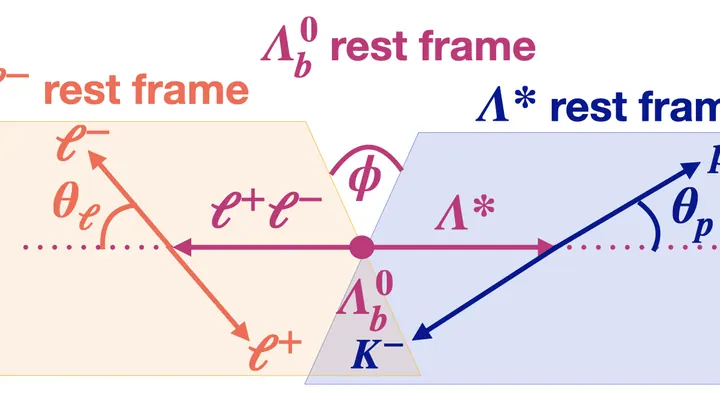
At the Large Hadron Collider, protons are smashed together, and among the debris, a heavyweight particle, the lambda baryon, sometimes appears. It lives for a tiny fraction of a second before decaying into other particles.