A Hot Star Built a Sulfur Factory ✛
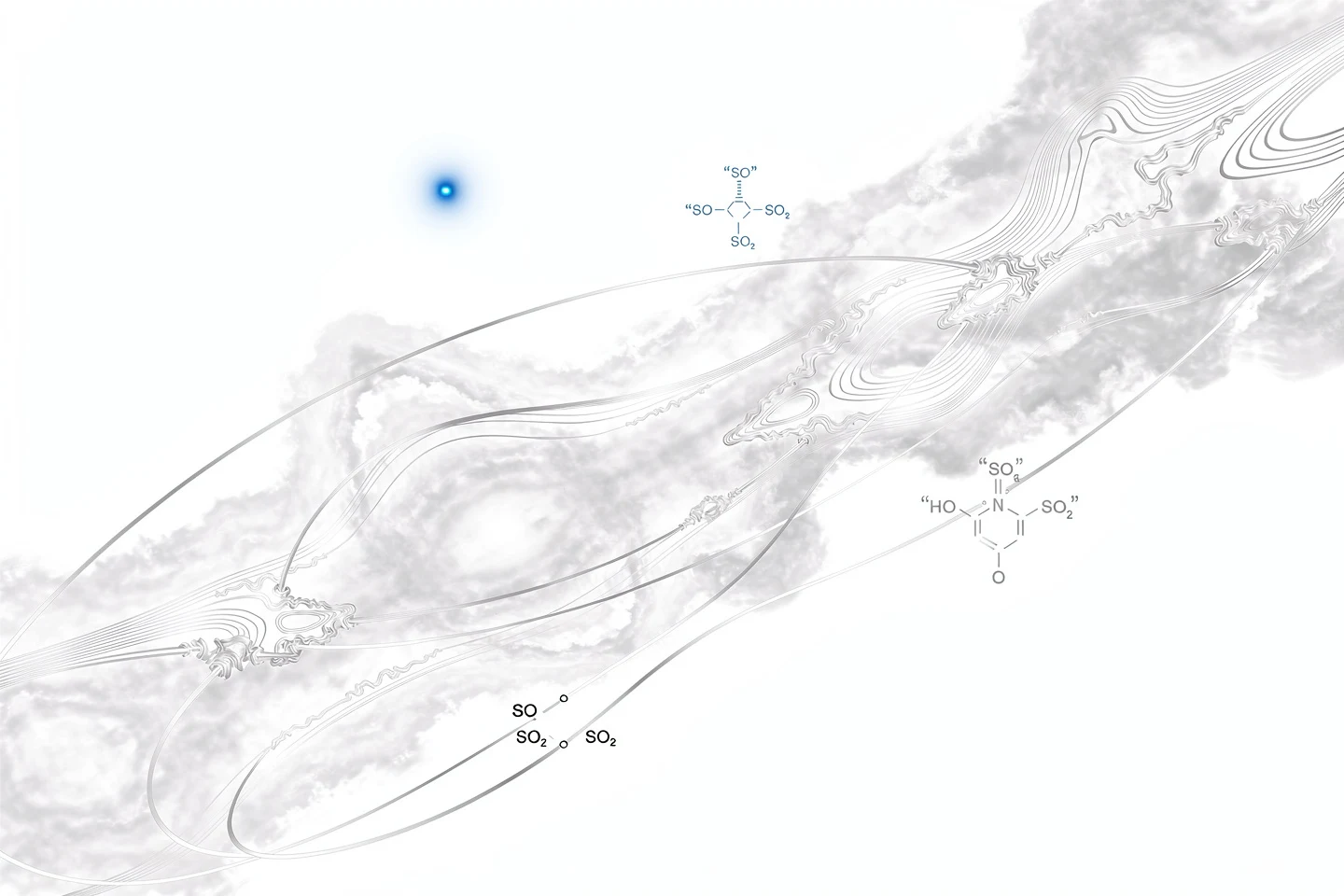
A hot supergiant, dozens of times more massive than the Sun, blazes so intensely that its ultraviolet light can tear apart nearly any molecule. Such stars live fast and die young, ending their lives as a supernova — a cataclysm scrutinized by Fritz Zwicky. Conventional wisdom held that complex molecules couldn't survive near such behemoths, save for the toughest ones like CO (carbon monoxide). But when astronomers aimed the ALMA radio telescope array at the exceptionally rare star HD 87643, the view was different. Using spectroscopy — a technique pioneered in the 19th century by Johann Balmer to decode starlight — they uncovered a host of sulfur molecules: SO, SO₂, and more.
Most unexpected was the behavior of sulfur isotopes — atoms with slightly different masses. Under normal conditions, in the universe, the light isotope ³²S is 127 times more abundant than the heavy ³³S. Here, the ratio was only 15. Scientists explain this by the star's ultraviolet light selectively destroying molecules containing the lighter isotope — much like a strong flame chars delicate foods faster on a skillet. This gives rise to non-equilibrium photochemistry, similar to what once simmered in the young Earth's atmosphere and left traces in ancient minerals. As Margaret Burbidge established, massive stars forge heavy elements, including sulfur, by burning hydrogen and helium in their cores, then scatter them across the galaxy.
The discovery shows that chemistry around massive stars is far richer than assumed. Their surroundings can serve as natural reactors where molecules important for prebiotic evolution are born. Further observations will help clarify exactly how complex substances accumulated in the early history of the cosmos.
The SO₂ molecule is familiar to everyone from the smell of a burnt match. Around the star, there's so much of it that a cloud roughly a thousand times larger than our Solar System would smell like volcanic gases and burning sulfur combined.
A veritable 'sulfur factory' at the star HD 87643 brings to mind the sulfur-based alien life from Star Trek.