Sulfur Anomaly: B[e] Supergiant as a Photochemical Reactor ✛
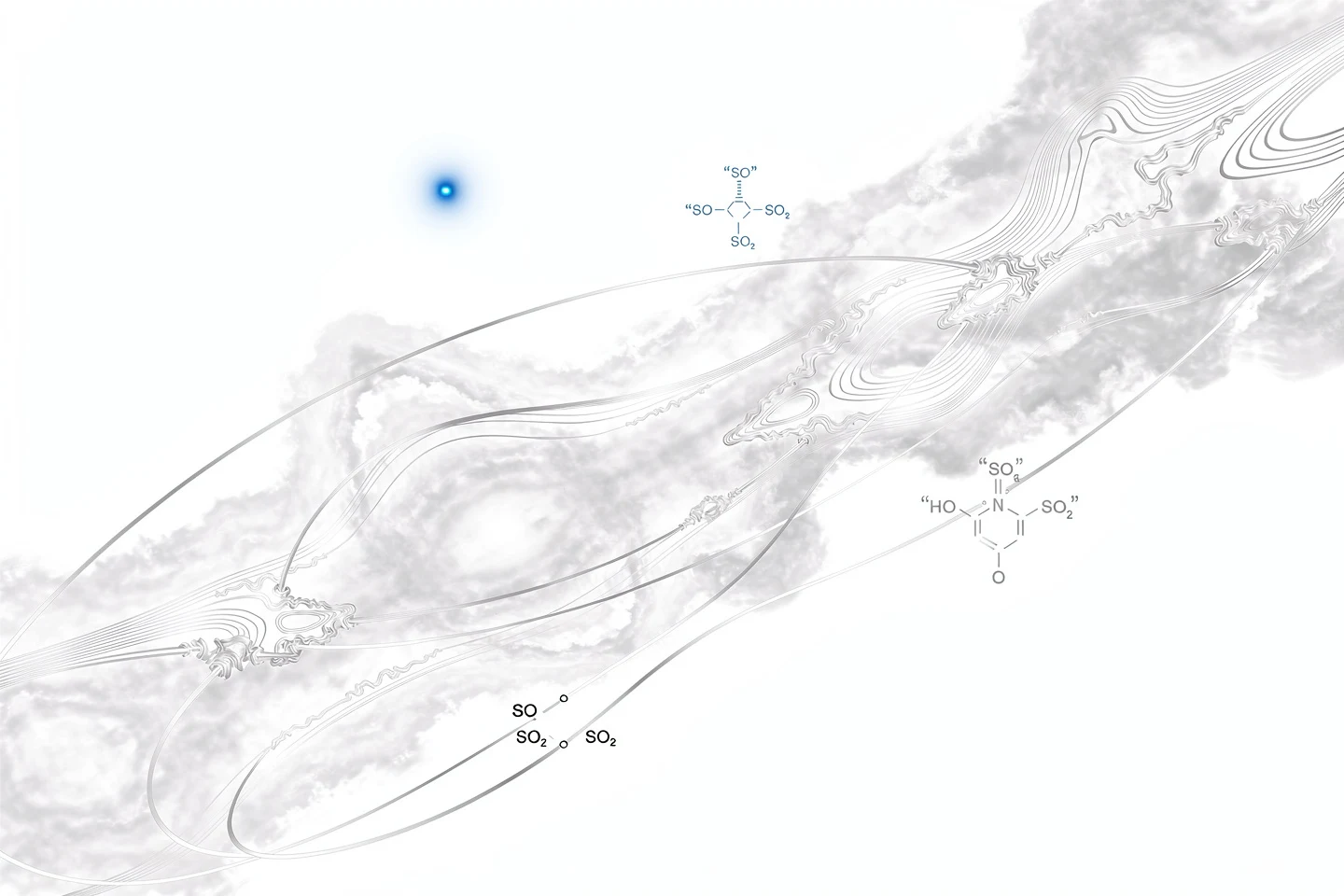
Massive stars are cosmic titans, living under the sign of indomitable energy. When such a star enters the B[e] supergiant phase, its radiation is so powerful that it would seemingly pulverize any molecule into atoms. The spectral lines, once systematized by Johann Balmer, blaze here with particular fury. But nature, like a capricious sculptor, picks up not a hammer but an ultraviolet chisel — and instead of chaos, creates elegant forms. This is exactly what astronomers found when they pointed ALMA's antennas at HD 87643, a star teetering on the edge of supernova, predicted long ago by Fritz Zwicky.
In the millimeter range, the star's spectrum shone with lines no one expected. In addition to the familiar carbon monoxide carbon CO, the instruments detected SO, SO₂, OCS, and even the isotopologue ³³SO. The sulfur dioxide abundance turned out to be colossal: nearly all available sulfur was locked up in this molecule — the concentration reached 1.1×10⁻⁵, close to the full cosmic abundance of the element. Normally, such a picture is typical of hot cores of molecular clouds, not of supergiant envelopes. Chemical modeling showed that such a high degree of processing requires a time on the order of 10⁴ years — exactly as long as the star spends in this unstable phase before becoming a supernova.
The reason for this skew is mass-independent fractionation. The star's hard radiation selectively destroys the rarer ³³SO₂ molecule faster than ³²SO₂, enriching the environment with the isotope ³³S in the form of SO. This same mechanism has left traces in Archean rocks on Earth, hinting that similar photochemical processes may have occurred in our planet's prebiotic atmosphere. Thus, HD 87643 becomes a natural laboratory where we can observe, in real time, chemistry that may have been key to the origin of life. As predicted by Margaret Burbidge, massive stars are the main forges of elements, and now we see that they not only scatter hydrogen and helium but also stage complex performances involving sulfur.
The discovery overturns old dogmas. An intense ultraviolet field does not necessarily destroy chemistry — it can trigger unique photochemical cycles, creating compounds that would not otherwise arise. In the future, detailed high-resolution spectroscopic mapping will allow us to separate the emission from the disk and the envelope, test models, and understand how typical this picture is for other B[e] stars. We stand on the threshold of understanding how massive giants, when they explode, enrich the Universe not just with elemental ash but with complex molecular constructs that may become seeds for future planets and, perhaps, life.
The SO₂ molecule, which we usually associate with the smell of a struck match, fills a space thousands of astronomical units across. If we could 'sniff' this cloud, we'd experience an aroma blending volcanic gases and burning sulfur — though in the vacuum of space, smells don't travel.
The idea of sulfur-based life has long excited science fiction writers: in the 'Star Trek' episode 'The Devil in the Dark,' a silicon-sulfur creature is featured, and in Arthur C. Clarke's novel '2010: Odyssey Two,' the possibility of sulfuric acid-based biochemistry is discussed. The discovery of a real 'sulfur factory' around an actual star makes such hypotheses a little less fantastical.