How Light Controls the Strongest Quantum Memory in a Diamond ✛ ✎ ✦
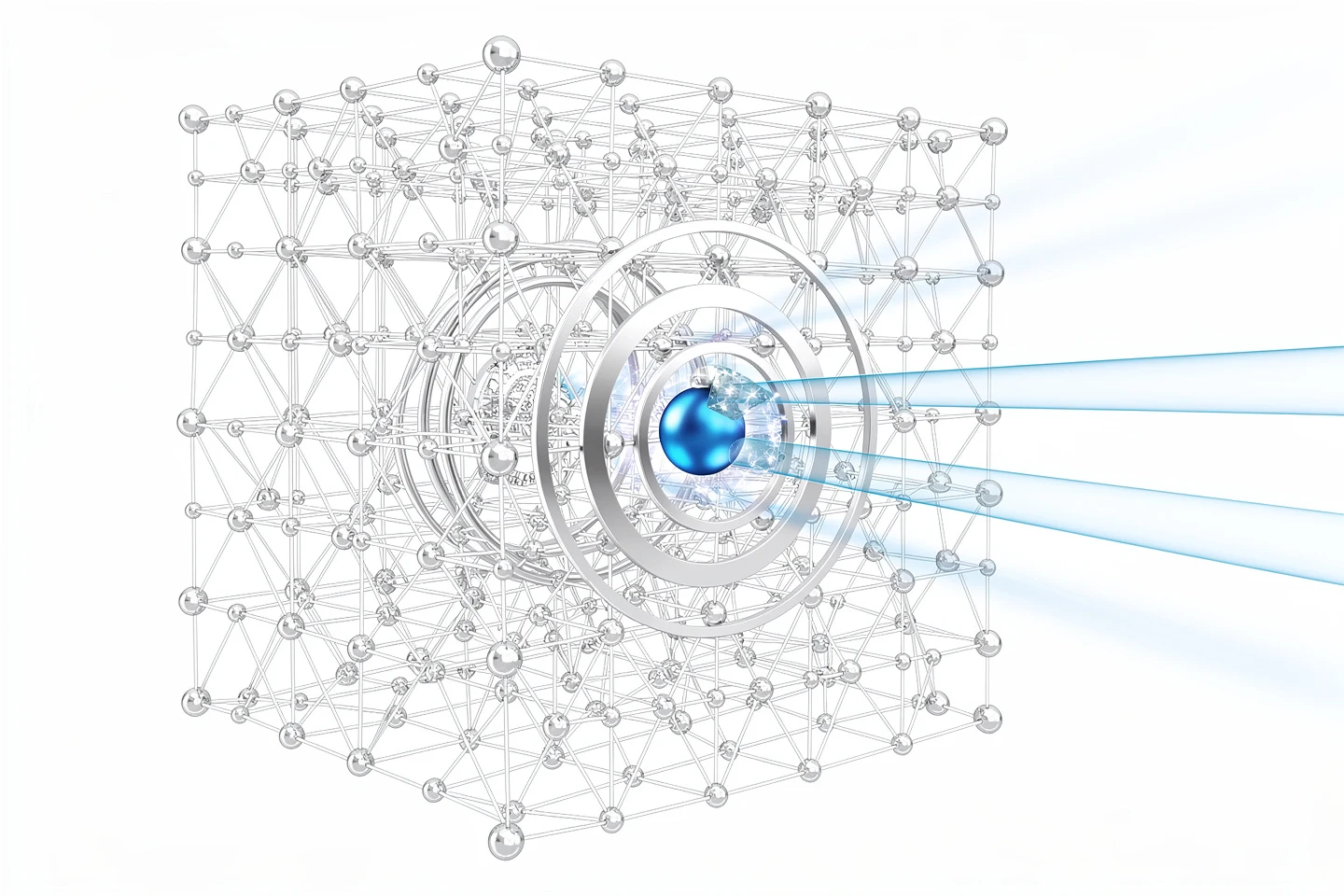
For quantum communication, which is studied by quantum optics, we need particles that can store information for a long time and respond to light. But one hinders the other: memory either quickly fades due to external disturbances, or it couples too weakly to light. The solution came in the form of a nickel atom in diamond — a tiny defect that acts like a safe with a photonic lock. Light opens and closes it, and the walls are so sturdy that thermal 'jolts' can’t break through.
The secret lies in a special internal geometry: the electron clouds around the nickel create a giant energy barrier, like a high breakwater against which even strong thermal ripples (phonons) crash. That's why even at liquid helium temperatures, just a degree and a half above absolute zero, the superposition lasts a record 1.27 milliseconds. And everything is controlled exclusively with light — no radio waves.
Experiments with interferometry, spectroscopy, and other quantum measurements confirmed: this is the most robust all-optical quantum bit, and its behavior aligns with the laws discovered by Bell and Aspect for entangled particles.
In 1.27 milliseconds, light can travel roughly 380 kilometers — the distance from Moscow to Nizhny Novgorod. That’s exactly the 'lifetime' of the quantum memory in this new defect.