Dancing on a Carbon Thread: A Diamond Qubit with Millisecond Memory ✛ ✎ ✦
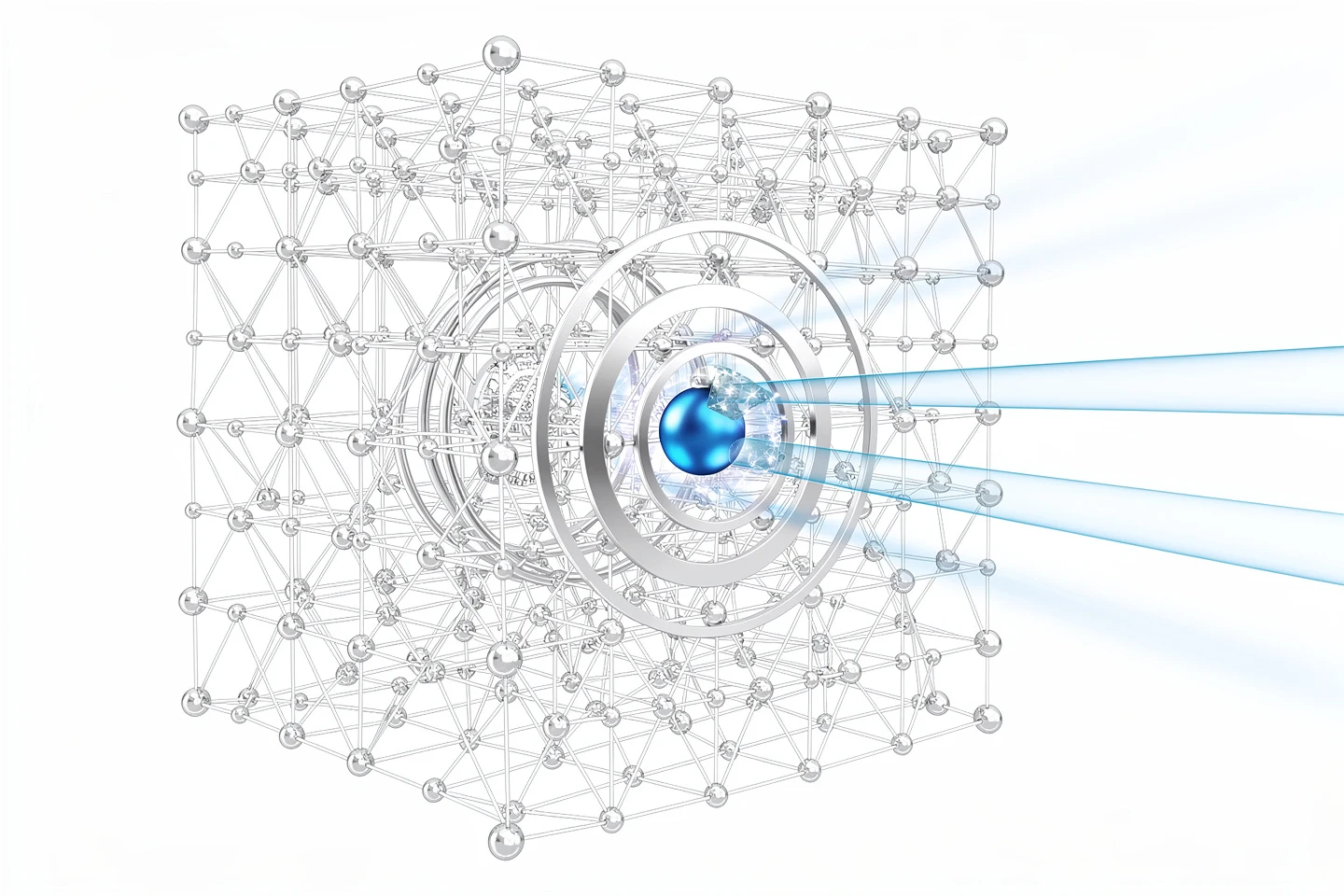
Building a quantum network node is like teaching a dancer to balance on a carbon thread over an abyss. One leg must spring lightly from the wire, hurling photon-messengers into the external world. The other must grip the rope tightly, guarding precious quantum information. Earlier diamond defects limped: the nitrogen-vacancy (NV⁻) held memory but was stingy with photons; the silicon-vacancy (SiV⁻) exchanged light generously, yet its spin faded at the slightest thermal whisper of the lattice. Then physicists swapped the dancer: a nickel atom stepped onto the thread, and glided without stumbling.
The secret is in the orbital dance. Diamond’s carbon bonds are taut springs, but when nickel embeds into the lattice, its d-orbitals hybridize with dangling bonds, creating a unique electronic pattern. An orbital singlet emerges — a stealth state in which the spin is flipped between 'up' and 'down' by a single light pulse, without any microwaves. That’s the key to fully optical quantum control. At the same time, spin-orbit interaction splits the energy levels by a colossal 670 GHz — roughly fifteen times wider than in SiV⁻. For thermal jitter ($k_{BT}$) at 1.65 K, such a chasm is insurmountable: phonons simply can’t steal away quantum information. The formula for this protective bolt is simple—$Δ_{SO}$ ≫ $k_B$ T. When the spin-orbit splitting is gigantic compared to the lattice’s vibrational energy, the spin becomes a pendulum in a vacuum: its quantum oscillation barely fades.
The experiment resembles a quantum ballet of a single performer. A lone nickel-vacancy center is placed in a closed-cycle helium cryostat. At a temperature of 1.65 K, a weak magnetic field of 150 mT creates Zeeman splitting. A laser initializes the spin into the 'down' state with over 99% fidelity. Then two Raman pulses, detuned by 250 MHz from resonance, perform coherent rotations. The final readout is a quantum measurement of the spin state. In essence, it’s a spin-based interferometer. Once, Bell and Aspect proved that such superpositions are real, and now they’ve become routine tools. In the simplest spectroscopic experiment, a dark superposition, coherent population trapping, appears with a width below 1 MHz, immediately promising a dephasing time of about 350 ns. Even better: the Carr-Purcell-Meiboom-Gill (CPMG) pulse sequence, like a quantum conductor, cancels the noise from the nuclear environment and extends coherence to 1.27 milliseconds. That’s longer than it takes light to travel to the Moon and back.
The path to thirty milliseconds, which theory promises when the diamond is isotopically purified to ¹²C, is already in sight. NiV⁻ becomes not just a record-holder but a prototype for a whole class of defects based on transition metals from titanium to copper. By swapping the guest atom, one can tune the orbital structure like a violin maker selecting wood and varnish for a note’s lasting resonance. Integrating such centers into nanophotonic resonators will enable conversion of single photons into telecom signals, linking diamond chips with optical fiber. Entangled qubit pairs will become the building blocks of quantum repeaters, and thus of secure communication across continents. In this way, quantum information will stop fearing distances, and decoherence will turn from a fatal foe into a tameable beast — if you know its weak spot. One last touch: at the current 1.27 ms, the qubit could already perform over a million quantum operations if the control pulses were fast enough. The dancer on the carbon thread has more than one act left to perform.
The NiV⁻ center preserves quantum coherence longer than it takes light to travel to the Moon and back (1.27 ms vs. 2.5 ms)—and all within a diamond region smaller than an atom.