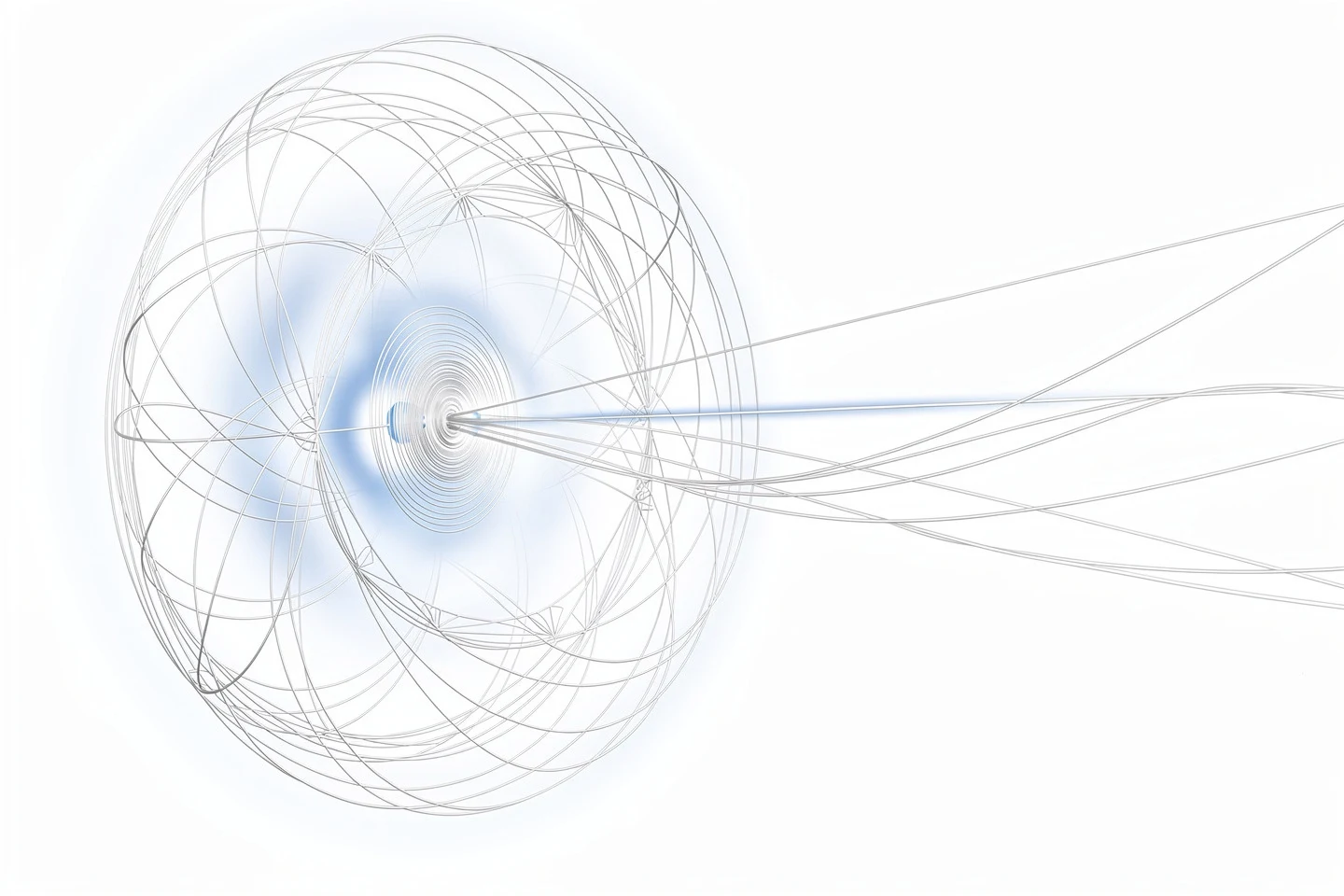
Recently, a powerful cosmic accelerator (a microquasar) in the Cygnus constellation gave itself away with a flare of radiation. This radiation acts like an 'echo' spreading hundreds of light-years, forming a giant bubble that astronomers have already spotted. It turns out that the familiar 'bubble' is actually the trail of a tiny stellar mill churning protons to incredible energies. Does this rewrite the map of our galactic neighborhood?
Look up at the constellation Cygnus on a dark night. Hidden from sight, one of the Galaxy’s most mysterious objects lurks there — the so-called Cygnus Bubble. It’s a giant cloud that emits gamma rays, the most powerful kind of light. For a long time, scientists thought it was spawned by a cluster of young, hot stars. But new calculations point to the culprit: a tiny binary system called Cygnus X-3.
Imagine someone pointing a pressure washer into a dusty room. The water jet blasts droplets in all directions, and a mist hangs in the air — huge compared to the nozzle itself. Cygnus X-3 works the same way: a tiny, ultra-dense star siphons material from its companion, whips it into an accretion disk (a vortex like the whirlpool in a bathtub), and then flings some of it out in two thin jets. Like twin firehoses, these jets blast into space, accelerating particles to nearly the speed of light. These particles are cosmic rays — specks like protons, racing along with insane energy.
Scientists built a computer model simulating how these particles spread out into the interstellar medium — the thin gas between stars. The thing is, particles don’t travel in straight lines: they scatter off magnetic fields and turbulence in the plasma (a gas so hot that electrons break free from atoms). The model showed that to create that gamma-ray cloud, Cygnus X-3 had to spew cosmic rays for about a hundred thousand years. And it used only about one percent of its jet energy to accelerate them — like a giant factory running but only a tiny fraction of the electricity goes into making stuff. Spectral analysis (breaking down the light by energy) from LHAASO confirmed: the source is point-like, not smeared across a star-forming region.
🎯 Cygnus X-3 is such a powerful radio source that it's been nicknamed a 'mini-quasar' — like a pint-sized version of those distant, super-bright quasars.