Balls on a Curved Stage express
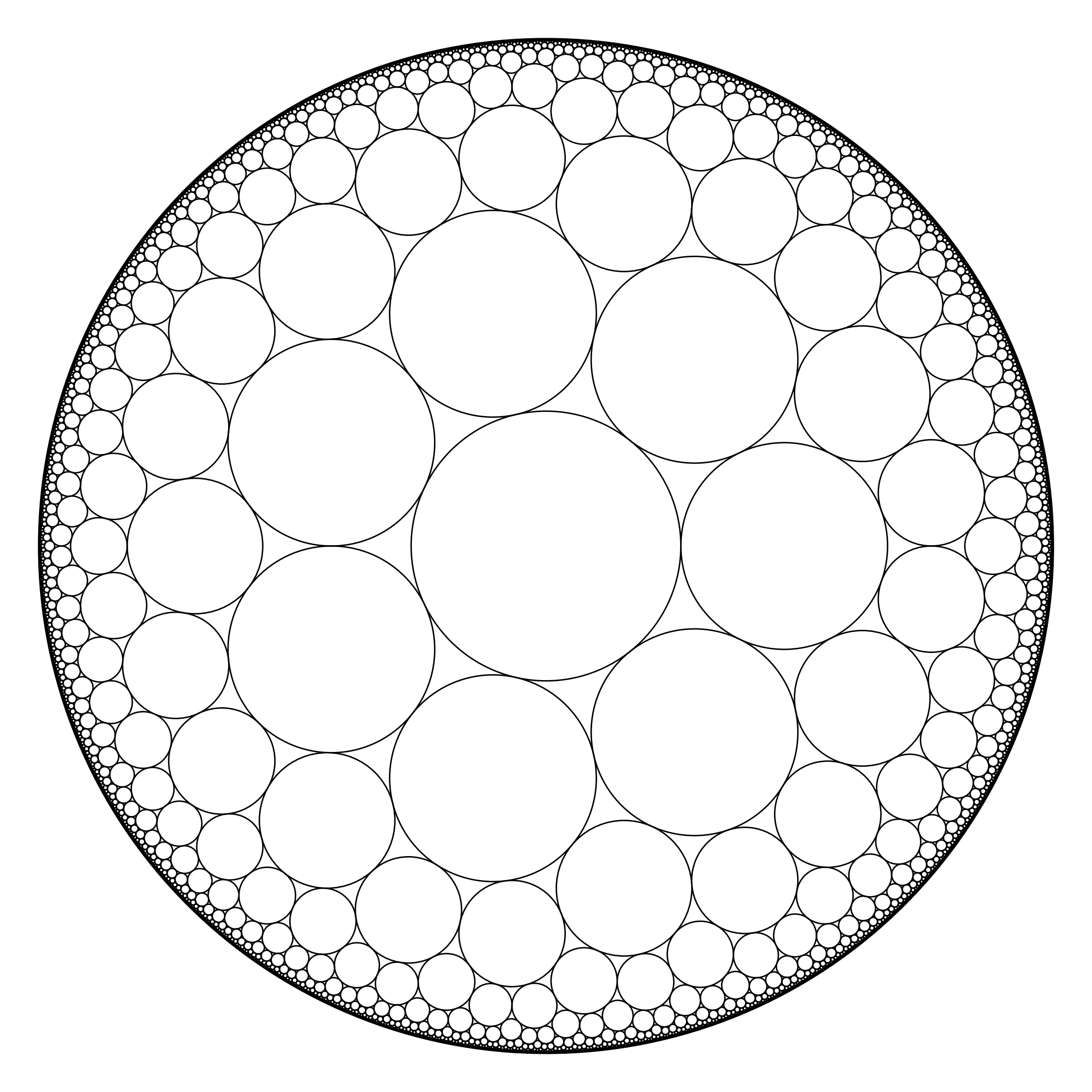
In a vast hall, billiard balls are scattered about. At first they lie sparsely, each on its own. Then someone adds more, and suddenly the balls compress into dense clusters. This is a phase transition — the moment when matter abruptly changes its state.
Physicists have long described such a picture with the hard-sphere model: particles are identical balls that cannot overlap. In ordinary space, the transition from a dilute "gas" to a dense "liquid" is predicted, but a rigorous proof has been missing for half a century. The authors of the new work found a workaround: they moved the model to the hyperbolic plane — a space curved like a saddle.
On the saddle-shaped stage, the authors managed to rigorously prove for the first time: the phase transition exists. At low density, balls roam freely; at high density, they bunch into dense clusters. The mathematical apparatus relies on subtle properties of hyperbolic geometry, where the probability of two balls meeting changes differently than in the familiar world.
Now physicists have a first rigorously grounded foothold. Perhaps the same approach will help tackle phase transitions in other complex media — from glasses to granular materials. For now, one can say: on a stage with a saddle-shaped floor, billiard balls behave exactly as the textbook says.
Original abstract
as written by the authors arXiv:2607.23873
The hard sphere model is a classical model from statistical physics in which particles are represented by equal-sized spheres. Longstanding predictions from the physics literature indicate that in $$\mathbb{R}^2$$ and $$\mathbb{R}^3$$ the system undergoes a phase transition, but it remains a major open problem to confirm this. We prove the existence of a phase transition for this model in the hyperbolic plane.
On the hyperbolic plane, the area of a circle grows exponentially with its radius — faster than in ordinary space. So it can accommodate far more non-overlapping balls than our world.