How to Catch the Gravitational Tremor of a Dying Star express
At the end of a massive star's life, its core collapses in a fraction of a second, giving birth to a supernova flash. This cataclysm shakes spacetime itself, emitting gravitational waves — ripples that race across the Universe. Catching such ripples directly has not yet been achieved, but they are precisely what can tell us what happens in the very furnace where no telescope can peer.
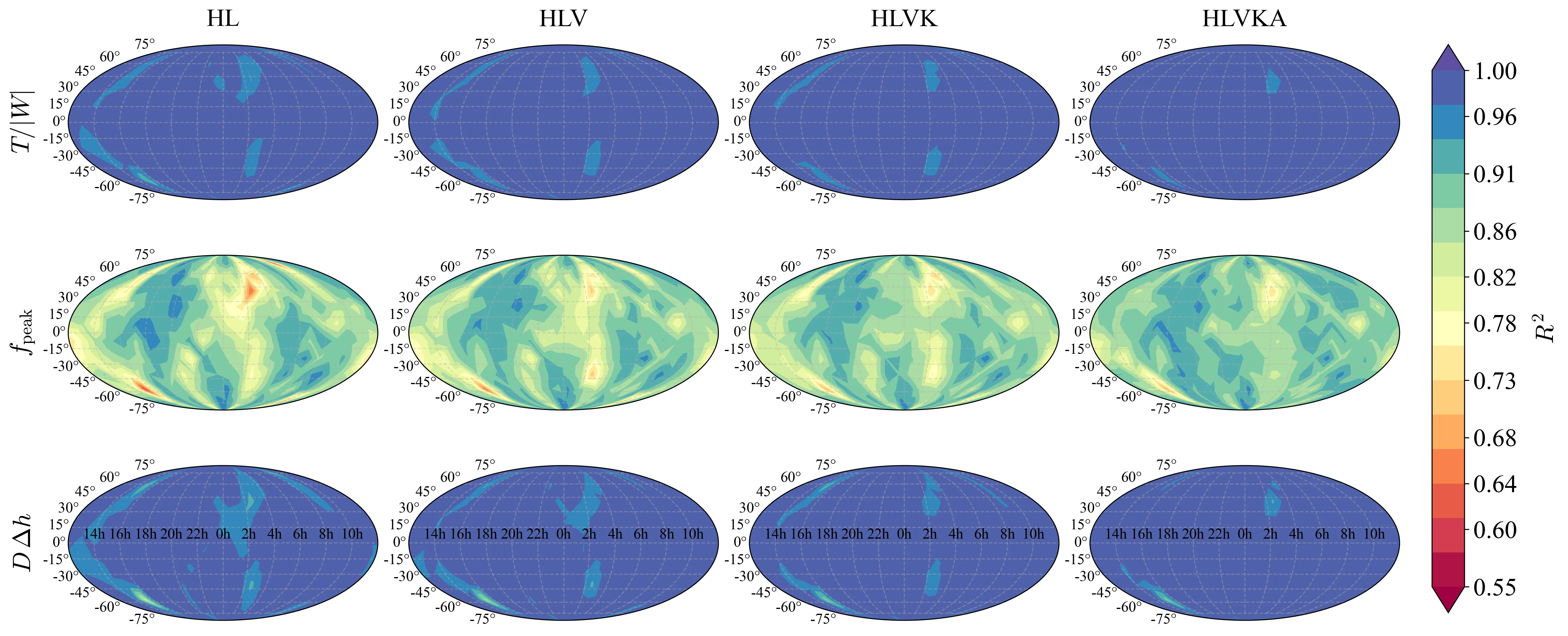
A team of researchers asked: how well could a network of several detectors fish out the characteristics of a rapidly spinning supernova from the noise? They took the signal typical of the moment when the core 'bounces' and begins to vibrate, and ran it through deep learning algorithms. The neural network learned to determine three things: the peak oscillation frequency, the star's spin rate, and the overall signal strength.
The result is encouraging. Even the current network, including LIGO and Virgo, can pick up the 'ring' frequency from distances up to 30 kiloparsecs — roughly the diameter of our Milky Way. The spin rate and loudness, however, can be recovered from much farther, beyond 100 kiloparsecs, covering neighboring galaxies as well. When third-generation detectors like the Einstein Telescope come online, these distances will grow by almost an order of magnitude. And then not just a few neighbors but entire galaxy clusters will fall within earshot.
Thus the network becomes a kind of orchestra pit: each detector-instrument catches its own part, and together they recreate a three-dimensional picture of the catastrophe. And one day that picture will show us, for the first time, the heart of a dying star.
The signal from a core collapse is so brief (milliseconds) that it can be compared to a camera flash that momentarily illuminates the star's interior from the darkness.
In Carl Sagan's novel 'Contact', the heroine hears a rhythmic signal from space — much as scientists hope one day to hear the 'pulse' of a newborn neutron star.