Plant Quenches Its Internal Light in 60 Picoseconds express
Sunlight is like a continuous stream of balls flying at a wall. Antenna proteins in photosynthetic bacteria catch these "balls" (photons), but sometimes the impact is too strong, and a dangerous vibration, a triplet state, arises in the "wall," a chlorophyll molecule. If not quenched, it can generate aggressive singlet oxygen that would burn down the whole structure. Carotenoid molecules act as fire extinguishers here: they take the dangerous energy onto themselves and dissipate it as heat.
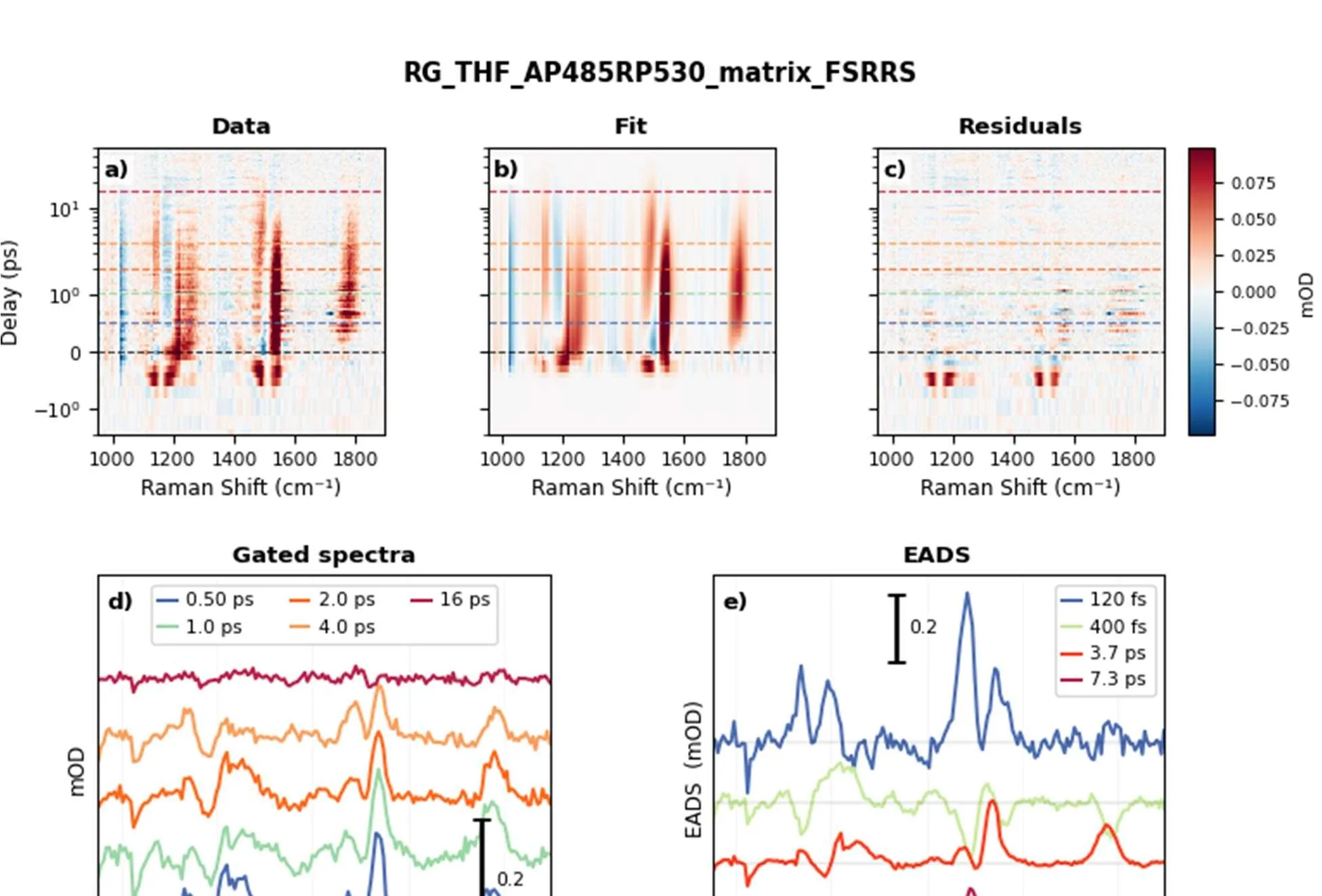
Until now, it was unclear exactly how the carotenoid receives this energy — whether directly from chlorophyll or by generating triplets itself through a process akin to splitting one strong pulse into two weak ones (singlet fission). Spectral noise obscured the answer: signals from different processes overlapped like voices in a crowded room. The authors used a method comparable to tuning a radio to different frequencies. Using femtosecond stimulated Raman spectroscopy under different resonance conditions, they separated the overlapping signals. It turned out that in the LH2 protein of Rhodoblastus acidophilus, the carotenoid triplet is born almost exclusively via energy transfer from bacteriochlorophyll, not through singlet fission.
Interestingly, the protein hosted an entangled triplet pair that lived eight times longer than in liquid solution. But this delay did not lead to separation into two independent triplets or trigger a harmful reaction with chlorophyll. Nature has built a reliable safety catch: the energy escapes along a single safe route, like water through an emergency spillway of a dam, without damaging the station.
Original abstract
as written by the authors arXiv:2608.07390v1
Photosynthetic antenna proteins harvest light energy while at the same time protecting the organism against photodamage. Carotenoid molecules are essential in the latter process, efficiently quenching unwanted (bacterio)chlorophyll excited states created after photon absorption. (Bacterio)chlorophyll triplets, formed by inter-system crossing, are particularly significant, since in the absence of carotenoid quenching, they sensitise the highly oxidative singlet oxygen. In light-harvesting complex 2 (LH2) from Rhodoblastus acidophilus, the pathways that populate carotenoid dark and triplet states remain controversial, involving bacteriochlorophyll-to-carotenoid triplet-triplet transfer and/or generation of triplets by the carotenoid molecules themselves through singlet fission. Transient absorption has been central to understanding photoprotection in these organisms, but spectral congestion limits the separation of the overlapping species needed to discriminate between these pathways. By applying femtosecond stimulated resonance Raman spectroscopy (FSRRS) in different resonance conditions to this protein, in combination with an extension of global analysis to four dimensions (wavenumber, time, intensity and resonance condition), we separate each component of the carotenoid dark-state manifold together with its kinetics. An entangled triplet pair S*/1(TT) is observed, which lives about 60 ps, some eight times longer than in solution. However, this stabilisation does not open a pathway to separated triplets or to carotenoid-BChl a heterofission. Triplet-triplet transfer from bacteriochlorophyll a to carotenoid is also resolved under BChl a excitation, and fits cleanly as a single 2100 ps component. The carotenoid triplet in LH2 is thus produced by photoprotective triplet-triplet transfer from BChl a, and not by singlet fission.
Carotenoids are not just protectors in photosynthesis. They also give carrots their orange color and help our vision by converting into vitamin A.