The Invisible Light of Galaxies: How Cross-Correlations Revealed a Bright Near-Infrared Background ✛
Context
The extragalactic background light (EBL) is the cumulative radiation from all sources beyond the Milky Way over the history of the Universe. At optical and near-infrared wavelengths, measurements of its absolute brightness disagree: direct estimates from CIBER and DIRBE give a value three times larger than the integral from known galaxies. Fluctuation measurements bypass the problem of absolute calibration, but their interpretation is hampered by uncertainty in the contribution from large-scale structure. Alongside this work, the archive contains studies that use gravitational lensing, gamma-ray emission, and laser detectors to probe dark matter and background radiation; this paper follows the cross-correlation approach but applies it tomographically to the near-infrared for the first time.
Methods
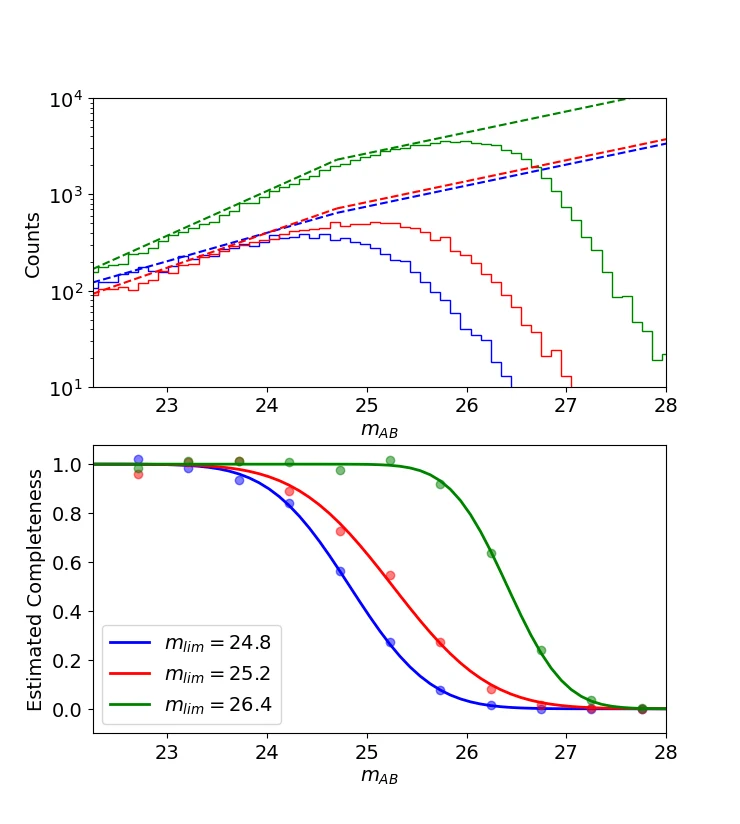
Data from the fourth flight of the rocket experiment CIBER were used: sky maps at 1.1 and 1.8 microns covering 20 square degrees across five fields. These maps were cross-correlated with photometric galaxy catalogs from DESI Legacy Survey (DR8, z < 22) and Hyper Suprime-Cam (i < 25, one field). Galaxies were divided into tomographic bins by photometric redshift with steps of Δz = 0.1 and 0.2. For power spectrum estimation, a pseudo-Cℓ method was applied with corrections for mode mixing, beam, and pixel window; noise covariance was estimated via Monte Carlo with 500 realizations. Modeling was done within the semi-empirical Ares framework, including one-halo and two-halo terms as well as Poisson noise. Parametric fitting of the cross-spectra was performed using MCMC with four free parameters.
Results
On scales 304 < ℓ < 2000, the cross-power is detected with significance 9.8σ/9.2σ for CIBER×DESI-LS and 5.5σ/7.1σ for CIBER×HSC. Compared to the standard model of integrated galaxy light, the measured cross-power exceeds predictions by a factor of 3–10, with the excess concentrated at z < 0.6. The contribution from cluster galaxies and associated structures is 15–20% of the large-scale cross-power. The parametric halo model reveals significant one-halo and two-halo components with amplitudes smoothly decreasing from z = 0 to z = 1. Estimates of the bias-weighted intensity bI × dI/dz exceed predictions even for the maximum possible bias, comparable to the bias of clusters from the Sunyaev–Zeldovich effect. The reconstructed auto-correlation power from low-redshift large-scale structure explains a substantial part of the previously unexplained CIBER auto-correlation excess.
Implications
This work shows for the first time that low-redshift large-scale structure is a significant and previously underestimated source of near-infrared background fluctuations. Unlike neighboring studies that focus on dark matter or use other wavelengths, here tomographic cross-correlation is applied specifically in the near-infrared, allowing the contribution from different redshifts to be separated and revealing an excess at z < 0.6. This challenges standard models of integrated galaxy light and points to the need to account for diffuse intra-halo light or brighter satellites in halos.
Future development
The topic could advance through more detailed modeling of central and satellite galaxies, as well as diffuse intra-halo light, using cosmological hydrodynamic simulations such as FIRE, FLAMINGO, IllustrisTNG, and COLIBRE. Combined analysis with the kinematic Sunyaev–Zeldovich effect would link the stellar and gas components of the baryon budget. Future missions CIBER-2 and SPHEREx, with their broad spectral coverage and full-sky surveys, will allow these results to be tested with much larger statistics.
Impact
The results will affect the interpretation of fluctuation measurements of the extragalactic background, especially for experiments searching for the epoch of reionization signal at 1–2 microns. They are also important for models of galaxy formation and the distribution of starlight in halos.
Next steps
Next steps include cross-correlations with spectroscopic surveys DESI and PFS, which will provide precise redshifts and allow splitting samples by stellar mass and environment. Also, self-consistent models that simultaneously vary satellite occupation, luminosity, and the fraction of intra-halo light need to be developed.
Key open problems
In astrophysics, the question of the full budget of starlight in the Universe remains unresolved: measurements of the absolute brightness of the near-infrared background disagree with the integral from known galaxies by a factor of several. This work links that discrepancy to low-redshift large-scale structure, but does not close the problem; rather, it shifts it to halo scales, where the contribution of diffuse light and satellites is still poorly constrained.
The knowledge machine's view
This section is addressed to the author of the paper and their colleagues. Neighbouring works were found by meaning-based search across our archive, not by word overlap. We do not review: we show the field around the work.
What the work does
This study presents a tomographic cross-correlation analysis of the near-infrared background maps from CIBER at 1.1 and 1.8 microns with galaxy catalogs from the DESI Legacy Survey and Hyper Suprime-Cam. The cross-power spectrum was measured on scales 304 < ℓ < 2000, revealing a significant excess compared to the standard model of integrated galaxy light, concentrated at z < 0.6. It is shown that low-redshift large-scale structure contributes substantially to the fluctuations of the near-infrared background.
Where its strength is
For the first time, the contribution of low-redshift large-scale structure to near-infrared background fluctuations has been isolated tomographically, allowing the separation of contributions from different redshifts and paving the way for more precise interpretations of CIBER measurements.
Where it could go next
- It might be interesting to compare the obtained constraints on large-scale structure with gravitational lensing signals, which are also sensitive to the distribution of matter on large scales; nearby in the archive is a review of a work on a cosmic lens showing the structure of a quasar.based on: Cosmic Lens Reveals the Anatomy of a Quasar arXiv:2604.09160
- A possible direction is to use gamma-ray emission from blazars to probe the extragalactic background light: the archive contains a quick review of a work on the gamma-ray glow of Markarian 421, discussing self-absorption related to EBL.based on: Gamma-Ray Candle Markarian 421 Trims Its Own Flame arXiv:2605.23107
- It is promising to compare the obtained cross-correlations with the signal from hot spots on the sky, which may be related to large-scale structure; the archive has a quick review of a work on the senders of superparticles, where similar correlations are discussed.based on: Sky Hotspots: The Senders of Ultra-Particles Identified arXiv:2510.06193
Worth trying
- Apply the tomographic cross-correlation analysis to data from future missions such as CIBER-2 and SPHEREx to test the reproducibility of the excess at z < 0.6.
- Use galaxy catalogs with more accurate photometric redshifts to refine the tomographic bins and isolate the contribution from clusters.
- Compare the measured cross-power with predictions from hydrodynamic simulations that include feedback effects to see if they can explain the excess.
Nearby works in our archive
- An Echo Born of Dark Energysimilarity 0.66
- A Cosmic Beacon in Cygnussimilarity 0.63
- The Cosmic Pearl String: How Galaxies Lost Their Dark Mattersimilarity 0.63
- Sky Hotspots: The Senders of Ultra-Particles Identifiedsimilarity 0.62
- Gamma Glow of an Invisible Spheresimilarity 0.62
- Cosmic Lens Reveals the Anatomy of a Quasarsimilarity 0.62
- Gamma-Ray Candle Markarian 421 Trims Its Own Flamesimilarity 0.62
The closest work in the archive sits at 0.66 by meaning — the usual level for our corpus.
Original abstract
as written by the authors arXiv:2608.12116v1
We perform the first tomographic analysis of near-IR extragalactic background light (EBL) anisotropies, cross-correlating CIBER 1.1 and 1.8 $$\mu$$m imager data with photometric galaxy catalogs from DESI Legacy Survey DR8 and Hyper-Suprime-Cam Ultra-Deep Survey. We measure significantly higher cross-power than expectations from an integrated galaxy light (IGL) model on scales $$\ell < 2000$$, concentrated at low redshift ($$z\lesssim 0.6$$). Cluster member galaxies and associated structure account for 15-20\% of the large-angle cross-power, indicating that group- and galaxy-scale halos contribute the bulk of the signal. Through a parametric halo model decomposition, we detect two-halo and one-halo clustering in cross-power at high significance, with amplitudes that decline smoothly across $$z=0{-}1$$. The inferred one-halo cross-power is of similar amplitude between DESI-LS and the deeper HSC catalog, implying a scenario in which low-redshift EBL fluctuations are amplified by contributions from lower-mass halos with satellites and/or diffuse intra-halo light (IHL). Converting our two-halo fits into estimates of $$b_I \times dI/dz$$, we find that standard IGL predictions underestimate our measurements, even when assuming an intensity bias as high as 3, similar to that of large SZ clusters, suggesting that a higher $$dI/dz$$ is required to reconcile observed discrepancies. Lastly, we find that correlated large-scale structure (LSS) at $$z<1$$ accounts for a substantial fraction of the CIBER auto-power reported in earlier work. These results identify low-redshift LSS as a significant and previously unappreciated contributor to near-IR EBL fluctuation measurements, setting the stage for cross-correlation science with CIBER-2, SPHEREx and a variety of LSS tracers.
Just 220 seconds of observations from the rocket-borne CIBER instrument were enough to reveal a significant excess of fluctuations that models could not explain for a decade.
In Gregory Benford's novel "The Light of Distant Galaxies," astronomers use background radiation to study the hidden structure of the Universe — much like how cross-correlations here reveal the invisible light from halos.
Key numbers
- excess cross-power at ℓ<2000: 3–10 times higher than model
- cluster contribution: 15–20% of large-scale cross-power
- CIBER survey area: 20 square degrees
- observation time: 220 seconds
- detection significance of cross-power: up to 9.8σ